Brucella Seropositivity at a Tertiary Care Hospital in Chandigarh
Uneza Husain, Sunil Sethi, Rakesh Yadav

TL;DR
This study tracks rising brucellosis cases in Chandigarh over four years, showing a significant increase in seropositivity.
Contribution
The study provides updated seropositivity trends of brucellosis in Chandigarh, highlighting a recent surge.
Findings
Seropositivity increased from 2.6% in 2018-19 to 7.4% in 2021-22.
A spike of 12.5% seropositivity was observed in 2019-20.
The study contributes to current serological data on brucellosis in the region.
Abstract
There are reports that the neglected zoonotic tropical disease brucellosis is reemerging today. Serological tests are being widely used in the diagnosis of brucellosis. In the present study, we performed a standard agglutination test (SAT) on 1348 suspected cases of brucellosis during the period of four years from April 2018 to March 2022. We noticed an increase in seropositivity from 2.6% in the year 2018-19 to 7.4% in the year 2021-22. We also noticed a spike in seropositivity in the years 2019-20 (12.5%). Our study shows the recent trend in seropositivity of the disease in Chandigarh and, hence, can be a meaningful addition to the existing serological diagnostic data related to brucellosis.
Genes, proteins, chemicals, diseases, species, mutations and cell lines named across the full text — each resolved to its canonical identifier and authoritative record.
Click any figure to enlarge with its caption.
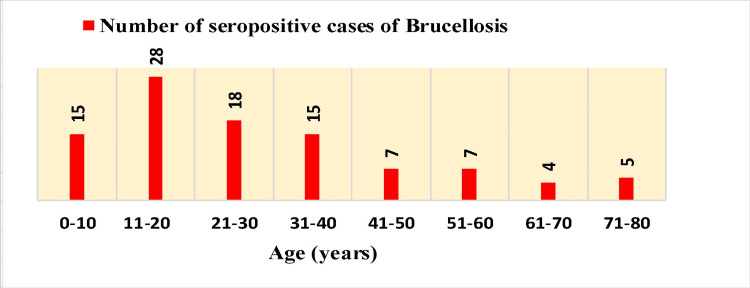 Figure 1
Peer Reviews
No public reviews on file for this paper yet. If you reviewed it on a platform where reviews are public (OpenReview, ICLR, NeurIPS, ICML), you can paste yours below so the community can read it here.
Videos
No videos yet. Explain this paper in a talk, walkthrough, or lecture? Add one.
Taxonomy
TopicsBrucella: diagnosis, epidemiology, treatment · Salmonella and Campylobacter epidemiology · Burkholderia infections and melioidosis