Intrinsically topological second Chern insulator via synthetic dimensions
Seokwoo Kim, Junsuk Rho

Abstract
Exploring Hidden Dimensions: Unveiling Topological Crystals in a 4D Space.
Genes, proteins, chemicals, diseases, species, mutations and cell lines named across the full text — each resolved to its canonical identifier and authoritative record.
Click any figure to enlarge with its caption.
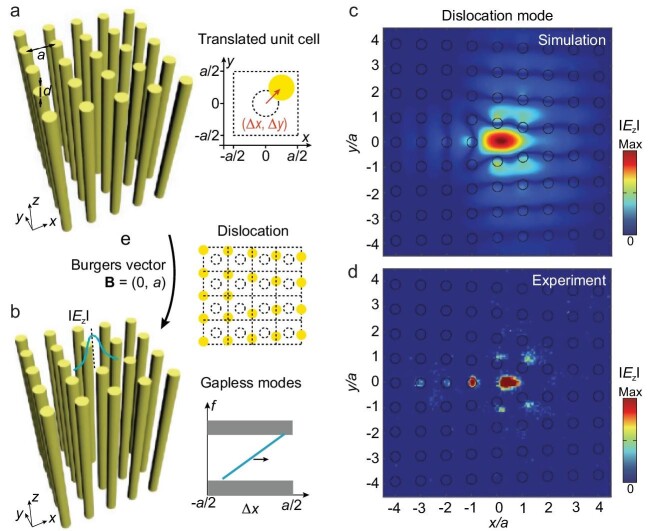 Figure 1
Peer Reviews
No public reviews on file for this paper yet. If you reviewed it on a platform where reviews are public (OpenReview, ICLR, NeurIPS, ICML), you can paste yours below so the community can read it here.
Videos
No videos yet. Explain this paper in a talk, walkthrough, or lecture? Add one.
Taxonomy
TopicsTopological Materials and Phenomena · Quantum many-body systems · Topological and Geometric Data Analysis
Topology, an invariant quantity under continuous deformation, has significantly expanded our understanding of the phases of matter over recent decades. This concept, extending from quantum mechanics to classical wave platforms, prompts us to consider the interplay between various symmetry operations and the physical boundaries of lattices. In crystal bulk bands, non-trivial topology ensures the existence of local boundary modes that are protected by global symmetry, a principle known as bulk-boundary correspondence. For instance, the Chern insulator exhibits unidirectional chiral edge states, as its bulk bands become twisted evident in a nonzero Chern number defined in 2D momentum space. Traditionally, discussions of topology centered on 2D or 3D Bloch momentum space [1,2]; however, they can be expanded to higher dimensions, incorporating additional synthetic dimensions such as external fields and geometric parameters [3].
The study of band topology beyond the dimensions of the real world has been successfully demonstrated in several research projects, e.g. the 4D generalization of the quantum Hall effect [4]. In the 4D case, the band topology is characterized by the second Chern number, which is different from the first Chern number in the conventional 2D momentum space. Although the second Chern insulator has been demonstrated in various classical wave platforms, such as acoustics and photonics, the realization of the proposed complicated systems remains a challenging task.
Recently, a remarkable study reported in the National Science Review introduces a novel approach for designing a second Chern crystal within a 4D synthetic parametric space [5]. They explore a four-dimensional parameter space that includes two Bloch momentum spaces ( \documentclass[12pt]{minimal} \usepackage{amsmath} \usepackage{wasysym} \usepackage{amsfonts} \usepackage{amssymb} \usepackage{amsbsy} \usepackage{upgreek} \usepackage{mathrsfs} \setlength{\oddsidemargin}{-69pt} \begin{document} {{k}_x},{{k}_y}\end{document} ) and two additional synthetic translation dimensions ( \documentclass[12pt]{minimal} \usepackage{amsmath} \usepackage{wasysym} \usepackage{amsfonts} \usepackage{amssymb} \usepackage{amsbsy} \usepackage{upgreek} \usepackage{mathrsfs} \setlength{\oddsidemargin}{-69pt} \begin{document} \Delta x,\Delta y\end{document} ) (Fig. 1). Interestingly, their crystal's topology is ‘inherently’ non-trivial, regardless of crystalline configuration. Since the bulk bands in synthetic translation space possess a non-trivial topology, it renders the Chern crystal topologically non-trivial in any configuration. This leads to the observation of a gapless 2D surface mode and robust 1D dislocation modes in real space (Fig. 1). These topological boundary modes originate from the intrinsically non-trivial topology of the second Chern insulator.
In summary, the research demonstrates topologically protected modes on lower-dimensional boundaries of this crystal, achieved through dimension reduction. This method confirms the robustness of one-dimensional gapless dislocation modes experimentally. The findings not only offer new insights into topologically non-trivial crystals with synthetic dimension but also pave the way for feasible designs in classical wave devices. It provides practical pathways for realizing high-dimensional topological states in classical wave systems, circumventing real-space dimensionality limitations. It underscores the potential of synthetic dimensions in unraveling complex topological phenomena, heralding a new era of exploration in photonic and other classical wave systems.
The reference list from the paper itself. Each links out to its DOI / PubMed record.
- 1Kim M , Jacob Z, Rho J. Light Sci Appl 2020; 9: 130.10.1038/s 41377-020-0331-y 32704363 PMC 7371865 · doi ↗ · pubmed ↗
- 2Kim M , Lee D, Lee Det al. Phys Rev B 2019; 99: 23.10.1103/Phys Rev B.99.235423 · doi ↗
- 3Lustig E , Weimann S, Plotnik Yet al. Nature 2019; 567: 356–60.10.1038/s 41586-019-0943-730778196 · doi ↗ · pubmed ↗
- 4Lohse M , Schweizer C, Price H Met al. Nature 2018 ; 553: 55–8.10.1038/nature 2500029300006 · doi ↗ · pubmed ↗
- 5Chen X-D , Shi F-L, Liu J-Wet al. Natl Sci Rev 2023; 10: nwac 289.10.1093/nsr/nwac 28937389141 PMC 10306366 · doi ↗ · pubmed ↗