Regularity of the edge ideals of perfect [ν,h]-ary trees and some unicyclic graphs
Fatima Tul Zahra, Muhammad Ishaq, Sarah Aljohani

TL;DR
This paper calculates a specific algebraic property called regularity for certain types of tree and unicyclic graph structures.
Contribution
The paper introduces new computations of Castelnuovo-Mumford regularity for edge ideals of specific tree and unicyclic graphs.
Findings
The Castelnuovo-Mumford regularity of quotient rings for perfect [ν,h]-ary trees is computed.
Regularity is also determined for some unicyclic graphs.
Abstract
We compute the Castelnuovo-Mumford regularity of the quotient rings of edge ideals of perfect [ν,h]-ary trees and some unicyclic graphs.
Genes, proteins, chemicals, diseases, species, mutations and cell lines named across the full text — each resolved to its canonical identifier and authoritative record.
Click any figure to enlarge with its caption.
 Figure 1
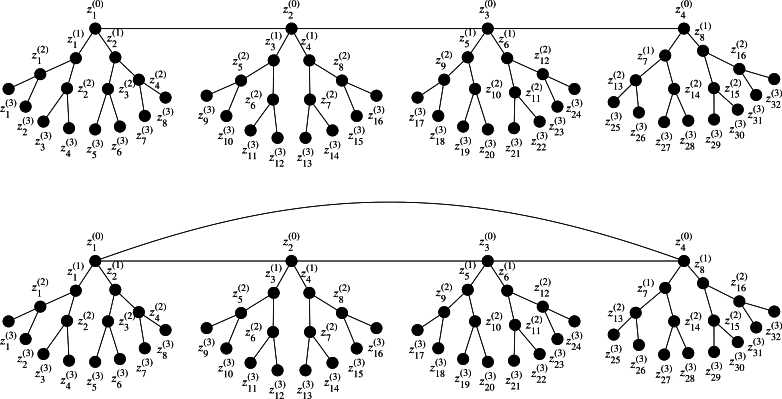 Figure 2
Peer Reviews
No public reviews on file for this paper yet. If you reviewed it on a platform where reviews are public (OpenReview, ICLR, NeurIPS, ICML), you can paste yours below so the community can read it here.
Videos
No videos yet. Explain this paper in a talk, walkthrough, or lecture? Add one.
Taxonomy
TopicsCommutative Algebra and Its Applications · Rings, Modules, and Algebras · Polynomial and algebraic computation
Introduction
1
Let be a standard graded polynomial ring over a field K. Let Q be a finitely generated graded Z-module. Suppose that Q admits the following minimal free resolution:
The numbers are -th graded Betti numbers and are uniquely determined by Q. The Castelnuovo-Mumford regularity is an algebraic invariant associated with this minimal graded free resolution, and is defined as follows:
The regularity was introduced by Mumford, generalizing the geometric idea of Castelnuovo [1]. It is quite difficult to find regularity in general by computing graded Betti numbers. For a detailed study on the regularity of monomial ideals and some interesting results we refer the readers to [2], [3], [4], [5], [6], [7], [8], [9], [10], [11]. Let be a finite simple graph, with vertex set and edge set . An edge ideal of a graph is a squarefree monomial ideal of the polynomial ring Z defined as . Villarreal first introduced the idea of edge ideals [12], which become an active research area with a rich literature. In recent years, establishing a relationship between regularity and combinatorial invariants of graph has become a prime focus of many researchers, as evident from [13], [14], [15].
The number of vertices incident to a vertex is referred as the degree of that vertex. A pendant vertex in a graph is a vertex of degree one. A vertex to which an edge is directed from the parent is known as a child. A path is a graph whose vertices can be ordered so that two vertices are adjacent if and only if they are consecutive in the list. A path graph on h vertices is denoted by . A tree is a graph in which there is a unique path between any two vertices of it. A rooted tree is a tree in which one vertex is designated as root vertex and all other vertices are directed away from it. A ν-ary tree is a tree in which at most ν edges are incident to each vertex of this tree. A rooted tree is a perfect ν-ary tree if each of its parent vertex has ν children, and all non parent vertices are at the same distance from the root vertex. Shaukat et al. [16] calculated the exact values of some algebraic invariants of cyclic modules associated with the edge ideals of perfect ν-ary trees. Then, Ayesha et al. defined the perfect -ary trees and some unicyclic graphs closely associated with perfect -ary trees in [17]. Let , and be perfect -ary trees such that , for all i and j. Let be the root vertices of respectively and be the vertices of path . Let be a forest with components and . A perfect -ary tree is obtained by fusing the root vertices of with vertices of path graph , for all in . If d is the common height of all perfect -ary trees in then the obtained perfect -ary tree is denoted by . Now let , a unicyclic graph is obtained from by adding an edge between and . See Fig. 1 and Fig. 2 for examples and labelling of and . Ayesha et al. calculated some algebraic invariants of the edge ideal of these graphs in [17]. In this article we compute the regularity of the quotient rings of the edge ideals of perfect -ary trees. These results are given in Theorem 3.3 and Theorem 3.5. We also compute the regularity of the quotient rings associated to the edge ideals of . For these results, see our Theorem 3.6 and Theorem 3.7.Figure 1 and C2,2,4, respectively.Figure 1. Figure 2 and C3,3,4, respectively.Figure 2
Preliminaries
2
In a graph , the neighbourhood of the vertex is the set . If , then denotes the subgraph of obtained by deleting all vertices of A from and all incident edges on vertices of A. If , then a subgraph of is an induced subgraph on A if and . For a graph , a subset is a matching in if all edges in H are pairwise non-adjacent. If a set of edges, say , forms a matching in and is precisely the set of edges of an induced subgraph of , then that set of edges is referred to as induced matching. The maximum cardinality among all possible induced matchings, is called induced matching number of , and denoted as . Remark 2.1Note that for some specific values of d and h, a perfect -ary tree reduces to some well-known graphs, for instance:
- (1)If , and , then is a perfect -ary tree.
- (2)If , and , then belongs to the class of caterpillar trees.
- (3)If , and , then belongs to the class of lobster trees. The values of regularity calculated for path graphs, some caterpillar trees and unicyclic graphs by different authors are given below. These values are helpful in the computation of regularity of perfect -ary trees and the unicyclic graphs we considered. We will use these results in the proofs of our main Theorems. Lemma 2.2[18, Theorem 2.28]Let and . Then . Lemma 2.3[18, Theorem 2.30]Let and . Then . Lemma 2.4[19, Proposition 3.1.1]If , then . Now, we state some results that are frequently used in this article. Lemma 2.5[20, Lemma 2.2]Let be a finite simple graph. Then
Lemma 2.6[21, Theorem 4.7]Let J be a monomial ideal and z a variable of Z. Then(a) , if ,(b) ∈ , if ,(c) = , if < . Lemma 2.7[22, Theorem 1.2]Let be a unicyclic graph with cycle . Then, if and only if and , where is the induced subgraph on and are the vertices in the neighbourhood of . Lemma 2.8[23, lemma 8]Let . If and are rings of polynomial and and are edge ideals of and , respectively, then
Regularity of cyclic module associated with perfect [ν,h]-ary tree
3
Let d, h and ν be integers such that and d, . Let and be the K-algebra which is the tensor product of n copies of the K-algebra over K. In the following remark we address some special cases of that will be encountered in the proofs of our main theorems.
Remark 3.1 For our convenience we set , . If we define then . We also define and .
Remark 3.2 Let and d, . Then by Lemma 2.8 we have .
Theorem 3.3 Let d, . Then
ProofIf , then and , therefore, by Lemma 2.4, we get . If , , then again by Lemma 2.4, we have
Now if , , , if , , and if , , , as required. Now let and . If , the result follows from Lemma 2.2, . Now let , we have the following isomorphisms:
and
Case 1: Let . Using Lemma 2.8, Lemma 2.4 and Equations (3.1), (3.2), and applying induction on h we have
and
Clearly, . Hence, by using Lemma 2.6 (c), .Case 2 : Let . Using Lemma 2.8, Lemma 2.4 and Equations (3.1), (3.2), and applying induction on h we have
and
Since implies . So we have
and
If , then , so we have
Thus, by using Lemma 2.6 (b),
If , then and . So we have
Thus, by using Lemma 2.6 (c), we have .If , then , so we have
Thus, by using Lemma 2.6 (b), we have
Now for finding lower bound when we find an induced matching of as follows:
Clearly , for all i. Let , be the edges of graph . Let and . It can easily be verified that E is an induced matching of . Therefore, , where . According to Lemma 2.5, we have . Hence, , as required.Case 3 : Let . Using Lemma 2.8, Lemma 2.4 and Equations (3.1), (3.2), and applying induction on h we have
and
Clearly, . Hence, by using Lemma 2.6 (c), . □ Lemma 3.4[16, Proposition 4.4] Let and . Then
Theorem 3.5 Let and d, . Then
ProofIf , the result follows from Lemma 3.4. Now, let and . If , the result follows from Lemma 2.2, . Let . If , we have the following isomorphisms:
and
Now if , we have
and
We consider the following cases:Case 1 : Let . As and , for , using Remark 3.2, Lemma 3.4, Lemma 2.8 and Equations (3.3), (3.4) we have
and
Now for , using Remark 3.2, Lemma 3.4, Lemma 2.8 and Equations (3.5), (3.6), and applying induction on h we have
and
Clearly for all , . Hence, by using Theorem 2.6 (c), .Case 2 : Let . As and , for , using Remark 3.2, Lemma 3.4, Lemma 2.8 and Equations (3.3), (3.4) we have
and
Thus, by using Lemma 2.2 (b), .Hence, we have . Now for , using Remark 3.2, Lemma 3.4, Lemma 2.8 and Equations (3.5), (3.6), and applying induction on h we have
and
If , then , so we have
Thus, by Lemma 2.6 (b), we have
If , then , so we have
Thus, by using Lemma 2.2 (c), . If , then , so we have
Thus, by using Lemma 2.2 (b), we have
Now for finding lower bound when we find an induced matching of as follows:
where and let . Let , be the edges of graph . Let and . It can easily be verified that M is an induced matching. Therefore, , where . According to Lemma 2.5, we have . Hence, .Case 3 : If . As and , for , using Remark 3.2, Lemma 3.4, Lemma 2.8 and Equations (3.3), (3.4) we have
and
Now for , using Remark 3.2, Lemma 3.4, Lemma 2.8 and Equations (3.5), (3.6), and applying induction on h we have
and
Clearly for all , . Hence, by Lemma 2.6(c), we have,
□ Theorem 3.6 Let , and . Then
ProofIf , the result follows from Lemma 2.3, . Now let , we have the following isomorphisms:
and
Case 1 : Let . Using Lemma 2.8, Lemma 2.4, Theorem 3.3 and Equations (3.8), (3.9) we have
and
Clearly, . Hence, by Lemma 2.6 (c),
Case 2 : Let . Using Lemma 2.8, Lemma 2.4, Theorem 3.3 and Equations (3.8), (3.9) we have
and
Since , . Thus, we have
and
If , then and . So we have
Hence, by Lemma 2.6, .If , then , so we have . Thus, by using Lemma 2.6 (b), we have
Now for finding lower bound when we find an induced matching of as follows:
Clearly , for all i. Let , be the edges of graph . Let and . It can easily be verified that E is an induced matching, where . Thus, by using Theorem 2.7 . Hence, .Case 3 : Let . Using Lemma 2.8, Lemma 2.4, Theorem 3.3 and Equations (3.8), (3.9) we have
and
Clearly, . Hence, by Lemma 2.6 (c),
□ Theorem 3.7 Let and . If , then
ProofIf , the result follows from Lemma 2.3, . Let , we have the following isomorphisms:
and
We consider the following three cases:Case 1 : Let . As and , using Remark 3.2, Lemma 3.4, Lemma 2.8 and Equations (3.10), (3.11), and applying induction on h we have
and
Hence, by Lemma 2.6 (c), .Case 2 : Let . As and , using Remark 3.2, Lemma 3.4, Lemma 2.8 and Equations (3.10), (3.11), and applying induction on h we have
and
If , then and . So we have
Hence, by Lemma 2.6(c), .If , then , so we have
Thus, by using Lemma 2.6 (b), we have
Now for finding lower bound when we find an induced matching of as follows:
where and let . Let , be the edges of graph . Let and . It can easily be verified that M is an induced matching, where . Thus, by using Lemma 2.7 . Hence, .Case 3 : Let . As and , using Remark 3.2, Lemma 3.4, Lemma 2.8 and Equations (3.10), (3.11), and applying induction on h we have
and
Clearly, . Hence, by using Lemma 2.6 (c), . □
CRediT authorship contribution statement
Fatima Tul Zahra: Writing – original draft, Software, Investigation. Muhammad Ishaq: Writing – review & editing, Visualization, Validation, Supervision, Methodology, Conceptualization. Sarah Aljohani: Writing – review & editing, Validation, Funding acquisition.
Declaration of Competing Interest
The authors declare that they have no known competing financial interests or personal relationships that could have appeared to influence the work reported in this paper.
The reference list from the paper itself. Each links out to its DOI / PubMed record.
- 1Mumford D.Bergman G.M.Lectures on Curves on an Algebraic Surface, vol. 591966 Princeton University Press
- 2Alilooee A.Banerjee A.Powers of edge ideals of regularity three bipartite graphs J. Commut. Algebra 942017441454
- 3Bayer D.Mumford D.What can be computed in algebraic geometry?ar Xiv preprintar Xiv:alg-geom/93040031993
- 4Moghimian M.Fakhari S.S.Yassemi S.Regularity of powers of edge ideal of whiskered cycles Commun. Algebra 453201712461259
- 5Vasconcelos W.V.Cohomological degrees of graded modules Six Lectures on Commutative Algebra 1998345392
- 6Banerjee A.The regularity of powers of edge ideals J. Algebraic Comb.412015303321
- 7Caviglia G.Chardin M.Mc Cullough J.Peeva I.Varbaro M.Regularity of prime ideals Math. Z.2912019421435
- 8Dao H.Huneke C.Schweig J.Bounds on the regularity and projective dimension of ideals associated to graphs J. Algebraic Comb.3820133755