Effectiveness and tolerability of eptinezumab in treating patients with migraine resistant to conventional preventive medications and CGRP (receptor) antibodies: a multicentre retrospective real-world analysis from Germany
Armin Scheffler, Pauline Wenzel, Merle Bendig, Astrid Gendolla, Jale Basten, Christoph Kleinschnitz, Michael Nsaka, Diana Lindner, Steffen Naegel, Philipp Burow, Robert Fleischmann, Dagny Holle

TL;DR
This study examines how well eptinezumab treats migraines in patients who didn't respond to other CGRP antibodies, finding it effective but with reduced benefits in those with prior treatment failures.
Contribution
The study provides real-world evidence on eptinezumab's effectiveness and tolerability in migraine patients resistant to other CGRP mAbs.
Findings
Eptinezumab significantly reduced headache and migraine days in both episodic and chronic migraine patients.
Effectiveness was lower in patients with more prior CGRP mAb failures.
Only 10.4% of patients reported mild side effects, indicating good tolerability.
Abstract
Eptinezumab is a monoclonal antibody that targets calcitonin gene-related peptide (CGRP mAb) and is used for migraine prophylaxis. Efficacy data are mainly from clinical trials, real-world data are hardly available yet. Reimbursement policy in Germany leads to eptinezumab mainly being used in patients having failed pre-treatment with other CGRP mAb. To date, it is unclear whether eptinezumab is efficacious and well tolerated in this population and how the treatment response differs from patients who are naive to CGRP mAbs. We analysed clinical routine data of 79 patients (episodic migraine (EM): n = 19; chronic migraine (CM): n = 60) from four different centres in Germany. All patients were treated with eptinezumab (100mg). Differences in monthly headache (MHD), migraine (MMD) and acute medication days (AMD) after three months were analysed. The correlation of response with the number…
Genes, proteins, chemicals, diseases, species, mutations and cell lines named across the full text — each resolved to its canonical identifier and authoritative record.
Click any figure to enlarge with its caption.
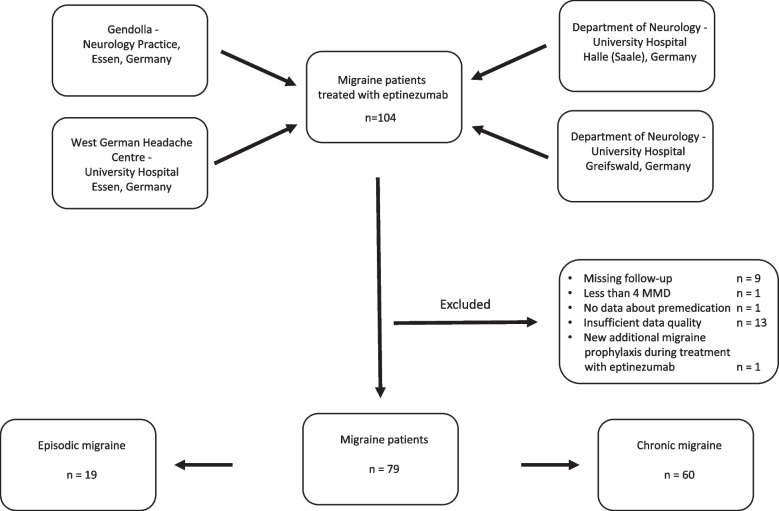 Figure 1
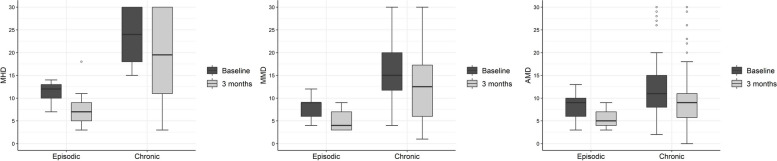 Figure 2
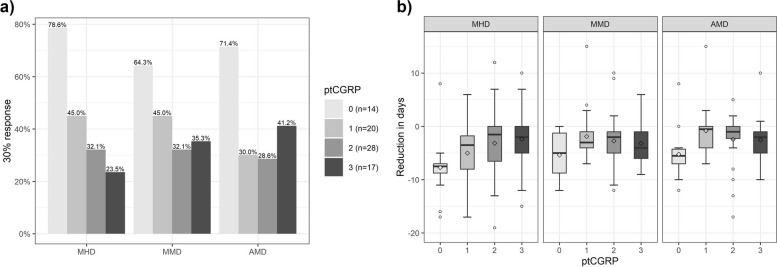 Figure 3
Peer Reviews
No public reviews on file for this paper yet. If you reviewed it on a platform where reviews are public (OpenReview, ICLR, NeurIPS, ICML), you can paste yours below so the community can read it here.
Videos
No videos yet. Explain this paper in a talk, walkthrough, or lecture? Add one.
Taxonomy
TopicsMedieval Literature and History · Joseph Conrad and Literature · Byzantine Studies and History