Need of orthogonal approaches in neurological disease modeling in mouse
Linda Bossini, Alessandro Sessa

TL;DR
This mini-review discusses the need for new strategies in mouse models to better understand and treat neurological diseases.
Contribution
The paper highlights recent intriguing strategies that could inspire improvements in animal models for neurological diseases.
Findings
Recent approaches in disease modeling show potential for enhancing translatability to human conditions.
Orthogonal methods may lead to more reliable and successful outcomes in neurological disease research.
Abstract
Over the years, advancements in modeling neurological diseases have revealed innovative strategies aimed at gaining deeper insights and developing more effective treatments for these complex conditions. However, these progresses have recently been overshadowed by an increasing number of failures in clinical trials, raising doubts about the reliability and translatability of this type of disease modeling. This mini-review does not aim to provide a comprehensive overview of the current state-of-the-art in disease mouse modeling. Instead, it offers a brief excursus over some recent approaches in modeling neurological diseases to pinpoint a few intriguing strategies applied in the field that may serve as sources of inspiration for improving currently available animal models. In particular, we aim to guide the reader toward the potential success of adopting a more orthogonal approach in the…
Genes, proteins, chemicals, diseases, species, mutations and cell lines named across the full text — each resolved to its canonical identifier and authoritative record.
Click any figure to enlarge with its caption.
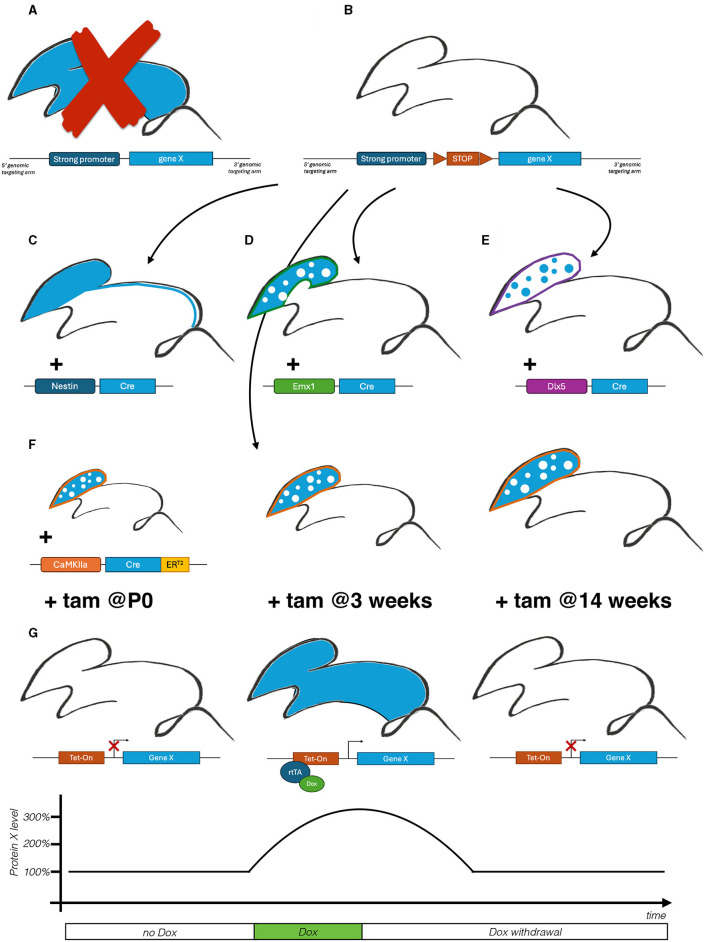 Figure 1
Peer Reviews
No public reviews on file for this paper yet. If you reviewed it on a platform where reviews are public (OpenReview, ICLR, NeurIPS, ICML), you can paste yours below so the community can read it here.
Videos
No videos yet. Explain this paper in a talk, walkthrough, or lecture? Add one.
Taxonomy
TopicsNeurogenesis and neuroplasticity mechanisms · Zebrafish Biomedical Research Applications · RNA Research and Splicing