What Matters to Others: A High-Threshold Account of Joint Attention
Anna Bloom-Christen

TL;DR
This paper argues that joint attention is a goal in anthropology fieldwork, not a starting point, by linking it to understanding others' lifeworlds.
Contribution
The paper introduces a novel perspective on joint attention as a goal in Participant Observation within anthropological fieldwork.
Findings
Joint attention is positioned as a goal rather than a starting point in fieldwork.
The paper draws parallels between Participant Observation and everyday interactions.
It emphasizes understanding what matters to others in their lifeworld context.
Abstract
If only implicitly, social anthropology has long incorporated joint attention as a research technique employed in what anthropologists call “the field”. This paper outlines the crucial role joint attention plays in anthropolgical fieldwork—specifically in Participant Observation—and advances the position that joint attention is a goal rather than a starting point of fieldwork practice. Exploring how anthropologists tentatively use attention as a methodological tool to understand other people’s lifeworlds, this paper draws parallels between Participant Observation and ordinary everyday interactions, thus teasing out a view of joint attention as a goal to be reached only by means of knowing what matters to others in the context of the lifeworld they inhabit.
Genes, proteins, chemicals, diseases, species, mutations and cell lines named across the full text — each resolved to its canonical identifier and authoritative record.
Click any figure to enlarge with its caption.
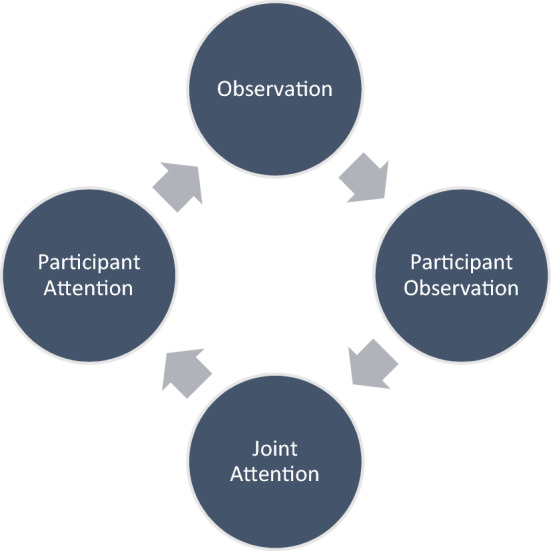 Figure 1
Peer Reviews
No public reviews on file for this paper yet. If you reviewed it on a platform where reviews are public (OpenReview, ICLR, NeurIPS, ICML), you can paste yours below so the community can read it here.
Videos
No videos yet. Explain this paper in a talk, walkthrough, or lecture? Add one.
Taxonomy
TopicsPsychology of Moral and Emotional Judgment · Cultural Differences and Values · Child and Animal Learning Development