Chronic sensory contact with subordinated conspecifics promotes splenic glucocorticoid resistance in experimentally wounded C57BL/6N male mice
Jessica Schiele, Giulia Mazzari, Antonia Struck, Yorick Bailer, Dominik Langgartner, Stefan O. Reber

TL;DR
Mice exposed to chronic social stress and a specific type of wound show reduced spleen response to stress hormones.
Contribution
A new bite wound-independent method to induce splenic glucocorticoid resistance in mice is proposed.
Findings
Individually-housed mice with sensory contact to social defeat show mild splenic glucocorticoid resistance.
Standardized i.p.-wounding combined with chronic sensory stress induces functional splenic GC resistance.
This method avoids the need for uncontrollable bite wounds in stress models.
Abstract
Chronic psychosocial stress induced by the chronic subordinate colony housing (CSC, 19 Days) paradigm promotes functional splenic in vitro glucocorticoid (GC) resistance, but only if associated with significant bite wounding or prior abdominal transmitter implantation. Moreover, sensory contact to social defeat of conspecifics represents a social stressor for the observer individual. As the occurence and severity of bite wounding is not adequately controllable, the present study aimed to develop an animal model, allowing a bite wound-independent, more reliable generation of chronically-stressed mice characterized by functional splenic in vitro GC resistance. Therefore, male C57BL/6N mice received a standardized sterile intraperitoneal (i.p.) incision surgery or SHAM treatment one week prior to 19-days of (i) CSC, (ii) witnessing social defeat during CSC exposure in sensory contact…
Genes, proteins, chemicals, diseases, species, mutations and cell lines named across the full text — each resolved to its canonical identifier and authoritative record.
Click any figure to enlarge with its caption.
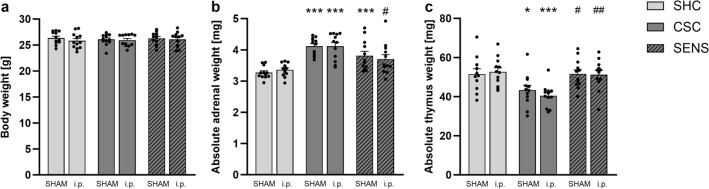 Figure 1
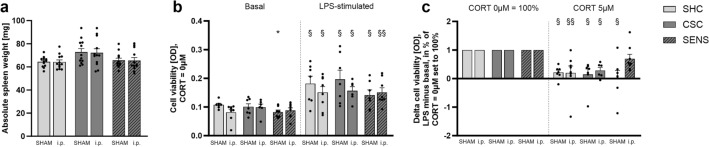 Figure 2
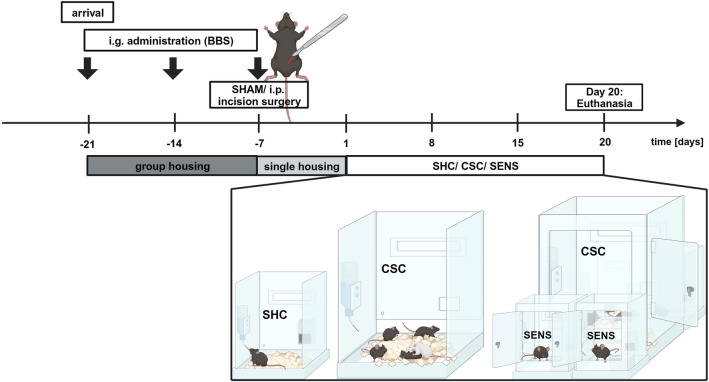 Figure 3
Peer Reviews
No public reviews on file for this paper yet. If you reviewed it on a platform where reviews are public (OpenReview, ICLR, NeurIPS, ICML), you can paste yours below so the community can read it here.
Videos
No videos yet. Explain this paper in a talk, walkthrough, or lecture? Add one.
Taxonomy
TopicsStress Responses and Cortisol · Tryptophan and brain disorders · Circadian rhythm and melatonin