Attention capture by own name decreases with speech compression
Simon Y. W. Li, Alan L. F. Lee, Jenny W. S. Chiu, Robert G. Loeb, Penelope M. Sanderson

TL;DR
A listener's own name can capture attention even in compressed speech, but the effect weakens with higher compression levels.
Contribution
The study shows that own-name attention capture decreases with speech compression, supporting the duplex-mechanism account of auditory distraction.
Findings
Participants were slower at word categorization when hearing their own name compared to other names.
Attention capture by own name was strongest with slight compression and weakest with intense compression.
Time-compressed speech still captures attention, but the effect depends on compression level.
Abstract
Auditory stimuli that are relevant to a listener have the potential to capture focal attention even when unattended, the listener’s own name being a particularly effective stimulus. We report two experiments to test the attention-capturing potential of the listener’s own name in normal speech and time-compressed speech. In Experiment 1, 39 participants were tested with a visual word categorization task with uncompressed spoken names as background auditory distractors. Participants’ word categorization performance was slower when hearing their own name rather than other names, and in a final test, they were faster at detecting their own name than other names. Experiment 2 used the same task paradigm, but the auditory distractors were time-compressed names. Three compression levels were tested with 25 participants in each condition. Participants’ word categorization performance was again…
Genes, proteins, chemicals, diseases, species, mutations and cell lines named across the full text — each resolved to its canonical identifier and authoritative record.
Click any figure to enlarge with its caption.
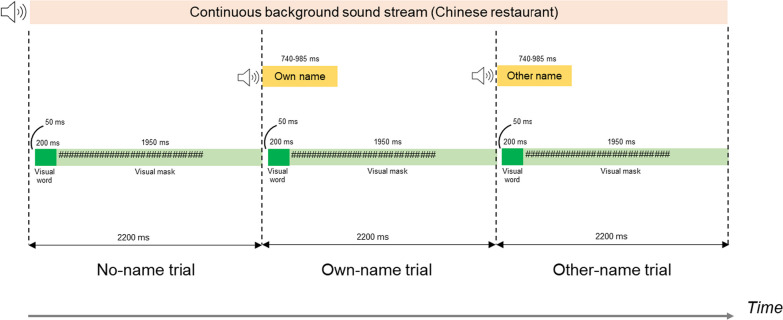 Figure 1
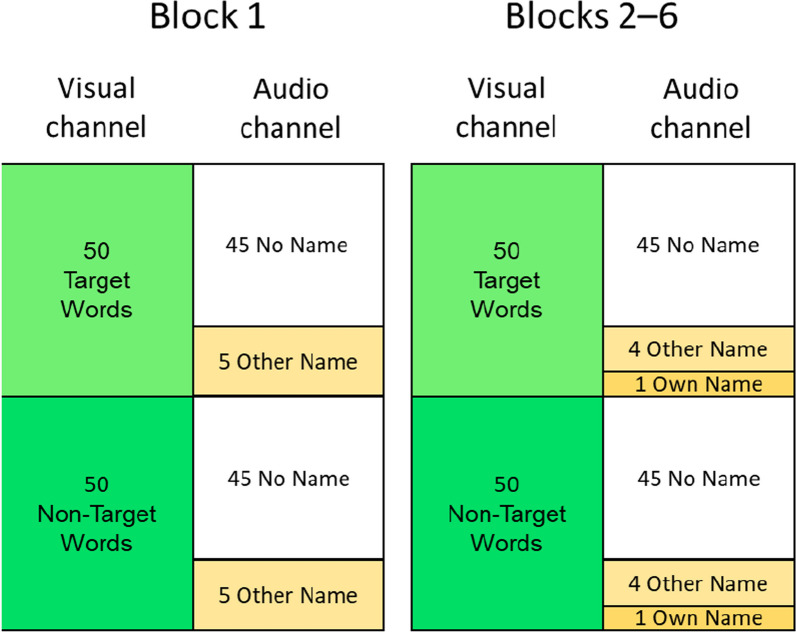 Figure 2
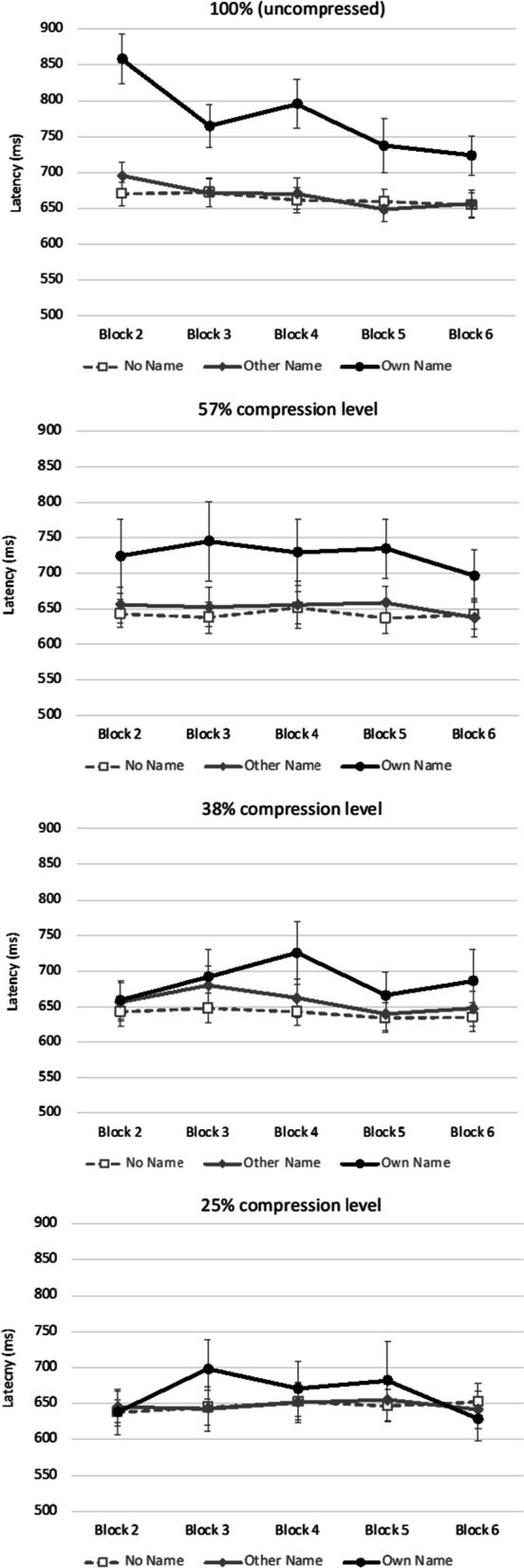 Figure 3
Peer Reviews
No public reviews on file for this paper yet. If you reviewed it on a platform where reviews are public (OpenReview, ICLR, NeurIPS, ICML), you can paste yours below so the community can read it here.
Videos
No videos yet. Explain this paper in a talk, walkthrough, or lecture? Add one.
Taxonomy
TopicsEEG and Brain-Computer Interfaces · Neural and Behavioral Psychology Studies · Neural dynamics and brain function