Novice providers’ success in performing lumbar puncture: a randomized controlled phantom study between a conventional spinal needle and a novel bioimpedance needle
Helmiina Lilja, Maria Talvisara, Vesa Eskola, Paula Heikkilä, Harri Sievänen, Sauli Palmu

TL;DR
A new bioimpedance needle helps medical students perform lumbar punctures more successfully than a conventional needle in a training model.
Contribution
The novel bioimpedance needle significantly improves success rates for lumbar punctures among novice providers in a phantom study.
Findings
90% success rate with the bioimpedance needle versus 40% with the conventional needle.
First-attempt success was 50% with the bioimpedance needle versus 16.7% with the conventional needle.
Abstract
Lumbar puncture (LP) is an important yet difficult skill in medical practice. In recent years, the number of LPs in clinical practice has steadily decreased, which reduces residents’ clinical exposure and may compromise their skills and attitude towards LP. Our study aims to assess whether the novel bioimpedance needle is of assistance to a novice provider and thus compensates for this emerging knowledge gap. This randomized controlled study, employing a partly blinded design, involved 60 s- and third-year medical students with no prior LP experience. The students were randomly assigned to two groups consisting of 30 students each. They performed LP on an anatomical lumbar model either with the conventional spinal needle or the bioimpedance needle. Success in LP was analysed using the independent samples proportion procedure. Additionally, the usability of the needles was evaluated…
Genes, proteins, chemicals, diseases, species, mutations and cell lines named across the full text — each resolved to its canonical identifier and authoritative record.
Click any figure to enlarge with its caption.
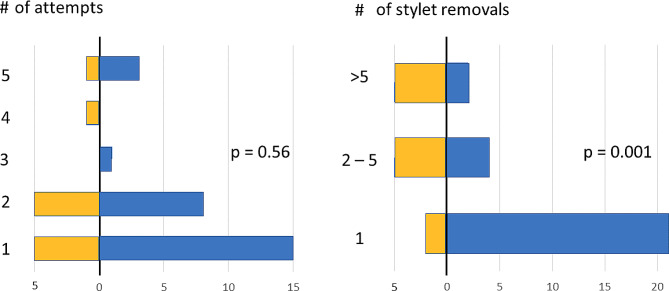 Figure 1
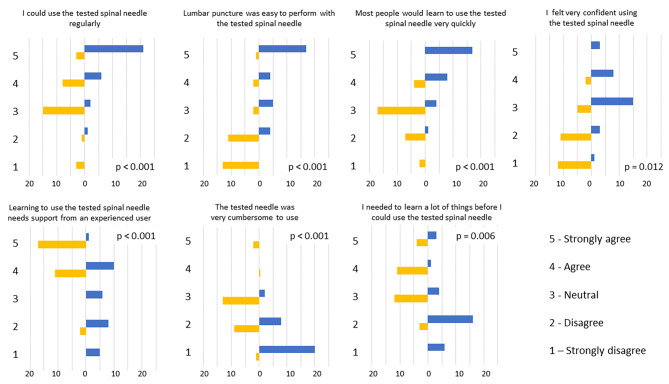 Figure 2
Peer Reviews
No public reviews on file for this paper yet. If you reviewed it on a platform where reviews are public (OpenReview, ICLR, NeurIPS, ICML), you can paste yours below so the community can read it here.
Videos
No videos yet. Explain this paper in a talk, walkthrough, or lecture? Add one.
Taxonomy
TopicsUltrasound in Clinical Applications · Radiology practices and education · Surgical Simulation and Training