Exploring the Role of Complexity in Health Care Technology Bottom-Up Innovations: Multiple-Case Study Using the Nonadoption, Abandonment, Scale-Up, Spread, and Sustainability Complexity Assessment Tool
Ulla Hellstrand Tang, Frida Smith, Ulla Leyla Karilampi, Andreas Gremyr

TL;DR
This study explores how complexity affects the success of bottom-up digital health innovations using a framework called NASSS, highlighting the importance of organizational readiness and adaptive leadership.
Contribution
The study applies the NASSS complexity assessment tool to bottom-up digital health innovations, revealing insights into organizational and contextual challenges.
Findings
Complexity in digital health innovations often lies outside the innovation itself, related to organizational readiness and financing.
Adaptive leadership and nonlinear approaches are crucial for successful innovation in complex healthcare settings.
The NASSS framework helps identify factors that facilitate or hinder innovation adoption and spread.
Abstract
New digital technology presents new challenges to health care on multiple levels. There are calls for further research that considers the complex factors related to digital innovations in complex health care settings to bridge the gap when moving from linear, logistic research to embracing and testing the concept of complexity. The nonadoption, abandonment, scale-up, spread, and sustainability (NASSS) framework was developed to help study complexity in digital innovations. This study aims to investigate the role of complexity in the development and deployment of innovations by retrospectively assessing challenges to 4 digital health care innovations initiated from the bottom up. A multicase retrospective, deductive, and explorative analysis using the NASSS complexity assessment tool LONG was conducted. In total, 4 bottom-up innovations developed in Region Västra Götaland in Sweden…
Genes, proteins, chemicals, diseases, species, mutations and cell lines named across the full text — each resolved to its canonical identifier and authoritative record.
Click any figure to enlarge with its caption.
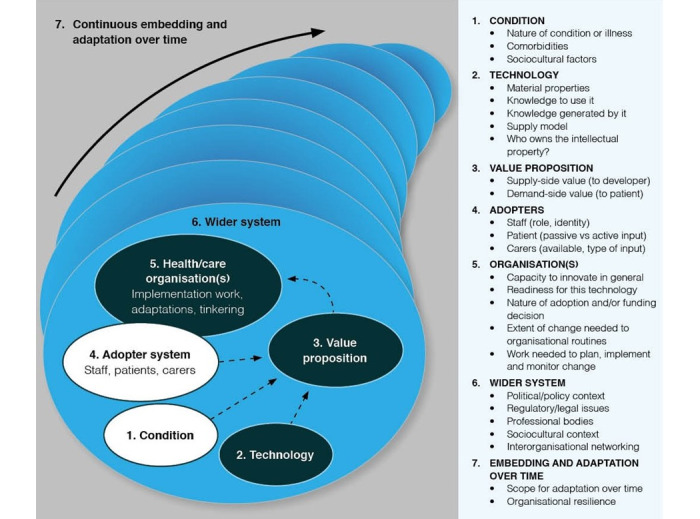 Figure 1
 Figure 2
Peer Reviews
No public reviews on file for this paper yet. If you reviewed it on a platform where reviews are public (OpenReview, ICLR, NeurIPS, ICML), you can paste yours below so the community can read it here.
Videos
No videos yet. Explain this paper in a talk, walkthrough, or lecture? Add one.
Taxonomy
TopicsChaos, Complexity, and Education · Ego Development and Educational Practices · Innovation and Knowledge Management