Relapsing Plasmodium vivax malaria in a 12-year-old Brazilian girl: A case report
Ezequias B. Martins, Anielle de Pina-Costa, Roxana F. Mamani, Otilia Lupi, Guilherme A. Calvet, Clarisse S. Bressan, Michele F. B. Silva, André M. Siqueira, Sidnei da Silva, Graziela Maria Zanini, Maria de Fátima Ferreira-da-Cruz, Cláudio Tadeu Daniel-Ribeiro, Patrícia Brasil

TL;DR
A 12-year-old Brazilian girl experienced two relapses of Plasmodium vivax malaria after standard treatment, but improved with extended chloroquine prophylaxis.
Contribution
This case highlights the challenges of treating relapsing P. vivax malaria and the effectiveness of prolonged chloroquine use.
Findings
The patient had two relapses after conventional chloroquine and primaquine treatment.
Chloroquine prophylaxis for three months led to a favorable outcome.
The case underscores the need for extended treatment strategies for P. vivax.
Abstract
Plasmodium vivax causes the vast majority of malaria cases in Brazil. The lifecycle of this parasite includes a latent stage in the liver, the hypnozoite. Reactivation of hypnozoites induces repeated relapses. We report a case of two relapses of vivax malaria in a teenage girl after conventional treatment with chloroquine and primaquine. Chloroquine prophylactic treatment for three months was prescribed with a favourable outcome of the case.
Genes, proteins, chemicals, diseases, species, mutations and cell lines named across the full text — each resolved to its canonical identifier and authoritative record.
Click any figure to enlarge with its caption.
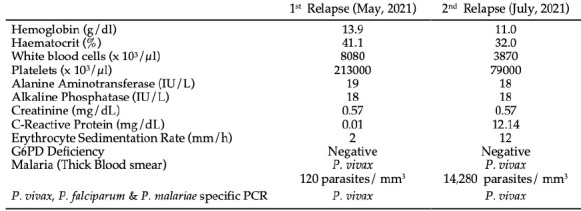 Figure 1
Peer Reviews
No public reviews on file for this paper yet. If you reviewed it on a platform where reviews are public (OpenReview, ICLR, NeurIPS, ICML), you can paste yours below so the community can read it here.
Videos
No videos yet. Explain this paper in a talk, walkthrough, or lecture? Add one.
Taxonomy
TopicsMalaria Research and Control · Vector-borne infectious diseases · Hematological disorders and diagnostics