Conservation of the Rare and Endangered Vascular Plants in the Mining and Tourism Area: Khibiny Mountains, Murmansk Region, Russia
Eugene A. Borovichev, Mikhail N. Kozhin, Natalia E. Koroleva, Olga V. Petrova, Diana R. Akhmerova, Maria V. Shulina

TL;DR
This study examines the conservation of rare and endangered plants in the industrialized Khibiny Mountains, highlighting the balance between biodiversity protection and human activities in the Russian Arctic.
Contribution
The paper provides a detailed analysis of the spatial distribution of rare vascular plants and evaluates the impact of mining and tourism on their conservation in the Arctic.
Findings
Approximately 28% of the protected vascular plant species in the Murmansk Region are found in the Khibiny Mountains.
Most rare species are confined to the southern part of the mountain range, with Papaver lapponicum being the only species found throughout the area.
Mining expansion, deforestation, and wildfires are identified as major threats to the region's biodiversity.
Abstract
The Khibiny Mountains (hereafter called Khibiny Mts.) are one of the most urbanized and industrialized regions in the Russian Arctic. There are combined a developed mining complex, elaborate infrastructure, a well-known tourist resort, and a large population, all amidst an exceptionally rich biodiversity of plants. In this study, we analyzed the current knowledge of the spatial distribution of rare and endangered vascular plants and vegetation and the impacts of human activities on these ecosystems. Approximately 28% of the protected vascular plant species in the Murmansk Region were registered within the confines of the Khibiny Mts. In particular, although only a handful of protected species had a widespread presence, most rare species were confined to the southern reaches of the mountain range, with only a select few extending into other parts. Papaver lapponicum was the only species…
Genes, proteins, chemicals, diseases, species, mutations and cell lines named across the full text — each resolved to its canonical identifier and authoritative record.
Click any figure to enlarge with its caption.
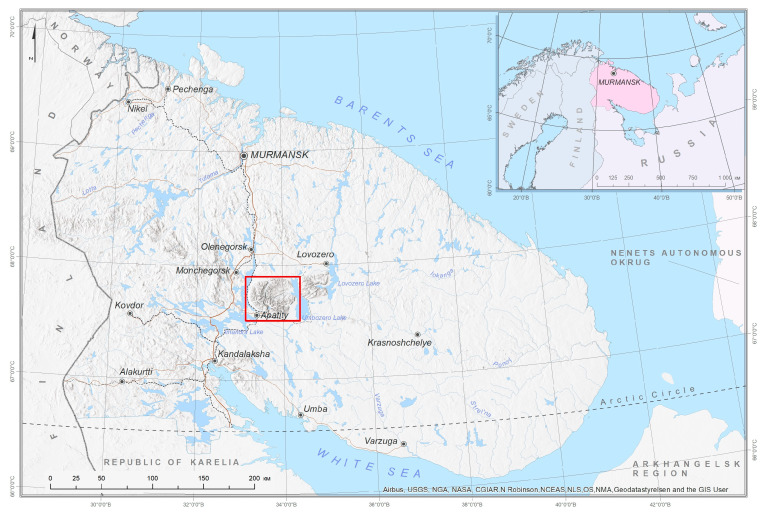 Figure 1
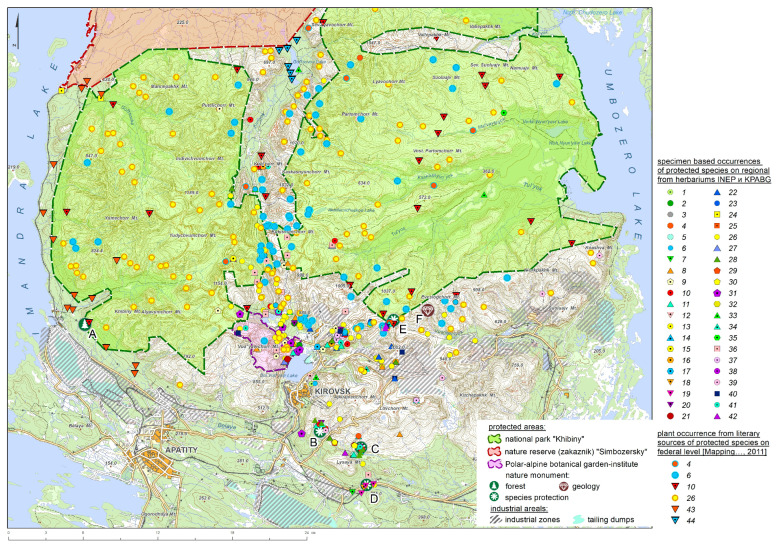 Figure 2
Peer Reviews
No public reviews on file for this paper yet. If you reviewed it on a platform where reviews are public (OpenReview, ICLR, NeurIPS, ICML), you can paste yours below so the community can read it here.
Videos
No videos yet. Explain this paper in a talk, walkthrough, or lecture? Add one.
Taxonomy
TopicsGeological Studies and Exploration · Lichen and fungal ecology · Bryophyte Studies and Records