Influence of Achalasia on the Spirometry Flow–Volume Curve and Peak Expiratory Flow
Jelena Jankovic, Branislava Milenkovic, Aleksandar Simic, Ognjan Skrobic, Arschang Valipour, Nenad Ivanovic, Ivana Buha, Jelena Milin-Lazovic, Natasa Djurdjevic, Aleksandar Jandric, Nikola Colic, Stefan Stojkovic, Mihailo Stjepanovic

TL;DR
This study explores how achalasia, a digestive disorder, affects lung function tests, showing that it can cause abnormal spirometry results that might be mistaken for lung disease.
Contribution
The study identifies a novel link between achalasia and specific spirometry patterns, highlighting the importance of recognizing non-pulmonary causes of airway obstruction.
Findings
Achalasia patients with mega-esophagus showed a plateau in the inspiratory flow–volume curve.
A plateau in spirometry correlated with a larger esophageal diameter and reduced peak expiratory flow (PEF).
Improvement in spirometry after surgery was not significant, but FEV1 improved more than FVC.
Abstract
Background: Achalasia is an esophageal motor disorder characterized by aperistalsis and the failure of the relaxation of the lower esophageal sphincter. We want to find out whether external compression or recurrent micro-aspiration of undigested food has a functional effect on the airway. Methods: The aim of this research was to analyze the influence of achalasia on the peak expiratory flow and flow–volume curve. All of the 110 patients performed spirometry. Results: The mean diameter of the esophagus was 5.4 ± 2.1 cm, and nine of the patients had mega-esophagus. Seven patients had a plateau in the inspiratory part of the flow–volume curve, which coincides with the patients who had mega-esophagus. The rest of the patients had a plateau in the expiration part of the curve. The existence of a plateau in the diameter of the esophagus of more than 5 cm was significant (p 0.003). Statistical…
Genes, proteins, chemicals, diseases, species, mutations and cell lines named across the full text — each resolved to its canonical identifier and authoritative record.
Click any figure to enlarge with its caption.
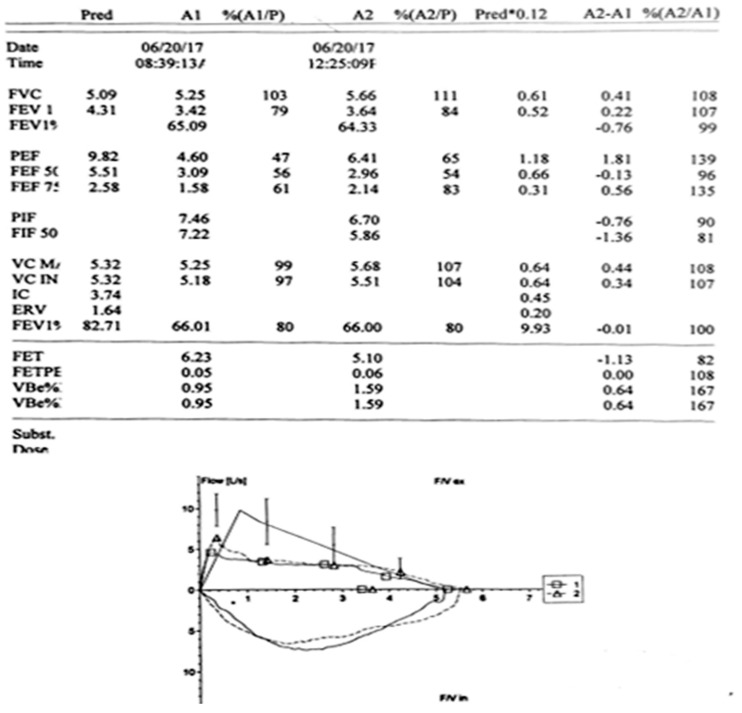 Figure 1
Peer Reviews
No public reviews on file for this paper yet. If you reviewed it on a platform where reviews are public (OpenReview, ICLR, NeurIPS, ICML), you can paste yours below so the community can read it here.
Videos
No videos yet. Explain this paper in a talk, walkthrough, or lecture? Add one.
Taxonomy
TopicsGastroesophageal reflux and treatments · Dysphagia Assessment and Management · Tracheal and airway disorders