The inner tube effect
Ian M. Thornton, Sunčica Zdravković, Dejan Todorović

TL;DR
A new visual illusion called the 'inner tube effect' makes objects seem to change size when enclosed in a narrow tube, depending on contrast.
Contribution
The discovery of a novel size illusion that works in both dynamic and static displays.
Findings
The inner tube effect causes perceived size changes based on contrast steps between display elements.
The illusion can be observed in both dynamic and static visual displays.
An interactive online demo was created to explore the illusion's parameters.
Abstract
We describe a novel size illusion in which targets appear to either shrink or grow when enclosed within a narrow tube. The direction of size change is determined by the contrast step between display elements. We first noticed this effect in the context of the dynamic “rocking line” illusion (RLI), but it can also be easily seen in completely static displays. As with the RLI, the overall scale of the display seems to play an important role. We provide an online, interactive demo, enabling the reader to explore the relevant parameter space.
Genes, proteins, chemicals, diseases, species, mutations and cell lines named across the full text — each resolved to its canonical identifier and authoritative record.
Click any figure to enlarge with its caption.
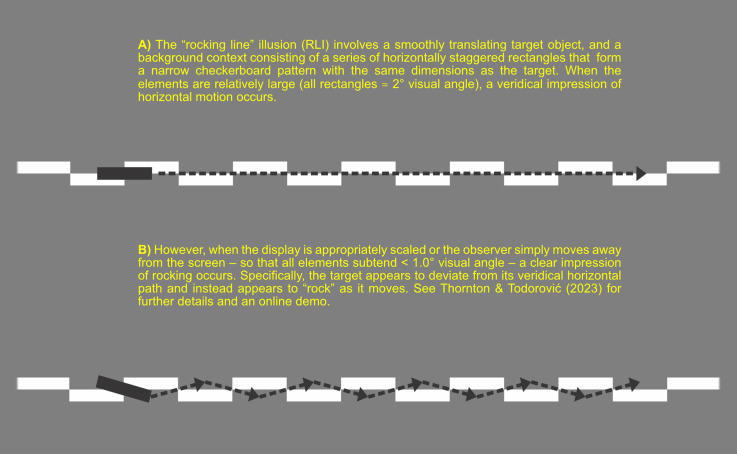 Figure 1
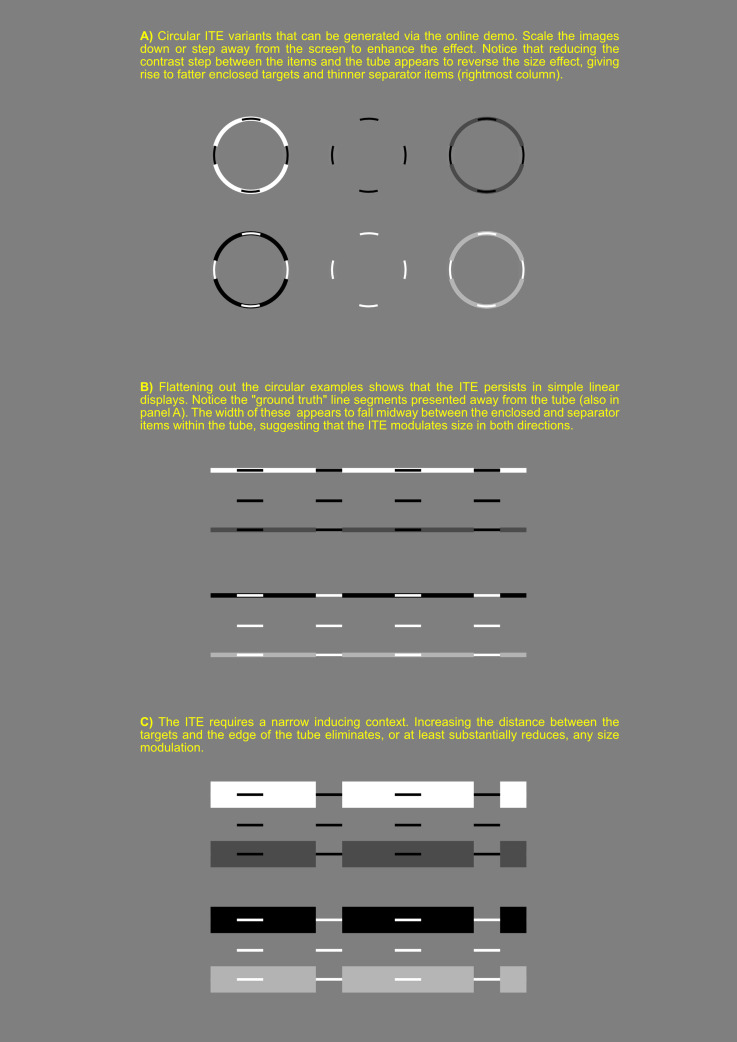 Figure 2
Peer Reviews
No public reviews on file for this paper yet. If you reviewed it on a platform where reviews are public (OpenReview, ICLR, NeurIPS, ICML), you can paste yours below so the community can read it here.
Videos
No videos yet. Explain this paper in a talk, walkthrough, or lecture? Add one.
Taxonomy
TopicsVisual perception and processing mechanisms · Advanced Optical Imaging Technologies · Data Visualization and Analytics