Perceived depth reversals of images on a concave screen
Xiayi Gu, Han Yu, Hiroyuki Ito, Tama Kanematsu

TL;DR
This paper explores how images on a concave screen can trick the brain into perceiving depth in the wrong direction.
Contribution
A new type of depth reversal is demonstrated using a concave screen with multiple depth cues.
Findings
Depth perception reverses when viewing images on a concave screen from certain distances.
The reversal occurs even with familiar cues like shading and perspective.
This effect is observed in binocular viewing conditions.
Abstract
Reverspectives and hollow masks cause a reversal of perceived depth when observed from a position beyond certain critical distances, even if viewed binocularly. Their 3D structures or images invariably contain a linear perspective, shading, or familiarity cue to depth. Using a concave screen, we demonstrate a novel type of perceived depth reversal in binocular viewing with a variety of depth cues.
Genes, proteins, chemicals, diseases, species, mutations and cell lines named across the full text — each resolved to its canonical identifier and authoritative record.
Click any figure to enlarge with its caption.
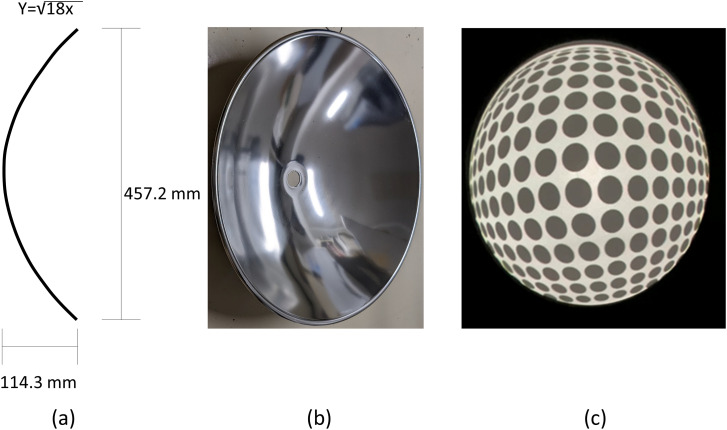 Figure 1
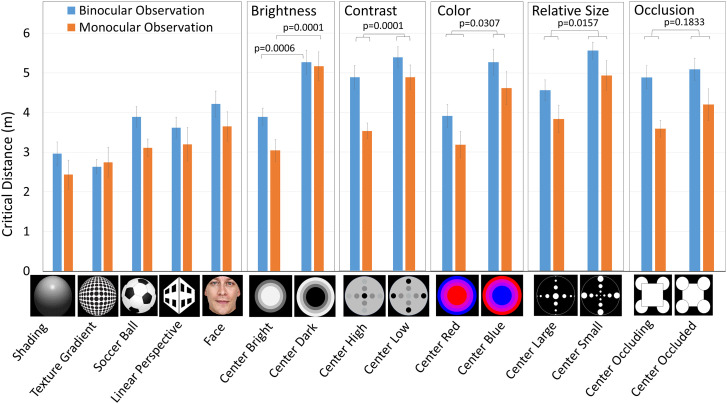 Figure 2
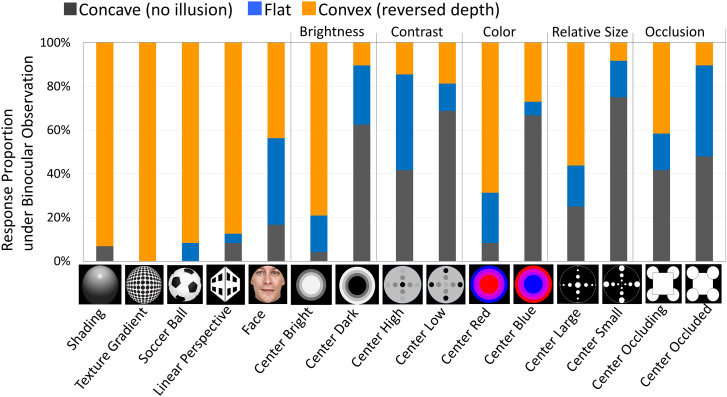 Figure 3
Peer Reviews
No public reviews on file for this paper yet. If you reviewed it on a platform where reviews are public (OpenReview, ICLR, NeurIPS, ICML), you can paste yours below so the community can read it here.
Videos
No videos yet. Explain this paper in a talk, walkthrough, or lecture? Add one.
Taxonomy
TopicsVisual perception and processing mechanisms · Advanced Optical Imaging Technologies · Advanced Vision and Imaging