The Classification of Gluteal Augmentation
Ebaa Sabri, Achraf Daoud

Abstract
Genes, proteins, chemicals, diseases, species, mutations and cell lines named across the full text — each resolved to its canonical identifier and authoritative record.
Click any figure to enlarge with its caption.
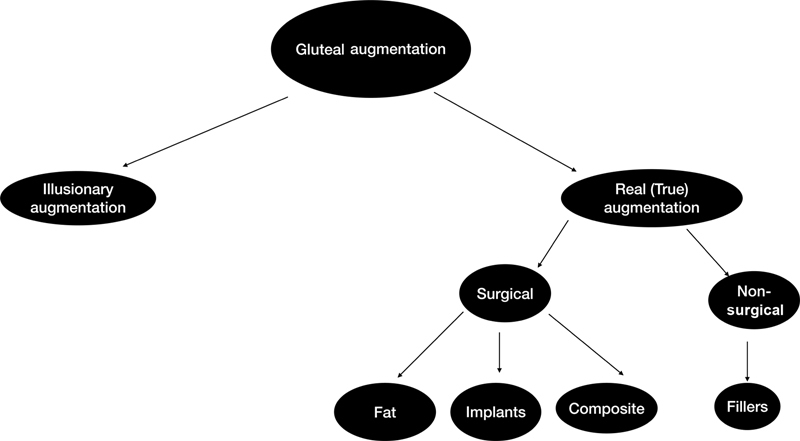 Fig. 1
Peer Reviews
No public reviews on file for this paper yet. If you reviewed it on a platform where reviews are public (OpenReview, ICLR, NeurIPS, ICML), you can paste yours below so the community can read it here.
Videos
No videos yet. Explain this paper in a talk, walkthrough, or lecture? Add one.
Taxonomy
TopicsBody Contouring and Surgery · Facial Rejuvenation and Surgery Techniques · Body Image and Dysmorphia Studies
Gluteal enhancement is a major growing trend within aesthetic surgery practice. Patient needs include volume augmentation and enhancement of the roundness of buttocks. Nonsurgical and surgical options exist. These procedures recently have the highest growth rate among all cosmetic surgery procedures in the United States. 1 2 In this letter, we suggest a classification of gluteal augmentation procedures. The gluteal augmentation can broadly be classified into pseudo-augmentation (illusionary) and real (true) augmentation ( Fig. 1 ).
Diagram of the Sabri-Daoud gluteal augmentation classification.
Pseudo-augmentation (or illusionary augmentation): It is the way by which the size of the buttocks appears to be altered, without actual alteration to the buttocks themselves. It consists of performing liposuction to the areas surrounding the gluteal region, such as the love handles and side saddles, to give the impression that the buttocks are bigger. Real (true) augmentation: It involves altering the actual size of the buttocks, via nonsurgical (aesthetic medicine act) or surgical means.
- ∘ Nonsurgical means of true gluteal augmentation is by the injection of various fillers into the gluteal region, such as Macrolane, HYAcorp, and others. The advantages of this method include that it is a minimally invasive procedure, with avoidance of surgery and general anesthetic risks. The disadvantages, however, include a significant risk of complications such as filler migration, inflammatory reaction, granuloma formation, and infection; that it is expensive; that the effects are often suboptimal and short-lived. 3
- ∘ Surgical methods of true gluteal augmentation include fat injection, gluteal implants, and composite gluteal augmentation.
Fat injection involves the process of liposuction and subsequent lipofilling to the gluteal region. The advantages of this method include the double-effect of fat removal in desired areas and volume gain in the buttocks region. The disadvantages include needing to have enough fat to perform the original liposuction; the high percentage of fat resorption within 6 months following the procedure which may apply a necessity to do more than one session to obtain the desired result, and the risk of fat embolism. 4 Sterodimas et al, 5 described stromal enriched lipograft, which increased and prolonged duration of the grafted fat that makes the necessity to repeat procedures very rare, as this technique allows to target the subcutaneous layer as the recipient site. 5
Gluteal implants are another method by which the buttocks may be truly augmented. They are long-lasting, can vary in size according to patient preference within the limit of implants size availability, and continue to hold their firmness over time. They have minimal associated disadvantages—pain that may radiate to lower limbs and it could continue for couple of weeks and needs to be managed by some analgesia and corticosteroid, the implant can be flipped over and that can be happened once or more than once, other complications like infection, seroma, wound healing complications, visible scars, and implant extrusion. 1 6 Composite gluteal augmentation involves the combination of gluteal implants and fat grafting. This technique is used to hide the implants, leading to a more natural and fuller look to the buttocks.
Conclusion
To apply the treatment plan, we need to have a classification that makes the analysis of the case easier and applying the most adaptable procedure for each patient, according to patient's wish, facilities, technical skills of the practitioner, and availabilities of necessary materials and instruments.
The reference list from the paper itself. Each links out to its DOI / PubMed record.
- 1Petit F Colli M Badiali V Ebaa S Salval A Buttocks volume augmentation with submuscular implants: 100 cases series Plast Reconstr Surg 20221490361562235196675 10.1097/PRS.0000000000008885 · doi ↗ · pubmed ↗
- 2ASPS National Clearinghouse of Plastic Surgery Procedural Statistics Plastic surgery statistics report 2016. Accessed December 1, 2021 at:https://www.plasticsurgery.org/documents/News/Statistics/2016/plastic-surgery-statistics-full-report-2016.pdf
- 3De Meyere B Mir-Mir S Peñas J Camenisch C C Hedén P Stabilized hyaluronic acid gel for volume restoration and contouring of the buttocks: 24-month efficacy and safety Aesthet Plast Surg 2014380240441210.1007/s 00266-013-0251-924464121 · doi ↗ · pubmed ↗
- 4Astarita D C Scheinin L A Sathyavagiswaran L Fat transfer and fatal macroembolization J Forensic Sci 2015600250951025653075 10.1111/1556-4029.12549 · doi ↗ · pubmed ↗
- 5Sterodimas A Nicaretta B Figus A Boriani F Safety and efficacy of gluteal contouring based on stromal enriched lipograft in 194 patients Eur J Plast Surg 202245641648
- 6Oranges C M Tremp Mdi Summa P G Gluteal augmentation techniques: a comprehensive literature review Aesthet Surg J 2017370556056928203698 10.1093/asj/sjw 240 · doi ↗ · pubmed ↗