Complete genome of Acinetobacter calcoaceticus AC001_UM from Red River soil banks in Winnipeg, Manitoba, Canada
Ruwani L. Wimalasekara, Ellen M. E. Sykes, Dawn White, Chris Rathgeber, Ayush Kumar

TL;DR
This paper presents the full genome sequence of an Acinetobacter calcoaceticus strain from Canadian soil, including its antibiotic resistance features.
Contribution
The study provides a new genome sequence and identifies specific antibiotic resistance genes in an environmental Acinetobacter isolate.
Findings
The genome of AC001_UM is 3,916,544 nucleotides long with a GC content of 38.7%.
The isolate contains a class D β-lactamase and three efflux pump families associated with antibiotic resistance.
Abstract
We report the whole-genome sequence and antibiotic-resistance gene profile of an Acinetobacter calcoaceticus isolate, designated AC001_UM, taken from soil along the Red River in Winnipeg, Manitoba, Canada. The genome comprised 3,916,544 nucleotides (GC content: 38.7%). Antibiotic-resistance gene analysis revealed a class D β-lactamase and three efflux pump families.
Genes, proteins, chemicals, diseases, species, mutations and cell lines named across the full text — each resolved to its canonical identifier and authoritative record.
Click any figure to enlarge with its caption.
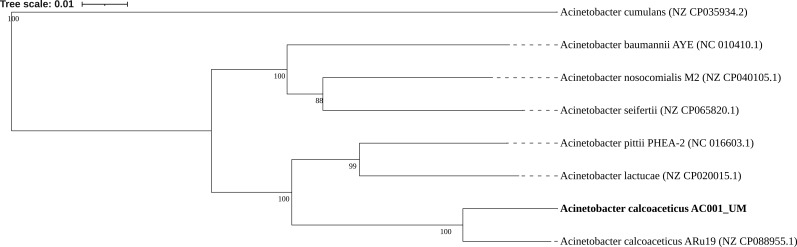 Fig 1
Fig 1| Antibiotic resistance gene | Locus tag | Antibiotic resistance gene family | CARD accession | Percent sequence identity |
|---|---|---|---|---|
|
|
| Resistance-nodulation-division transporter | ARO:3000781 | 96 |
|
|
| OXA β-lactamase | ARO:3001724 | 100 |
|
|
| Major facilitator superfamily transporter | ARO:3004577 | 96 |
|
|
| Small multidrug resistance family transporter | ARO:3000768 | 94 |
|
|
| Resistance-nodulation-division transporter | ARO:3000777 | 98 |
- —Canadian Government | Natural Sciences and Engineering Research Council of Canada (NSERC)
Peer Reviews
No public reviews on file for this paper yet. If you reviewed it on a platform where reviews are public (OpenReview, ICLR, NeurIPS, ICML), you can paste yours below so the community can read it here.
Videos
No videos yet. Explain this paper in a talk, walkthrough, or lecture? Add one.
Taxonomy
TopicsGenomics and Phylogenetic Studies · Microbial Community Ecology and Physiology · Antibiotic Resistance in Bacteria
ANNOUNCEMENT
Acinetobacter calcoaceticus, part of the Acinetobacter calcoaceticus-Acinetobacter baumannii complex, is ubiquitous in nature but is also emerging as a major healthcare challenge due to antibiotic resistance (1). We isolated an A. calcoaceticus that we designated AC001_UM from the banks of the Red River in Winnipeg, Canada, and sequenced its genome to gain insight into its resistome.
Isolation involved plating 0.1 mL of suspension (1 g soil/1 mL saline) on MacConkey agar (Oxoid, UK) and incubating at 37°C for 24 hours. Distinct colonies were re-streaked on Tryptic Soy Agar (Oxoid) and tentatively identified as Acinetobacter spp. using the API 20E system following the manufacturer’s instructions (Biomerieux, France). DNA was extracted with an EZ-10 Spin Column Bacterial Genomic DNA Miniprep Kit (Bio Basic Inc, Canada). Unsheared and non-size selected DNA was used to generate libraries with SQK-LSK114 (Oxford Nanopore Technologies) and sequenced with the MinION FLO-MIN112 (Oxford Nanopore Technologies, UK). Default parameters were used for all sequence processing unless otherwise noted. Base-calling and filtering low-quality reads (cut off-Q9) were achieved using Guppy v.6.3.7 (Oxford Nanopore Technologies). Sequence adapters were trimmed with Porechop v.0.2.1 (2). A total of 483,964 reads (length N_50_ of 9685) were assembled de-novo with Flye v.2.9.1 (3) and verified with Bandage v.0.9.0 (4). Sequencing quality was evaluated with QUAST v.5.0.2 (5); the genome consisted of a single contig (length 3,916,544) with a GC content of 38.7%, an N_50_ of 3,916,544 bp, and 700× coverage. Genome completeness was verified with CheckM v.1.0.11 (6) (99.4% completeness, 1.14% contamination) and whole-genome alignment with reference genome A. calcoaceticus Aru19 (NZ_CP088955.1) using progressiveMauve v.2.4.0 (7). Annotation with NCBI Prokaryotic Genome Annotation Pipeline v.6.5 (8) revealed 3,646 protein-coding genes, 95 RNA genes (18 rRNAs, 73 tRNAs, and 4 ncRNAs), and 370 pseudogenes. Our isolate was confirmed as A. calcoaceticus with Fastani v.1.33 (9) and shared 96.2% nucleotide identity with the reference strain Aru19. The phylogeny of AC001_UM was verified using whole-genome taxonomy-based analysis in Type Strain Genome Server (10) and visualized using iToL (11) (Fig. 1).
Phylogenetic dendrogram of A. calcoaceticus AC001_UM and Acinetobacter spp. The tree was inferred with FastME 2.1.6.1 (12) based on genome sequences analyzed using the Genome BLAST Distance Phylogeny (GBDP) method. Branch lengths are scaled in terms of GBDP distance formula d5, and numbers above the branches indicate GBDP pseudo bootstrap support values of >60% from 100 replications, with an average branch support of 97.8%. The tree was rooted at the midpoint.
Resistance genes were identified with the Comprehensive Antibiotic Resistance Database (13) using RGI main with strict and perfect parameters (Table 1). Of note was the class D β-lactamase bla_OXA-268_ implicated in carbapenem resistance (14); BLASTn against the NCBI RefSeq genome database (https://www.ncbi.nlm.nih.gov/datasets/taxonomy/471/) revealed that bla_OXA-268_ is prevalent in 93% A. calcoaceticus (15). A component of the AdeFGH multidrug efflux pump, adeG, was also identified (16). Using RefSeq, we found a single nucleotide polymorphism in AC001_UM at position 356 (356delC) of adeH resulting in a frameshift mutation and predicted truncated protein. It will be intriguing to explore how this mutation might influence the antibiotic susceptibility profile of AC001_UM; however, as this assembly was generated using Nanopore-only data it is possible that this frameshift is artifactual. In conclusion, the A. calcoaceticus AC001_UM genome offers valuable genetic insights for future studies on antibiotic resistance in Acinetobacter spp.
The reference list from the paper itself. Each links out to its DOI / PubMed record.
- 1Castanheira M, Mendes RE, Gales AC. 2023. Global epidemiology and mechanisms of resistance of Acinetobacter baumannii-calcoaceticus complex. Clin Infect Dis 76:S 166–S 178. doi:10.1093/cid/ciad 10937125466 PMC 10150277 · doi ↗ · pubmed ↗
- 2Wick RR, Judd LM, Gorrie CL, Holt KE. 2017. Completing bacterial genome assemblies with multiplex min ION sequencing. Microb Genom 3:e 000132. doi:10.1099/mgen.0.00013229177090 PMC 5695209 · doi ↗ · pubmed ↗
- 3Kolmogorov M, Yuan J, Lin Y, Pevzner PA. 2019. Assembly of long, error-prone reads using repeat graphs. Nat Biotechnol 37:540–546. doi:10.1038/s 41587-019-0072-830936562 · doi ↗ · pubmed ↗
- 4Wick RR, Schultz MB, Zobel J, Holt KE. 2015. Bandage: interactive visualization of de novo genome assemblies. Bioinformatics 31:3350–3352. doi:10.1093/bioinformatics/btv 38326099265 PMC 4595904 · doi ↗ · pubmed ↗
- 5Gurevich A, Saveliev V, Vyahhi N, Tesler G. 2013. QUAST: quality assessment tool for genome assemblies. Bioinformatics 29:1072–1075. doi:10.1093/bioinformatics/btt 08623422339 PMC 3624806 · doi ↗ · pubmed ↗
- 6Parks DH, Imelfort M, Skennerton CT, Hugenholtz P, Tyson GW. 2015. Check M: assessing the quality of microbial genomes recovered from isolates, single cells, and metagenomes. Genome Res 25:1043–1055. doi:10.1101/gr.186072.11425977477 PMC 4484387 · doi ↗ · pubmed ↗
- 7Darling ACE, Mau B, Blattner FR, Perna NT. 2004. Mauve: multiple alignment of conserved genomic sequence with rearrangements. Genome Res 14:1394–1403. doi:10.1101/gr.228970415231754 PMC 442156 · doi ↗ · pubmed ↗
- 8Li W, O’Neill KR, Haft DH, Di Cuccio M, Chetvernin V, Badretdin A, Coulouris G, Chitsaz F, Derbyshire MK, Durkin AS, Gonzales NR, Gwadz M, Lanczycki CJ, Song JS, Thanki N, Wang J, Yamashita RA, Yang M, Zheng C, Marchler-Bauer A, Thibaud-Nissen F. 2021. Ref Seq: expanding the prokaryotic genome annotation pipeline reach with protein family model curation. Nucleic Acids Res 49:D 1020–D 1028. doi:10.1093/nar/gkaa 110533270901 PMC 7779008 · doi ↗ · pubmed ↗