The genomic characterization of three Microbacterium foliorum-specific bacteriophages, “Nucci,” “MCubed,” and “QMacho”
Jennifer Cook Easterwood, Joanna Mantis Katsanos, Jenna Lloyd

TL;DR
This paper describes the genomic analysis of three new bacteriophages found in soil near Charlotte, NC.
Contribution
The study characterizes three novel bacteriophages and their gene content, expanding knowledge of phage diversity.
Findings
Nucci, MCubed, and QMacho were classified into distinct phage clusters (EA10, EA2, and EB).
Nucci and MCubed each have 63 predicted genes, while QMacho has 73 predicted genes.
Abstract
Nucci, MCubed, and QMacho are microbacteriophages that were isolated from soil samples in Charlotte, NC. They were classified into EA10, EA2, and EB clusters, respectively. Nucci and MCubed each had 63 predicted genes, while QMacho had 73 predicted genes.
Genes, proteins, chemicals, diseases, species, mutations and cell lines named across the full text — each resolved to its canonical identifier and authoritative record.
Click any figure to enlarge with its caption.
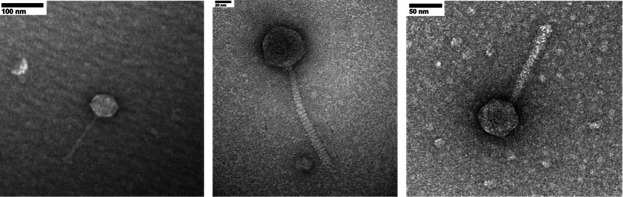 Fig 1
Fig 1| Phage | Soil sample collection site | Isolation year | Plaque morphology | Plaque size (mm) | Capsid size (nm) | Tail | Approximate | Genome length (bp) | Genome end | G-C | No. of | No. of tRNAs | Cluster |
|---|---|---|---|---|---|---|---|---|---|---|---|---|---|
| Nucci ( | 35.16569 N, 80.759107 W | 2018 | Clear, small | 1 | 60 | 121 | 2,373 | 40,373 | Circularly permuted | 63.7 | 63 | 0 | EA10 |
| MCubed ( | 35.16569 N, 80.759107 W | 2018 | Hazy, small | 1 | 51 | 140 | 235 | 40,381 | Circularly permuted | 62 | 63 | 0 | EA2 |
| QMacho ( | 35.189512 N, 80.831178 W | 2021 | Clear, medium sized | 2 | 61 | 136 | 548 | 41,685 | 3′ sticky overhang | 67 | 73 | 3 | EB |
Peer Reviews
No public reviews on file for this paper yet. If you reviewed it on a platform where reviews are public (OpenReview, ICLR, NeurIPS, ICML), you can paste yours below so the community can read it here.
Videos
No videos yet. Explain this paper in a talk, walkthrough, or lecture? Add one.
Taxonomy
TopicsBacteriophages and microbial interactions · Genomics and Phylogenetic Studies · Microbial Community Ecology and Physiology
ANNOUNCEMENT
We report the genome sequences of three microbacteriophages (Nucci, MCubed, and QMacho) isolated using the host Microbacterium foliorum NRRL B-24224 from soil samples collected in Charlotte, NC (Table 1). These microbacteriophages represent clusters EA10, EA2, and EB, which contribute to the greater understanding of the diversity and abundance of microbacteriophage species in the Southeast. This information can provide a better understanding of their relationship to the local soil ecosystem (1).
Using protocols in the SEA-PHAGES discovery guide (https://seaphagesphagediscoveryguide.helpdocsonline.com/home), we isolated the microbacteriophages using enriched isolation and the host Microbacterium foliorum grown in PYCa liquid media at 30°C for 2 days. Isolation was followed by three rounds of plaque assays to purify the phage, ensuring uniform plaque morphology (Table 1), followed by production of high-volume lysates to amplify the phage. Negative staining transmission electron microscopy revealed that all three have siphovirus morphology (Fig. 1). A representative virion for each phage was used to determine capsid and tail measurements using ImageJ v.1.53k.(2) (Table 1).
Transmission electron microscopy revealed that Nucci, MCubed, and QMacho (left to right) belong to the Siphoviridae viral family. Negative staining was performed using 2% uranyl acetate, and specimens were examined at an accelerating voltage of 120 kV using the JEM 1400Plus transmission electron microscope.
Genomic DNA was isolated from a high-titer lysate using the Wizard DNA Clean-Up kit (Promega) and prepared for sequencing with a NEB Ultra II DNA Kit. Genomes were sequenced with an Illumina MiSeq instrument. Nucci yielded 717,195 reads of 150-base single-end reads; MCubed yielded 334,594 reads of 150-base single-end reads, while QMacho yielded 258,988 reads of 150-base single-end reads. Raw reads were assembled using Newbler v.2.7 (3) with default settings. Consed v.29 (4) was used to check for genomic termini, accuracy, and completeness for quality control (5).
Auto-annotation of these genomes was performed using DNA Master v.5.23.6 (http://cobamide2.bio.pitt.edu/computer.htm) with protein-coding regions predicted by Glimmer v.3.02 (6) and GeneMark v.2.5p (7) using the default settings described in Howard Hughes Medical Institute’s SEA-PHAGES Bioinformatics Guide (https://seaphagesbioinformatics.helpdocsonline.com/home). Gene starts were predicted using Starterator (http://seaphages.org/software/), while protein function was determined using NCBI BLASTp v.2.7 (8), Phamerator (9), and HHPred v.3.0beta (10). Characteristics of the genomes and viral clusters are included in Table 1, and representative virion morphologies are included in Fig. 1.
Nucci contained 63 predicted protein-coding regions with 24 putative functions, MCubed contained 63 predicted protein-coding genes with 22 putative functions, and QMacho contained 73 predicted protein-coding genes with 31 putative functions. QMacho also contained three tRNA sequences predicted by Aragorn v1.1 (11) and tRNAscan-SE v.2.0.6 (12) and a putative translational frameshift in the tail assembly chaperone genes. MCubed and QMacho each had one transmembrane protein predicted by TMHMM v.2.0 (13) and SOSUI v.1.11 (14)
Clustal Omega alignment (https://www.ebi.ac.uk/Tools/msa/clustalo/) (15) using default settings indicated an 83.73% average nucleotide sequence identity (ANI) between Nucci and Mandalorian and an 83.95% ANI with Quartz. MCubed had a 96.66% ANI with Eleri and a 96.48% ANI with Sansa, all members of the EA cluster, a microbacteriophage cluster. QMacho had a 93.72% ANI with Swervy, a member of the EB cluster, also a microbacteriophage cluster.
The reference list from the paper itself. Each links out to its DOI / PubMed record.
- 1Jordan TC, Burnett SH, Carson S, Caruso SM, Clase K, De Jong RJ, Dennehy JJ, Denver DR, Dunbar D, Elgin SCR, et al.. 2014. A broadly implementable research course in phage discovery and genomics for first-year undergraduate students. m Bio 5:e 01051-13. doi:10.1128/m Bio.01051-1324496795 PMC 3950523 · doi ↗ · pubmed ↗
- 2Schneider CA, Rasband WS, Eliceiri KW. 2012. NIH image to imagej: 25 years of image analysis. Nat Methods 9:671–675. doi:10.1038/nmeth.208922930834 PMC 5554542 · doi ↗ · pubmed ↗
- 3Miller JR, Koren S, Sutton G. 2010. Assembly algorithms for next generation sequencing data. Genomics 95:315–327. doi:10.1016/j.ygeno.2010.03.00120211242 PMC 2874646 · doi ↗ · pubmed ↗
- 4Gordon D, Green P. 2013. Consed: a graphical editor for next-generation sequencing. Bioinformatics 29:2936–2937. doi:10.1093/bioinformatics/btt 51523995391 PMC 3810858 · doi ↗ · pubmed ↗
- 5Russell DA. 2018. Sequencing, assembling, and finishing complete bacteriophage genomes. Methods Mol Biol 1681:109–125. doi:10.1007/978-1-4939-7343-9_929134591 · doi ↗ · pubmed ↗
- 6Delcher AL, Harmon D, Kasif S, White O, Salzberg SL. 1999. Improved microbial gene identification with GLIMMER. Nucleic Acids Res 27:4636–4641. doi:10.1093/nar/27.23.463610556321 PMC 148753 · doi ↗ · pubmed ↗
- 7Besemer J, Borodovsky M. 2005. Gene Mark: web software for gene finding in prokaryotes, eukaryotes, and viruses. Nucleic Acids Res 33:W 451–4. doi:10.1093/nar/gki 48715980510 PMC 1160247 · doi ↗ · pubmed ↗
- 8Altschul SF, Gish W, Miller W, Myers EW, Lipman DJ. 1990. Basic local alignment search tool. J Mol Biol 215:403–410. doi:10.1016/S 0022-2836(05)80360-22231712 · doi ↗ · pubmed ↗