Comparing the biological activity and composition of Cerebrolysin with other peptide preparations
Lisa-Franziska Seidl, Ludwig Aigner

TL;DR
This study compares Cerebrolysin, a neuropeptide used for neurological disorders, with other similar peptide preparations and finds that they lack comparable biological activity and composition.
Contribution
The study reveals that other peptide preparations differ significantly in composition and biological activity compared to Cerebrolysin.
Findings
Other peptide preparations lack relevant biological activity compared to Cerebrolysin.
The peptide composition of these preparations is significantly different from Cerebrolysin.
Abstract
Neurological disorders, ranging from acute forms such as stroke and traumatic brain injury to neurodegenerative diseases like dementia, are the leading cause of disability-adjusted life years (DALYs) worldwide. A promising approach to address these conditions and promote nervous system regeneration is the use of the neuropeptide preparation Cerebrolysin, which has been shown to be effective in both clinical and preclinical studies. Despite claims of similar clinical efficacy and safety by several peptide preparations, concerns regarding their generic composition and efficacy have been previously raised. Based on these reports, we analyzed the peptide composition and neurotrophic activity of several peptide preparations allegedly similar to Cerebrolysin and approved in some countries for treating neurological diseases. Our results demonstrate that these preparations lack relevant…
Genes, proteins, chemicals, diseases, species, mutations and cell lines named across the full text — each resolved to its canonical identifier and authoritative record.
Click any figure to enlarge with its caption.
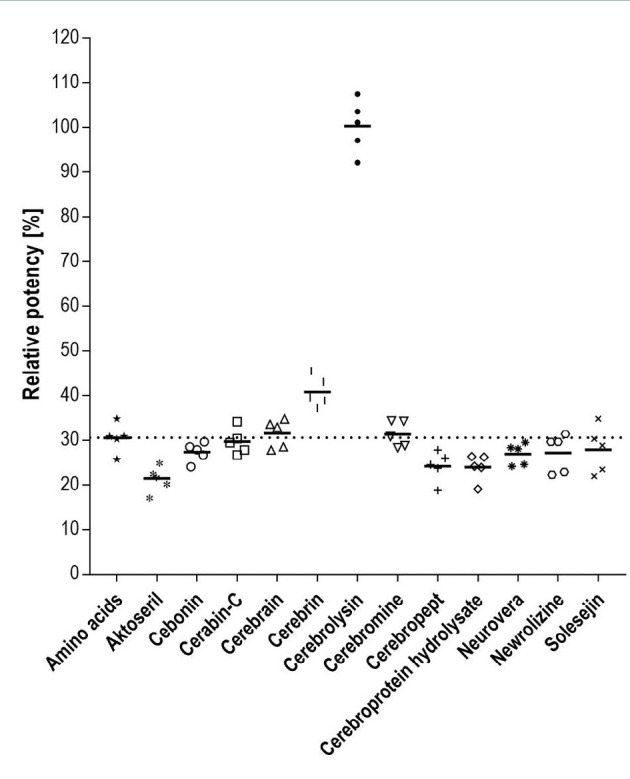 Figure 1
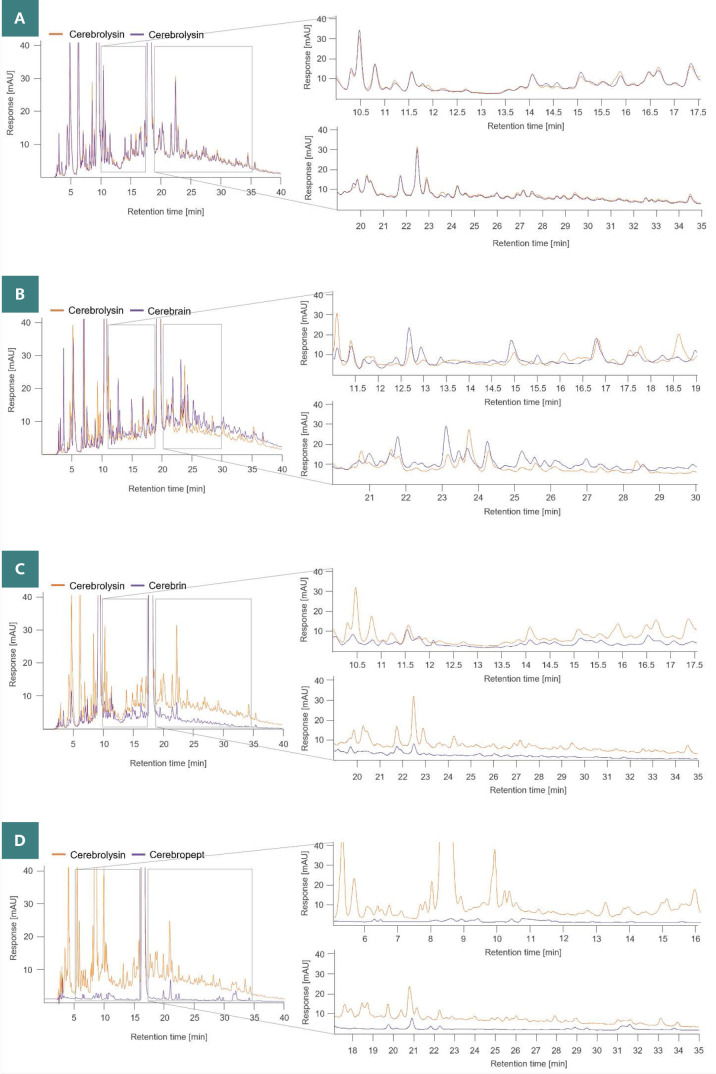 Figure 2
Peer Reviews
No public reviews on file for this paper yet. If you reviewed it on a platform where reviews are public (OpenReview, ICLR, NeurIPS, ICML), you can paste yours below so the community can read it here.
Videos
No videos yet. Explain this paper in a talk, walkthrough, or lecture? Add one.
Taxonomy
TopicsNeurological Disorders and Treatments · Neurological Disease Mechanisms and Treatments · Biochemical effects in animals
INTRODUCTION
Neurological disorders comprise the leading cause of disability-adjusted life years (DALYs) lost due to death or disability worldwide [1]. This highlights the urgent need for effective treatment options to diminish this immense burden of disease. Neurotrophic factors, a family of growth factors crucial for the development, function, and survival of adult neurons, have been extensively studied as a potential treatment option [2]. These factors are released in response to acute neurological damage or neurodegenerative diseases to protect and regenerate the affected neurons [3]. However, the use of neurotrophic factors in treating neurological disorders has not been successful since they cannot cross the blood-brain barrier or show considerable side effects [4].
Another approach that has been already explored for several decades is the use of neuropeptides that mimic the action of endogenous neurotrophic factors while being able to cross the blood-brain barrier. Neuropeptides are important in all stages of life, ranging from brain development to maintenance of neuronal homeostasis. Thus, it is not surprising that an imbalance of neuropeptides and neurotrophic factors is also a hallmark of neurological disorders. Therefore, the restoration of neuropeptide homeostasis is a promising approach in neuropathy therapy [5]. However, treatments using a single, specific neuropeptide tend to offer limited efficacy, as they may only address one aspect of the disorder, such as neuroprotection. Neurological disorders manifest as pleiotropic pathological conditions that need to be addressed by a multimodal approach that promotes not only neuroprotection but also neurogenesis and neuroplasticity. Thus, a promising strategy is the use of multimodal neuropeptide preparations. Cerebrolysin constitutes the originator product of multimodal neuropeptide preparations with a longstanding record of clinical efficacy and safety in various cerebrovascular and neurodegenerative diseases.
Several clinical trials have investigated the therapeutic potential of Cerebrolysin and demonstrated beneficial effects on neurorecovery across various neurological pathologies. Patients with acute ischemic stroke experienced significant improvements in neurological and functional outcomes following Cerebrolysin treatment [6]. Furthermore, Cerebrolysin treatment in conjunction with a structured neurorehabilitation program have led to substantial improvements in upper limb motor function and neurological outcomes [7,8]. Cerebrolysin also improved cognitive function and functional and rehabilitation outcomes in patients with moderate to severe brain trauma [9-11]. Importantly, clinical studies have not raised any safety concerns regarding Cerebrolysin, and a meta-analysis has shown that the occurrence of adverse effects after Cerebrolysin treatment is rare and comparable to that seen with placebo treatments [12].
Recent studies suggest that neuropeptide preparations that are allegedly produced in a similar way have distinct peptide profiles that can have a negative impact on their biological efficacy. Teng et al. [13] and Zhang et al. [14] demonstrated variability in efficacy both in vitro (cerebral endothelial cell permeability) and in vivo (in a rat model of embolic stroke) between Cerebrolysin and other peptide preparations. Teng et al. [13] already compared the composition of Cerebrolysin and cerebroprotein hydrolysate regarding their peptide fingerprints and could show profound differences in composition and biological activity.
Our aim was to systematically investigate a broad range of neuropeptide preparations from distinct manufacturers, including a deproteinized calf blood extract (Aktoseril), to assess their composition and neurotrophic activity. Cerebrolysin is known to induce neuronal differentiation, as evidenced by the expression of the neuronal cytoskeletal protein Neurofilament-L (NF-L) in the rat pheochromocytoma cell line PC12 [15]. Here, we used this system to compare the biological activity of various peptide preparations with the originator product Cerebrolysin.
MATERIAL AND METHODS
Material
Aktoseril (BIH Pharmaceuticals), Cebonin (Nexpharm), Cerabin-C (Unimed Pharmaceuticals), Cerebrain (Daewoong Pharmaceuticals), Cerebrin (B-Pharm), Cerebrolysin and an amino acid solution reflecting the amino acid component of Cerebrolysin (EVER Pharma), Cerebromine (Guju Pharm), Cerebropept (Kursk Biofactory Company 'BIOK'), cerebroprotein hydrolysate (Hangzhou Huajin Pharmaceuticals), Neurovera (Hyundai Pharm), Newrolizine (Huons), Solesejin (Kunil).
Bioassay for neurotrophic activity
The materials and methods for cell cultivation and cell-based assay to evaluate the neurotrophic activity of the peptide preparations were used and performed as described by Seidl et al. [15]. Briefly, the enhanced green fluorescent protein (EGFP)-NF-L reporter PC12 cells were treated with 100 µl/ml of the indicated compounds for 4 days, followed by measurement of their EGFP mean fluorescence intensity using flow cytometry (BD FACSLyric). The Neurofilament-L Bioassay was validated for use with Cerebrolysin; thus, the results are stated as 'relative potency [%]', meaning percentage EGFP mean fluorescence intensity relative to a designated Cerebrolysin reference batch.
High-Performance Liquid Chromatography analysis
The peptide fingerprint was obtained via reversed-phase High-Performance Liquid Chromatography (HPLC), as described by Teng et al. [13]. Chromatograms were generated using Agilent OpenLab CDS software.
Statistical analysis
Cell-based assay data are shown as scatter plots with mean using GraphPad Prism 7 (version 7.04).
RESULTS
Literature
We conducted a literature search for published data already available for the compounds used in this study. Our search in PubMed for 'Cerebrolysin' returned 570 publications [16], indicating a substantial volume of research on this compound, whereas 'cerebroprotein hydrolysate' yielded 17 publications [17]. Searches for the remaining compounds returned no results. In addition, the Cochrane Library listed 270 trials related to Cerebrolysin and 9 trials for cerebroprotein hydrolysate, but none for the other preparations investigated in this work [18].
Cerebrolysin is the only compound able to induce EGFP-NF-L expression
As shown previously, Cerebrolysin induces the expression of Neurofilament-L. Subsequently, we investigated the NF-L-inducing capacity of other preparations marketed for treating neurological disorders. One batch of Aktoseril, Cebonin, Cerabin-C, Cerebrain, Cerebrin, Cerebrolysin, Cerebromine, Cerebropept, cerebroprotein hydrolysate, Neurovera, Newrolizine and Solesejin, respectively was tested against a Cerebrolysin reference. Except for Cerebrolysin, none of the products was able to induce NF-L expression that would be considerably above that of the amino acid solution used as a control (Figure 1).
Cerebrolysin is the only compound able to induce relevant levels of EGFP-Neurofilament-L expression.Scatter plot with mean of Neurofilament-L Bioassay data from cells treated for 4 days with 100 µl/ml of the indicated compounds, 'amino acids' refers to the amino acid component of Cerebrolysin, n = 5. Dotted line shows the baseline neurotrophic activity represented by the median of 25 independent measurements of the amino acid component of Cerebrolysin.
The peptide composition of preparations varies
Teng et al. [13] previously demonstrated differences in peptide fingerprint between cerebroprotein hydrolysate and Cerebrolysin. Cerebroprotein hydrolysate is the common active ingredient of all the tested peptide preparations except Aktoseril, Cerebropept, and the originator product Cerebrolysin. Since the compounds could not induce NF-L expression like Cerebrolysin did, we assumed their peptide composition might also differ. To investigate this, we used reversed-phase HPLC to characterize the peptide profiles of the drugs. The resulting chromatograms indicated significant variations from Cerebrolysin, demonstrating the clear differences in the peptide composition of the preparations investigated (Figure 2A–D). Interestingly, even among different manufacturers using cerebroprotein hydrolysate as the common source of the active ingredient, the peptide composition of the compounds was also not comparable, suggesting different and non-standardized manufacturing steps for these products.
The peptide composition of preparations varies.Representative overlays of peptide fingerprint chromatograms, with sections of clear difference in the peak pattern and intensity enlarged. Overlay of (A) two different Cerebrolysin batches, as well as overlays of Cerebrolysin with (B) Cerebrain, (C) Cerebrin and (D) Cerebropept.
DISCUSSION
Recent literature suggests differences in efficacy or composition between distinct neuropeptide preparations [13,14]. In this study, we examined these observations in 12 different compounds, which have received approval in some countries for treating acute or degenerative neurological diseases. All tested peptide preparations claim generic composition to Cerebrolysin and are approved with the same treatment regimen. Our findings revealed that, apart from Cerebrolysin, none of the tested compounds demonstrated neurotrophic activity and all of them had a significantly different composition when compared to Cerebrolysin. This investigation further reinforces that the biological activity and the peptide composition differ substantially among the examined preparations from the originator product Cerebrolysin. We could not find any clinical studies conducted with these compounds, so the data basis for their approval and clinical use is often unclear. Consequently, these various products can be expected to have a different clinical efficacy and safety profile from Cerebrolysin and, therefore, should not be considered interchangeable.
CONCLUSION
Despite claims of similar clinical efficacy and safety by several peptide preparations, recent research suggests substantial differences in pharmacological activity and composition. We conducted a comprehensive study to investigate this topic and demonstrated that distinct peptide preparations differ substantially in composition and biological activity. The only compound found to have a profound clinical data basis and biological activity was Cerebrolysin.
The reference list from the paper itself. Each links out to its DOI / PubMed record.
- 1GBD 2016 Neurology Collaborators Global, regional, and national burden of neurological disorders 1990-2016: a systematic analysis for the Global Burden of Disease Study. 2016 Lancet Neurol 2019184598010.1016/S 1474-4422(18)30499-X 30879893 PMC 6459001 · doi ↗ · pubmed ↗
- 2El Ouaamari Y Van den Bos J Willekens B Cools N Wens I Neurotrophic Factors as Regenerative Therapy for Neurodegenerative Diseases: Current Status, Challenges and Future Perspectives Int J Mol Sci 2023244386610.3390/ijms 2404386636835277 PMC 9968045 · doi ↗ · pubmed ↗
- 3Huang EJ Reichardt LF Neurotrophins: roles in neuronal development and function Annu Rev Neurosci 20012467773610.1146/annurev.neuro.24.1.67711520916 PMC 2758233 · doi ↗ · pubmed ↗
- 4Rocco ML Soligo M Manni L Aloe L Nerve Growth Factor: Early Studies and Recent Clinical Trials Curr Neuropharmacol 20181614556510.2174/1570159 X 1666618041209285929651949 PMC 6295934 · doi ↗ · pubmed ↗
- 5Yeo XY Cunliffe G Ho RC Lee SS Jung S Potentials of Neuropeptides as Therapeutic Agents for Neurological Diseases Biomedicines 202210234310.3390/biomedicines 1002034335203552 PMC 8961788 · doi ↗ · pubmed ↗
- 6Bornstein NM Guekht A Vester J Heiss W-D Gusev EHömberg V Safety and efficacy of Cerebrolysin in early post-stroke recovery: a meta-analysis of nine randomized clinical trials Neurol Sci 2017396294010.1007/s 10072-017-3214-029248999 PMC 5884916 · doi ↗ · pubmed ↗
- 7Guekht A Vester J Heiss WD Gusev E Hoemberg V Rahlfs VW Safety and efficacy of Cerebrolysin in motor function recovery after stroke: a meta-analysis of the CARS trials Neurol Sci 2017381761910.1007/s 10072-017-3037-z 28707130 PMC 5605586 · doi ↗ · pubmed ↗
- 8Muresanu DF Ciurea AV Gorgan RM Gheorghita E Florian SI Stan HA retrospective, multi-center cohort study evaluating the severity-related effects of cerebrolysin treatment on clinical outcomes in traumatic brain injury CNS Neurol Disord Drug Targets 2015145879910.2174/187152731466615043016253125924999 · doi ↗ · pubmed ↗