Catecholaminergic neurons orchestrate fasting-induced immune harmony
Mengdi Guo, Weiyan Wang, Xiao Tu, Meiling Jiang, Cun-Jin Zhang

Abstract
Genes, proteins, chemicals, diseases, species, mutations and cell lines named across the full text — each resolved to its canonical identifier and authoritative record.
Click any figure to enlarge with its caption.
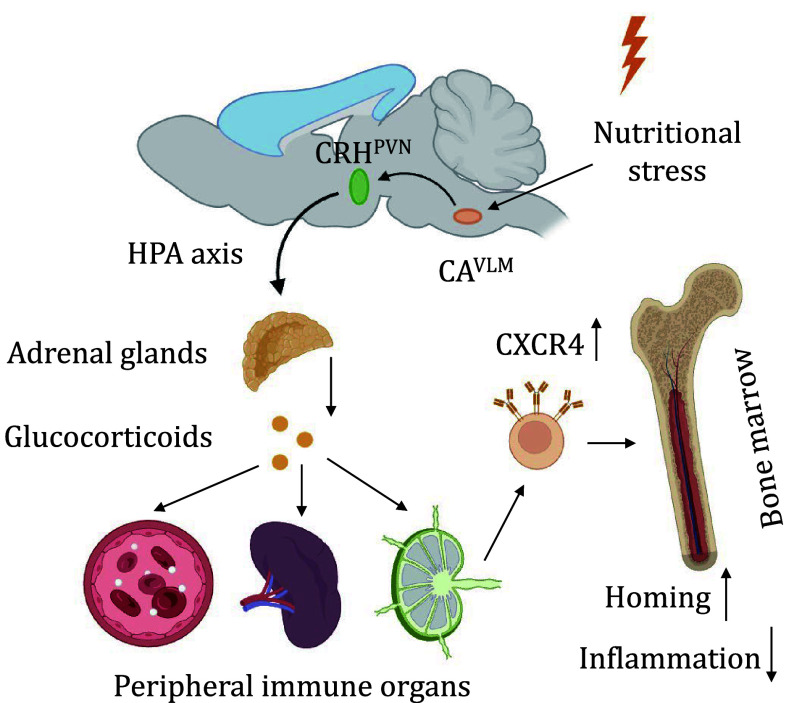 Figure 1
Peer Reviews
No public reviews on file for this paper yet. If you reviewed it on a platform where reviews are public (OpenReview, ICLR, NeurIPS, ICML), you can paste yours below so the community can read it here.
Videos
No videos yet. Explain this paper in a talk, walkthrough, or lecture? Add one.
Taxonomy
TopicsDietary Effects on Health · Circadian rhythm and melatonin · Regulation of Appetite and Obesity
Dietary fasting is a well-established intervention for immunosuppressive therapy, but the underlying mechanism remains elusive. Host fitness to nutritional stress has been confirmed to initiate a cascade of adaptive responses mediated by the central nervous system, shedding new light on a neural link between fasting and immunity (de Cabo and Mattson 2019). In a recent study published in Nature Neuroscience, Wang et al. reveal a complex interplay among fasting, neuromodulation, and the immune system. While fasting remobilized the circulating T cell pool in a CXCR4/CXCL12 axis-dependent manner, continuous activation of ventrolateral medullary catecholaminergic neurons (CA^VLM^) mimicked the bone marrow homing effect and proved obvious relief in autoimmune diseases (Wang et al. 2024).
Compared with other immune organs, bone marrow is a nutrient-rich shelter for the mature immune cells faced with nutrient scarcity. Fasting is acknowledged to trigger these high-energy consumed cells colonized in bone marrow, a fundamental adaptation strategy for promoting extended lifespan and protective functions, raising interesting questions about the underlying regulatory mechanisms and consequences of inflammatory disease outcomes (Nagai et al. 2019). In the groundbreaking investigation, the authors demonstrated that this phenomenon largely relied on an undiscovered neural mechanism, which emphasized the central role of CA^VLM^ neurons in orchestrating immune responses during energy scarcity. Activated by 24-hour fasting, these neurons drove T cell homing to the bone marrow but decreasing in the blood, spleen, and inguinal lymph nodes. Selective ablation of CA^VLM^ neurons effectively demonstrated their sufficiency and necessity for fasting-induced T cell redistribution (Wang et al. 2024). Strikingly mirroring fasting effects, sustained activation of CA^VLM^ neurons with chemogenetics curtails T cell activation, proliferation, differentiation, and cytokine production in mouse models of pathogenic T cells mediated autoimmune diseases. Excessive immune responses were also consequently reduced in experimental autoimmune encephalomyelitis (EAE), psoriasis-like skin inflammation, and mBSA-induced delayed-type hypersensitivity (DTH), especially the percentages and numbers of pathogenic Th1 and Th17 cells (Wang et al. 2024).
In addition, the observed bone marrow homing effect was found to be controlled in a CXCR4/CXCL12 axis-dependent manner, which was potentially mediated by a CA^VLM^→CRH^PVN^ neural circuit governing adrenal corticosterone secretion through the hypothalamic‒pituitary‒adrenal axis (HPA) (Wang et al. 2024). CA^VLM^ neurons had an anatomical connection with corticotropin-releasing hormone neurons in the hypothalamic paraventricular nucleus (CRH^PVN^), a brain region implicated in immune regulation. Consistent with the projections from CA^VLM^ neurons to CRH^PVN^ neurons, and the known role of glucocorticoids in circulating T cell redistribution, stimulation of CA^VLM^ neurons or selective activation of the CA^VLM^→PVN neural circuit promoted corticosterone secretion from the adrenal glands and upregulated CXCR4 expression of T cells, triggering significant blood-to-bone marrow homing (Fig.1) (Wang et al. 2024). This collective evidence underscores the pivotal role of neuronal control in fasting-mediated immunosuppression, opening new avenues for understanding and potentially modulating immune responses under nutritional stress.
This research may hold considerable importance for a broad audience, encompassing individuals engaging in fasting for health advantages, and researchers specializing in neuroscience and immunity. In fact, the nervous system has long been implicated in orchestrating large-scale immune cell migration (Pavlov and Tracey 2017). Pioneering studies have revealed the intricate connection between the nervous and immune systems, highlighting how specific neural circuits and brain regions influence the stressed-induced, counter-directional shifts in leukocyte populations. A fasting/refeeding-induced mechanism underscores the temporal dynamics of diet in modulating monocyte lifespan, which also involves a CXCR4 response mediated by corticosteroid and monocytic glucocorticoid receptor NR3C1 via the HPA axis (Janssen et al. 2023). Poller et al. demonstrate that motor circuits induce rapid mobilization of neutrophils from the bone marrow to peripheral tissues, while the paraventricular hypothalamus controls monocyte and lymphocyte dynamics between secondary lymphoid organs, blood, and bone marrow through glucocorticoid signaling, finally participating in the altered susceptibility to infection, injury, and systematic inflammation (Poller et al. 2022). More evidence from diabetes research suggests a role for sympathetic neuronal activation in the generation of inflammatory myeloid cells from hematopoietic progenitor cells. Myeloid cell numbers strongly correlated with plasma norepinephrine levels in diabetic patients, and mice lacking tyrosine hydroxylase (TH)-producing leukocytes exhibited diminished granulocyte macrophage progenitor (GMP) proliferation, highlighting the role of catecholamines in modulating hematopoiesis and leukocyte hemostasis (Vasamsetti et al. 2018). In addition to the cooperation of neural catecholaminergic circuits, vagus nerve–splenic nerve reflex, Pavlovian conditioning and reward system, as well as brain integration of neuroimmune pathways are also involved in the neural regulation of immunity and inflammation (Carnevale et al. 2016; Schedlowski and Pacheco-López 2010; Udit et al. 2022). Understanding the depth and selectivity of the nervous system's regulatory control over immune function will be crucial for monitoring and modulating immune homeostasis and maximizing efforts in implementing effective strategies for aberrant immune responses.
To summarize, this research lays the foundation for future investigations into the involvement of diverse neuronal populations in regulating immune responses during fasting, and hints at the broader implications of orexigenic CA^VLM^ neurons in immune modulation, particularly in the context of various stress stimuli beyond fasting. Although the research has limitations in directly translating to human physiology, it offers valuable insights into the potential mechanisms underlying fasting-induced immune harmony and neural regulation on T cell function and distribution. Additional studies are required to investigate the implications for human health, dietary recommendations, and potential therapeutic interventions for inflammatory and autoimmune illnesses.
Conflict of interest
Mengdi Guo, Weiyan Wang, Xiao Tu, Meiling Jiang and Cun-Jin Zhang declare that they have no conflict of interest.
The reference list from the paper itself. Each links out to its DOI / PubMed record.
- 1Carnevale D, Perrotta M, Pallante F, Fardella V, Iacobucci R, Fardella S, Carnevale L, Carnevale R, De Lucia M, Cifelli G, Lembo GA cholinergic-sympathetic pathway primes immunity in hypertension and mediates brain-to-spleen communication Nat Commun 201671303510.1038/ncomms 1303527676657 PMC 5052663 · doi ↗ · pubmed ↗
- 2de Cabo R, Mattson MP Effects of intermittent fasting on health, aging, and disease N Engl J Med 2019381262541255110.1056/NEJ Mra 190513631881139 · doi ↗ · pubmed ↗
- 3Janssen H, Kahles F, Liu D, Downey J, Koekkoek LL, Roudko V, D'Souza D, Mc Alpine CS, Halle L, Poller WC, Chan CT, He S, Mindur JE, Kiss MG, Singh S, Anzai A, Iwamoto Y, Kohler RH, Chetal K, Sadreyev RI, Weissleder R, Kim-Schulze S, Merad M, Nahrendorf M, Swirski FK Monocytes re-enter the bone marrow during fasting and alter the host response to infection Immunity 2023564783796.e 78710.1016/j.immuni.2023.01.02436827982 PMC 10101885 · doi ↗ · pubmed ↗
- 4Nagai M, Noguchi R, Takahashi D, Morikawa T, Koshida K, Komiyama S, Ishihara N, Yamada T, Kawamura YI, Muroi K, Hattori K, Kobayashi N, Fujimura Y, Hirota M, Matsumoto R, Aoki R, Tamura-Nakano M, Sugiyama M, Katakai T, Sato S, Takubo K, Dohi T, Hase K Fasting-refeeding impacts immune cell dynamics and mucosal immune responses Cell 2019178510721087.e 101410.1016/j.cell.2019.07.04731442401 · doi ↗ · pubmed ↗
- 5Pavlov VA, Tracey KJ Neural regulation of immunity: molecular mechanisms and clinical translation Nat Neurosci 201720215616610.1038/nn.447728092663 · doi ↗ · pubmed ↗
- 6Poller WC, Downey J, Mooslechner AA, Khan N, Li L, Chan CT, Mc Alpine CS, Xu C, Kahles F, He S, Janssen H, Mindur JE, Singh S, Kiss MG, Alonso-Herranz L, Iwamoto Y, Kohler RH, Wong LP, Chetal K, Russo SJ, Sadreyev RI, Weissleder R, Nahrendorf M, Frenette PS, Divangahi M, Swirski FK Brain motor and fear circuits regulate leukocytes during acute stress Nature 2022607791957858410.1038/s 41586-022-04890-z 35636458 PMC 9798885 · doi ↗ · pubmed ↗
- 7Schedlowski M, Pacheco-López G The learned immune response: Pavlov and beyond Brain Behav Immun 201024217618510.1016/j.bbi.2009.08.00719698779 · doi ↗ · pubmed ↗
- 8Udit S, Blake K, Chiu IM Somatosensory and autonomic neuronal regulation of the immune response Nat Rev Neurosci 202223315717110.1038/s 41583-021-00555-434997214 PMC 9539447 · doi ↗ · pubmed ↗