Photo Quiz: Unusual phenotypic and Lancefield group testing in blood culture isolate
Christopher C. Attaway, Erick Tobin, Daniel D. Rhoads

Abstract
Genes, proteins, chemicals, diseases, species, mutations and cell lines named across the full text — each resolved to its canonical identifier and authoritative record.
Click any figure to enlarge with its caption.
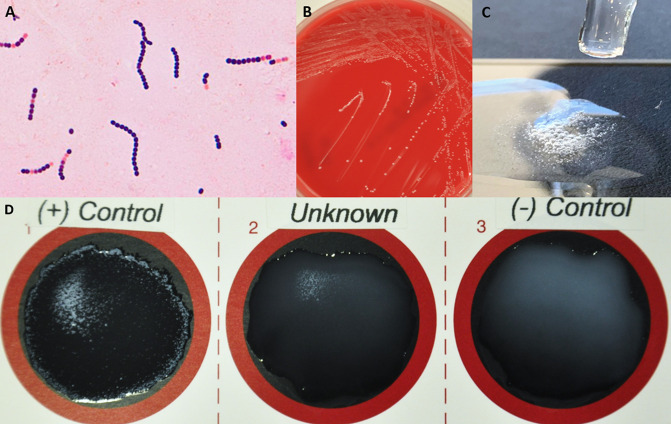 Fig 1
Fig 1Peer Reviews
No public reviews on file for this paper yet. If you reviewed it on a platform where reviews are public (OpenReview, ICLR, NeurIPS, ICML), you can paste yours below so the community can read it here.
Videos
No videos yet. Explain this paper in a talk, walkthrough, or lecture? Add one.
Taxonomy
TopicsBlood groups and transfusion · Bacterial Identification and Susceptibility Testing · Immunodeficiency and Autoimmune Disorders
PHOTO QUIZ
A 55-year-old patient with a past medical history of diabetes, hypertension, and chronic kidney disease presents with malaise and fever for approximately 1 week. On physical examination, he was found to have a painful lower extremity, and non-healing ulcer present for approximately a month. The ulcer is 3.0 cm in diameter and ulcerated with a hyperemic border. He has two dogs and a pet fish. No significant travel or vocational history is noted. Blood cultures are collected and submitted to the microbiology laboratory. Growth was detected in the aerobic and anaerobic blood culture bottles after 16-hour incubation. A representative Gram stain of the blood cultures is pictured (Fig. 1A). Subcultured colonies were visible on the sheep blood agar (Fig. 1B: 48-hour incubation); there was no growth on MacConkey agar. Bubbles formed when the colony was exposed to hydrogen peroxide (Fig. 1C). Latex agglutination testing with the Lancefield group B reagent produced a weak reaction showing fine clumping (Fig. 1D). The VEREGENE System (Luminex) Gram-positive panel was negative. What is the diagnosis?
Gram stain of the blood culture bottle (A); colonies on sheep blood agar after 48-hour incubation (B); reaction when the colony was exposed to hydrogen peroxide (C); latex agglutination testing with the Lancefield group B reagent showing positive control, unknown patient specimen, and negative control (D).