A Survey of Demographics and Treatments in Melanoma Case Reports: Retrospective Bibliometric Analysis
Ross O'Hagan, Jessie Ngandjui, Benjamin Ungar, Jonathan Ungar, Nicholas Gulati

Abstract
Melanoma case reports show variations in treatment by age and sex.
Genes, proteins, chemicals, diseases, species, mutations and cell lines named across the full text — each resolved to its canonical identifier and authoritative record.
Click any figure to enlarge with its caption.
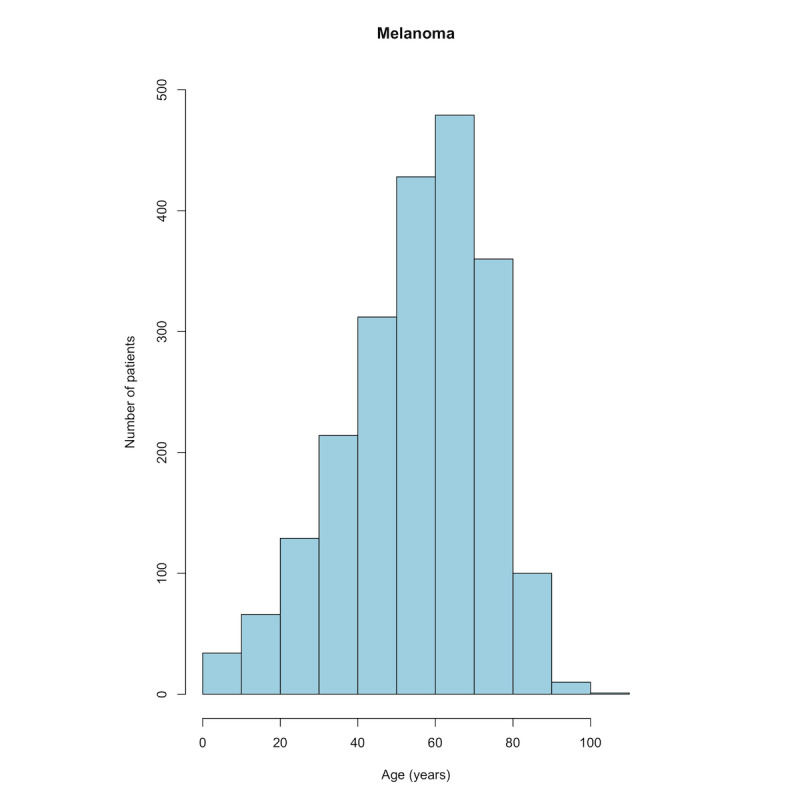 Figure 1
| Mentions | Case report, n (%) | |||
|
| ||||
|
|
| |||
|
|
| Included | 693 (32.5) | |
|
|
| Not included | 1440 (67.5) | |
|
|
| |||
|
|
| Included | 156 (7.3) | |
|
|
| Not included | 1977 (92.7) | |
|
|
| |||
|
|
| Included | 613 (28.7) | |
|
|
| Not included | 1520 (71.3) | |
|
|
| |||
|
|
| Included | 597 (28) | |
|
|
| Not included | 1536 (72) | |
|
| ||||
|
| Dacarbazine | 102 (4.8) | ||
|
| Cisplatin | 88 (4.1) | ||
|
| Paclitaxel | 62 (2.9) | ||
|
| Temozolomide | 61 (2.9) | ||
|
| Carboplatin | 61 (2.9) | ||
|
| Nab-paclitaxel | 6 (0.3) | ||
|
| ||||
|
| Ipilimumab | 341 (16) | ||
|
| Nivolumab | 272 (12.8) | ||
|
| Pembrolizumab | 182 (8.5) | ||
|
| Atezolizumab | 7 (0.3) | ||
|
| T-VECa | 7 (0.3) | ||
|
| Relatlimab | 1 (0.05) | ||
Peer Reviews
No public reviews on file for this paper yet. If you reviewed it on a platform where reviews are public (OpenReview, ICLR, NeurIPS, ICML), you can paste yours below so the community can read it here.
Videos
No videos yet. Explain this paper in a talk, walkthrough, or lecture? Add one.
Taxonomy
TopicsCutaneous Melanoma Detection and Management · Skin Protection and Aging · Animal testing and alternatives
Introduction
Case reports provide valuable insights into clinical practices. However, dermatological case reports are not perfect, with some diseases being overreported and others having sex imbalances relative to patient populations [1]. Melanoma is a skin cancer that has differences in outcomes based on patient demographics [2,3]; thus, it is important to understand the treatments reported in case reports and their demographic variations. Therefore, we assessed the demographics represented in melanoma case reports, the various treatment modalities listed, and how treatments vary by demographics.
Methods
To explore the demographics of patients in PubMed-listed case reports, we used techniques previously described [1,4]. Patients with melanoma and their treatment regimens were determined via string match. Included patients had the text “melanoma” listed in their case report summary. Each treatment modality was included in the analysis if its name was found in the case report summary. Age and sex information was listed in the PMC-Patients database. Differences in treatment by sex and mean age were determined by calculating odds ratios (ORs). Analysis was performed using R (version 4.2.2; R Foundation for Statistical Computing).
Results
Of the 167,034 patients listed in the PMC-Patients database, 2133 (1.3%) had case reports that mentioned “melanoma.” The mean age of patients with melanoma was 55.4 (SD 18.3) years (Figure 1), and 1173 (55%) of the 2133 patients were male.
Age histogram of patients with melanoma.
Of the 2133 patients, the most mentioned treatment modality was surgery (n=693, 32.5% patients). The least frequently mentioned modality of treatment was radiation therapy (n=156, 7.3% patients; Table 1). Of the chemotherapies mentioned, the most common was dacarbazine (n=102, 4.8% patients). Of the immunotherapies mentioned, the most common was ipilimumab (n=341, 16% patients; Table 1).
Female patients were significantly more likely to receive surgery than male patients (OR 1.27, 95% CI 1.06-1.53; P=.009), and male patients were significantly more likely to receive immunotherapy (OR 1.34, 95% CI 1.10-1.62; P=.003). There were no significant differences by sex for receiving radiation therapy (P=.84) or chemotherapy (P=.49). Those older than the median age of 58 years were more likely to receive immunotherapy (OR 1.94, 95% CI 1.60-2.35; P<.001). There were no significant differences by age for surgery (P=.11), radiation therapy (P=.09), or chemotherapy (P=.42).
Discussion
This study explores the demographics represented in melanoma case reports, their treatments, and how treatments vary by demographics. The most common treatment modality was surgery, and the least common treatment modality was radiation therapy. There were significant differences in treatment modalities between sexes, with more male patients receiving immunotherapy and more female patients receiving surgery. Finally, older patients were more likely to receive immunotherapy. Previous work has highlighted the increased stage of melanoma at diagnosis in male patients [3]. Thus, it is plausible that some variations in treatment could be secondary to staging differences. Previous work looking at patients with metastatic melanoma from 2011 to 2015 found that older patients were less likely to receive immunotherapy, despite its greater survival benefit [5]. These differences may stem from practice changes or publication bias. If treatment variations were found to be present in clinical practice, such variations in management by sex could lead to suboptimal patient care and outcomes. Our study was limited in that the use of string-matched case report information may have missed some treatments. Additionally, the PMC-Patients database did not include information on race and ethnicity. Our study highlights the need for more research on treatment variations by demographics in melanoma cases.
The reference list from the paper itself. Each links out to its DOI / PubMed record.
- 1O'Hagan R Caldas SA Brunner PM Ungar BA survey of patient demographics in inflammatory skin disease case reports JMIR Dermatol 202309256 e 49070 10.2196/4907037747769 v 6i 1e 4907037747769 PMC 10562968 · doi ↗ · pubmed ↗
- 2Cortez JL Vasquez J Wei ML The impact of demographics, socioeconomics, and health care access on melanoma outcomes J Am Acad Dermatol 2021068461677168310.1016/j.jaad.2020.07.12532783908 S 0190-9622(20)32405-132783908 · doi ↗ · pubmed ↗
- 3Schwartz MR Luo L Berwick M Sex differences in melanoma Curr Epidemiol Rep 2019063162112118 10.1007/s 40471-019-00192-73285590032855900 PMC 7449145 · doi ↗ · pubmed ↗
- 4Zhao Z Jin Q Chen F Peng T Yu SPMC-Patients: a large-scale dataset of patient summaries and relations for benchmarking retrieval-based clinical decision support systemsar Xiv. Preprint posted online on February 28, 202210.48550/ar Xiv.2202.13876 · doi ↗
- 5Jain V Hwang W Venigalla S Nead KT Lukens JN Mitchell TC Shabason JE Association of age with efficacy of immunotherapy in metastatic melanoma Oncologist 202002252 e 381e 385 10.1634/theoncologist.2019-03773204376532043765 PMC 7011618 · doi ↗ · pubmed ↗