A case of dystrophic epidermolysis bullosa with a rare COL7A1 variant
Patrícia Amoedo, Ana Grangeia, Lígia Peralta, Alberto Mota

Abstract
Genes, proteins, chemicals, diseases, species, mutations and cell lines named across the full text — each resolved to its canonical identifier and authoritative record.
Click any figure to enlarge with its caption.
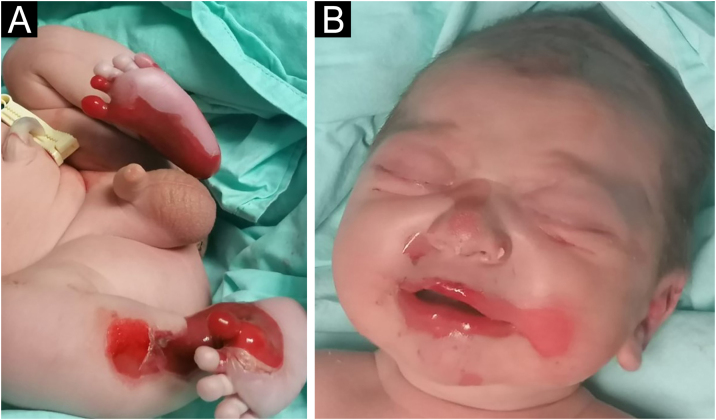 Figure 1
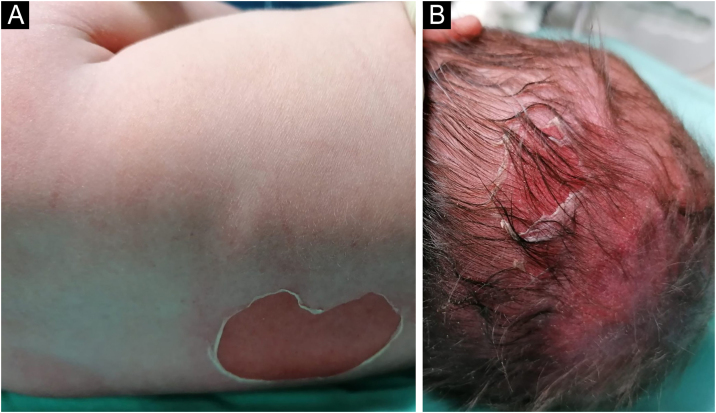 Figure 2
Peer Reviews
No public reviews on file for this paper yet. If you reviewed it on a platform where reviews are public (OpenReview, ICLR, NeurIPS, ICML), you can paste yours below so the community can read it here.
Videos
No videos yet. Explain this paper in a talk, walkthrough, or lecture? Add one.
Taxonomy
TopicsSkin and Cellular Biology Research · Cell Adhesion Molecules Research · Cellular Mechanics and Interactions
Dear Editor,
A full-term male infant was born with bullae and several eroded areas, mainly in the feet and the face, but also affecting the trunk, scalp, and perineal region (Figure 1, Figure 2). He also presented corneal opacity in the right eye with hypervascularization and hemorrhage. Nails, hair, and mucosae were normal. The patient was the first child of a healthy, non-consanguineous couple with no family history of blistering skin diseases. A 22 gene panel performed by Next-Generation Sequencing (NGS) found a pathogenic variant, c.325_326insCG (p.Glu109Alafs*39), in homozygosity in the COL7A1 gene. In the first months of life, the condition worsened with new lesions on the hands and armpits and mutilating scarring of the feet. Unfortunately, parents declined further studies. Based on clinical presentation and genetic analysis, a diagnosis of Severe Recessive Dystrophic Epidermolysis Bullosa was made.Figure 1. Extensive areas of skin detachment on the anteromedial aspects of both lower extremities (A) and perioral region (B).Figure 1. Figure 2Blistering and skin detachment at trunk (A) and scalp (B).Figure 2
Dystrophic Epidermolysis Bullosa (DEB) is an inherited skin fragility disorder, characterized by blister formation in the sublamina densa. It is caused by pathogenic variants in the COL7A1 gene, that encodes type VII collagen, responsible for a cohesive dermal-epidermal junction. The inheritance pattern could be Recessive (RDEB) or Dominant (DDEB).1, 2 The clinical spectrum is highly variable, from generalized blistering forms, with mucous involvement, to mild localized ones, and, in general, recessive forms are more severe.2 The latter is usually associated with variants causing Premature Stop Codons (PTC), with subsequent decay or truncated polypeptides. In heterozygosity, PTC variants do not cause disease, but compound heterozygosity with missense variants could be associated with milder forms of RDEB. DDEB is generally caused by glycine substitutions, but other mutations could be involved. Glycine substitutions could also be inherited recessively, and some specific substitutions were even associated with both RDEB and DDEB.1, 2, 3
The severity of symptoms depends on the level of COL7A1 expression, which is determined by the type and position of the pathogenic variant.1, 2, 3 However, genotype-phenotype correlation is not consistent and identical variants could result in different phenotypes, which suggests that other factors, genetic or environmental, may be involved in this phenotype divergence.1, 4
The variant presented in our patient is rare, with less than 10 cases previously reported. Interestingly, this variant was only reported in northern parts of Portugal and Brazil, which could be due to a founding effect, related to the former Portuguese settlement.1
The present case contributes to the mutational spectrum associated with RDEB and to a better understanding of its clinical correlation.
Financial support
None declared.
Authors’ contributions
Patrícia Amoedo: Writing and editing (lead).
Ana Grangeia: Review (support).
Lígia Peralta: Review (support).
Alberto Mota: Review and final approval.
Conflicts of interest
None declared.
The reference list from the paper itself. Each links out to its DOI / PubMed record.
- 1Mariath L.M.Santin J.T.Frantz J.A.Doriqui M.J.R.Kiszewski A.E.Schuler-Faccini L.An overview of the genetic basis of epidermolysis bullosa in Brazil: discovery of novel and recurrent disease-causing variants Clin Genet 9620191891983100181710.1111/cge.13555 · doi ↗ · pubmed ↗
- 2Dang N.Murrell D.F.Mutation analysis and characterization of COL 7A 1 mutations in dystrophic epidermolysis bullosa Exp Dermatol 1720085535681855899310.1111/j.1600-0625.2008.00723.x · doi ↗ · pubmed ↗
- 3Mariath L.M.Santin J.T.Schuler-Faccini L.Kiszewski A.E.Inherited epidermolysis bullosa: update on the clinical and genetic aspects An Bras Dermatol 9520205515693273207210.1016/j.abd.2020.05.001PMC 7563003 · doi ↗ · pubmed ↗
- 4Knöpfel N.Noguera-Morel L.Hernández-Martin A.García-Martin A.García M.Mencía A.Identical COL 71A 1 heterozygous mutations resulting in different dystrophic epidermolysis bullosa phenotypes Pediatr Dermatol 352018 e 94e 982927204710.1111/pde.13367 · doi ↗ · pubmed ↗