Hypercapnia Induced by Pectus Excavatum and Cardiomegaly
Shota Shirotani, Yasuhiro Kano, Hiroyuki Tanaka

Abstract
Genes, proteins, chemicals, diseases, species, mutations and cell lines named across the full text — each resolved to its canonical identifier and authoritative record.
Click any figure to enlarge with its caption.
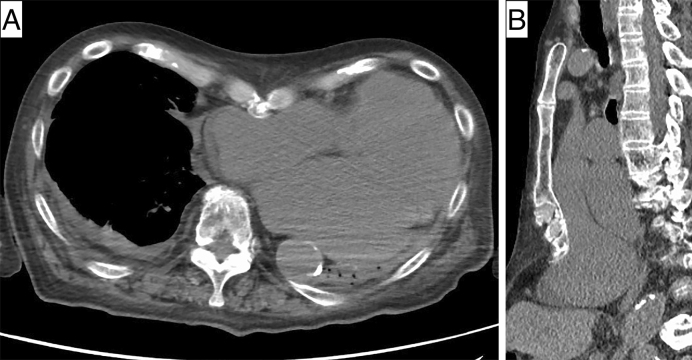 Figure 1
Peer Reviews
No public reviews on file for this paper yet. If you reviewed it on a platform where reviews are public (OpenReview, ICLR, NeurIPS, ICML), you can paste yours below so the community can read it here.
Videos
No videos yet. Explain this paper in a talk, walkthrough, or lecture? Add one.
Taxonomy
TopicsPectus Deformity Diagnosis and Treatment
An 89-year-old man was admitted with acute decompensated heart failure, which was possibly due to nonischemic cardiomyopathy. Upon admission, arterial blood gas analysis demonstrated acute hypercapnia with pH 7.17, PCO_2_ 91.9 mm Hg, and HCO_3_ 33.6 mmol/L. Transthoracic echocardiography revealed that the left ventricular, end-diastolic diameter had increased to 55 mm. Computed tomography demonstrated heart enlargement and its dislocation leftward by the pectus excavatum, causing almost complete occupancy of the left thoracic cavity by the heart and a disturbance in left lung expansion (Figure 1). His hypercapnia resolved with intravenous furosemide and noninvasive positive pressure ventilation along with cardiomegaly improvement. Hypercapnia caused by the lung expansion restriction by the pectus excavatum and cardiomegaly was finally diagnosed.
Pectus excavatum is a common deformation caused by depression of the anterior chest wall into the thoracic cavity. Although it is usually asymptomatic, severe cardiomegaly associated with this condition can decrease forced vital capacity by disrupting lung expansion ^(1), (2)^, potentially leading to a life-threatening hypercapnia.
Article Information
Conflicts of Interest
None
Acknowledgement
The authors thank Mr. James R. Valera for his assistance with editing this manuscript.
Author Contributions
Shota Shirotani, Yasuhiro Kano, and Hiroyuki Tanaka were involved in the conception or design of the work, drafting the work or reviewing it critically for important intellectual content, final approval of the version to be published, and agreement to be accountable for all aspects of the work in ensuring that questions related to the accuracy or integrity of any part of the work are appropriately investigated and resolved.
Informed Consent
Consent to publish the details of the present case was obtained from the patient.
The reference list from the paper itself. Each links out to its DOI / PubMed record.
- 1Agostoni P, Cattadori G, Guazzi M, et al. Cardiomegaly as a possible cause of lung dysfunction in patients with heart failure. Am Heart J. 2000;140(5):e 24.11054632 10.1067/mhj.2000.110282 · doi ↗ · pubmed ↗
- 2Redding GJ, Kuo W, Swanson JO, et al. Upper thoracic shape in children with pectus excavatum: impact on lung function. Pediatr Pulmonol. 2013;48(8):817-23.22912067 10.1002/ppul.22660 · doi ↗ · pubmed ↗