Visual scanning of social stimuli in preterm and autism spectrum disorder children
Vivian Renne Gerber Lederman, Ana Lucia Goulart, Juliana Gioia Negrão, José Salomão Schwartzman

TL;DR
This study compares how preterm, autistic, and neurotypical children visually explore social scenes, finding differences in where they focus their gaze.
Contribution
The study identifies distinct eye-gaze patterns in preterm and autistic children during social stimuli observation.
Findings
ASD children showed significant differences in object fixation time compared to others.
Preterm children fixated more on central social interactions than typical children.
All groups focused on the central social figure without significant differences.
Abstract
To evaluate the pattern of eye-gaze of preterm (PT), autism spectrum disorder (ASD) and neurotypical (Ty) children. A cross-sectional study with eight preterm (born with ≤2000 g weight), nine ASD and five Ty male children, between six and nine years old, was performed. The eye gaze was evaluated presenting a board with a couple in social interaction, and a video with four children playing with blocks, projected in a screen computer, successively, evaluating the time that the children looked at each stimulus. Although all the groups focus on the central social figure with no significant differences, ASD presented significant differences in time fixation of the objects (p=0.021), while premature children fixated more time in the central social interaction than in the whole scene than typical children. Although this study found noteworthy differences in the eye-gaze patterns among the…
Genes, proteins, chemicals, diseases, species, mutations and cell lines named across the full text — each resolved to its canonical identifier and authoritative record.
Click any figure to enlarge with its caption.
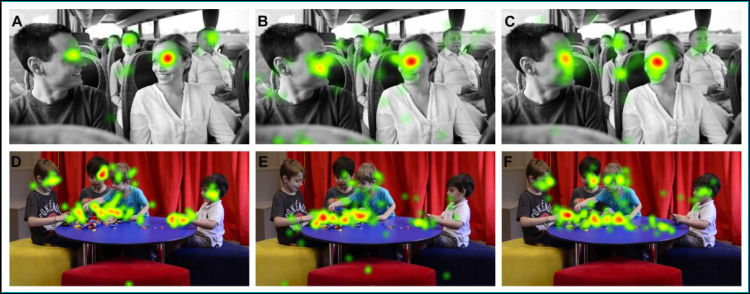 Figure 1
| Mean | Median | SD | n | 95%CI | p-value | |||||
|---|---|---|---|---|---|---|---|---|---|---|
| Figure 1 – A Couple on a bus | Women’s eyes | Typical | 0.73 | 0.67 | 0.54 | 5 | 0.48 | 0.918 | ||
| Premature | 0.69 | 0.66 | 0.45 | 10 | 0.28 | |||||
| ASD | 0.62 | 0.90 | 0.57 | 9 | 0.37 | |||||
| Man’s eyes | Typical | 0.52 | 0.62 | 0.35 | 5 | 0.31 | 0.021 | |||
| Premature | 0.55 | 0.45 | 0.51 | 10 | 0.32 | |||||
| ASD | 0.06 | 0.00 | 0.11 | 9 | 0.07 | |||||
| Bus background | Typical | 1.60 | 1.49 | 0.41 | 5 | 0.36 | 0.021 | |||
| Premature | 0.89 | 0.77 | 0.46 | 10 | 0.29 | |||||
| ASD | 1.31 | 1.44 | 0.46 | 9 | 0.30 | |||||
| Video – Children’s interaction | Child 4 | Typical | 0.47 | 0.38 | 0.31 | 5 | 0.27 | 0.042 | ||
| Premature | 0.18 | 0.04 | 0.25 | 10 | 0.15 | |||||
| ASD | 0.11 | 0.00 | 0.21 | 9 | 0.14 | |||||
| Blocks | Typical | 0.16 | 0.20 | 0.16 | 5 | 0.14 | 0.002 | |||
| Premature | 1.04 | 1.12 | 0.67 | 10 | 0.41 | |||||
| ASD | 1.96 | 2.04 | 1.12 | 9 | 0.73 | |||||
| Child 1 | Typical | 0.32 | 0.12 | 0.44 | 5 | 0.39 | 0.084 | |||
| Premature | 0.20 | 0.06 | 0.26 | 10 | 0.16 | |||||
| ASD | 0.00 | 0.00 | 0.00 | 9 | - x - | |||||
| Child 2 | Typical | 0.62 | 0.71 | 0.51 | 5 | 0.45 | 0.089 | |||
| Premature | 0.41 | 0.27 | 0.47 | 10 | 0.29 | |||||
| ASD | 0.12 | 0.00 | 0.20 | 9 | 0.13 | |||||
| Child 3 | Typical | 0.21 | 0.22 | 0.22 | 5 | 0.19 | 0.241 | |||
| Premature | 0.43 | 0.27 | 0.55 | 10 | 0.34 | |||||
| ASD | 0.13 | 0.16 | 0.13 | 9 | 0.09 | |||||
| Differences between groups | ||||||||||
| Typical-premature | Typical-ASD | Premature-ASD | ||||||||
|
| Man’s eyes | 0.991 | 0.089 | 0.024 | ||||||
| Bus background | 0.022 | 0.486 | 0.126 | |||||||
| Video - Children’s interaction | Child 4 | 0.095 | 0.038 | 0.821 | ||||||
| Blocks | 0.151 | 0.002 | 0.056 | |||||||
Peer Reviews
No public reviews on file for this paper yet. If you reviewed it on a platform where reviews are public (OpenReview, ICLR, NeurIPS, ICML), you can paste yours below so the community can read it here.
Videos
No videos yet. Explain this paper in a talk, walkthrough, or lecture? Add one.
Taxonomy
TopicsInfant Development and Preterm Care · Autism Spectrum Disorder Research · Family and Disability Support Research
INTRODUCTION
Neurotypical (TY) newborns (those whose neurological development follows the expected pattern for their age, without presenting significant neurological conditions or disorders) show visual preferences for social stimuli from the very first days of their lives.^ 1 ^ On the other hand, full-term children latter diagnosis as having autism spectrum disorder (ASD) show social figure eye gaze decline between two and six months of age, which does not occur in Ty term children. The lack of interest in social figures could be a sign of social impairment and may be identified from the first child life months through eye tracking. The eye tracking equipment records the visual scanning of the child and helps to determine how a child explore the ambience, providing important contributions to the comprehension of social gaze and social interactions.^ 2 ^
Few studies have analyzed premature children’s gaze patterns, although they are a well-known group of risk for several behavioral impairments.^ 3 ^ The first visual scanning studies with preterm (PT) babies were not conclusive as to whether they have a similar pattern of visual scanning as neurotypical children,^ 4 ^ or present impairments due to prematurity or signs of ASD.^ 5 ^
The present work hypothesizes that PT children may have a different pattern of eye-gaze from ASD and Ty groups, if evaluated later in development, and those patterns should be better understood.
METHOD
This brief report is an exploratory cross-sectional study that was conducted after approval by the ethics committees of Universidade Presbiteriana Mackenzie (protocol #2.886.398) and after all parents or guardians and children had signed a consent form. A convenience sample including eight PT with birth weight ≤2000 g, nine children with ASD diagnosis, according to DSM-5,^ 6 ^ and five Ty children, born at term and with no ASD diagnosis, was evaluated. The inclusion criteria were boys between six and nine years old and a minimum IQ>70, measured through Wechsler Abbreviated Scale Intelligence.^ 7 ^ The exclusion criteria were genetic syndrome and/or presence of a major motor, visual, or hearing impairment.
Visual scanning was evaluated with eye-tracking Tobii Pro Lab X3-120 (Tobiipro AB, Stockholm, Sweden). This equipment is able to monitor and record the eye gaze of a person in a screen, recording not only where the person is looking, but also what the pattern of the gaze and eye fixation time in the screen is. In this work, as stimuli, one board and one video were used, with 5 seconds of exposure each one (Figure 1). The board (Figure 1 A, B and C) showed a couple in social interaction on a bus, and the video (Figure 1 D, E and F) showed three children playing with blocks and a fourth child by the side. Only one session of one hour was performed in the presence of parents or guardians. All the participants were able to focus appropriately on the equipment, and the eye tracker was capable of tracking more than 70% of the scanning time. Time of fixation was elected as a parameter, following previous research.^ 4,5 ^ A single trained researcher extracted the data from the equipment. Only one session of one hour was performed in the presence of parents or guardians. The percentage of eye gaze of the infants on social first and second stimuli were compared using the Wilcoxon test and variance analysis (ANOVA), considering a significant difference, with p<0.05.
Eye-tracking results.
RESULTS
Social economics measures of the PT group were lower than Ty and ASD groups (p=0.20). Intelligence quotient (IQ) measures of the Ty group were superior to PT and ASD groups (p=0.05) (Table 1).
Regarding the eye-tracking on the board (Figure 1A, B and C), where the central social figure is a woman, and a second, lateral figure is a man, the three groups did not present significant differences in eye-gaze towards the central social stimulus (woman) (p=0.918), but there were significant differences towards the second social stimulus (man) (p=0.21). The man’s eyes were less scanned by ASD than PT (ASD 0.06 sec vs. PT 0.89 sec, p= 0.024) and tended to be less scanned by ASD than Ty (ASD 0.06 vs. Ty 0.52 sec, p=0.089). The PT and Ty groups did not show significant differences (p=0.991). Fixation time on the back of social interaction (bus) presented a significant difference of eye-gaze between the three groups (p=0,021), with the PT group presenting less fixation than Ty (0.89 sec vs. 1.60 sec, p=0,022). The PT group seemed to fix their attention on the social interaction, not screening the whole scene, while ASD seemed to gaze from the central social figure to non-social aspects.
In the video (Figure 1D, E and F), children 1, 2 and 3 (central social figure) played with blocks and child 4 did not participate in the social interaction. There were significant differences between the groups in the blocks’ fixation time (non-social stimulus) (p=0.02), ASD being superior to PT (p=0.056) and Ty (p= 0.02). Regarding the social stimuli (children faces), there was no significant difference among the three groups considering the fixation time on Child 3 (p=0.241), the central social figure. ASD did not present fixation time on Child 1, and Ty tended to fix more than PT (PT 0.20 sec vs. Ty 0.32 sec, p=0.084). This tendency could be also observed regarding Child 2 (ASD 0.12 sec vs. PT 0.41 sec vs. Ty 0.62, p=0.089). Although the central social figure seemed to have been scanned by the three groups, secondary social figures tended to be less gazed by PT and ASD groups. Eye-tracking of Child 4 showed significant differences between the groups (p=0.042). ASD time fixation was inferior than Ty (ASD 0.11 sec vs. Ty 0.47 sec, p=0.038) and PT fixation time was inferior to Ty group (PT 0.18 sec vs. Ty 0.47 sec, p=0.095).
DISCUSSION
Our preliminary eye-gaze study comparing ASD and premature children showed that although the groups appear to primarily focus on social figures with no significant differences when compared to Ty children, PT and ASD children tend to fixate less on secondary social stimuli. ASD showed gaze on objects present at the scene, while premature fixed their gaze on part of the social interaction, but eventually not on whole interaction as Ty children.
An adequate visual scan of a social situation is important to comprehend how to behave and give a suitable response.^ 8 ^ The lack of a complete visual scan of a social situation could lead to behavioral difficulties. Although few are the studies with eye-tracking of premature babies, they can perform visual scanning from six months of corrected age, being a helpful tool to elucidate ASD signs or neurodevelopmental delays.^ 4 ^ Premature babies present a differential pattern of eye-gaze in the first month of life,^ 9,10 ^ and our results highlight the possibility of maintenance of a differential pattern through childhood or even later in life. As limitations of this study, we include the small and convenient sample, as well as the lack of IQ and social economics matching among the groups. This study specifically focuses on children aged 6–8, and it’s possible that the findings may not generalize to other age groups. We conclude that differences in the pattern of eye-gaze between Ty, PT and ASD children can be present, and those differences should be investigated in additional research with a larger sample.
The reference list from the paper itself. Each links out to its DOI / PubMed record.
- 1Johnson MH Dziurawiec S Ellis H Morton J Newborns’ preferential tracking of face-like stimuli and its subsequent decline Cognition 19914011910.1016/0010-0277(91)90045-61786670 · doi ↗ · pubmed ↗
- 2Jones W Klin A Attention to eyes is present but in decline in 2-6-month-old infants later diagnosed with autism Nature 201350442743110.1038/nature 1271524196715 PMC 4035120 · doi ↗ · pubmed ↗
- 3Arpi E Ferrari F Preterm birth and behaviour problems in infants and preschool-age children: a review of the recent literature Dev Med Child Neurol 20135578879610.1111/dmcn.1214223521214 · doi ↗ · pubmed ↗
- 4Lederman VR Goulart AL Negrão JG Cunha DH Santos AM Schwartzman JS Visual scanning preferences in low birth weight preterm infants Trends Psychiatry Psychother 20194133433910.1590/2237-6089-2018-008331967194 · doi ↗ · pubmed ↗
- 5Sekigawa-Hosozawa M Tanaka K Shimizu T Nakano T Kitazawa S A group of very preterm children characterized by atypical gaze patterns Brain Dev 20173921822410.1016/j.braindev.2016.10.00127814930 · doi ↗ · pubmed ↗
- 6American Psychiatric Association Diagnostic and statistical manual of mental disorders 5th ed.Arlington American Psychiatric Association 2013
- 7Trentini CM Yates DB Heck VS WASI: Escala Wechsler abreviada de inteligência São Paulo Casa do Psicólogo 2014
- 8Gibson EJ Exploratory behavior in the development of perceiving, acting, and the acquiring of knowledge Ann Rev Psychol 19883914210.1146/annurev.ps.39.020188.000245 · doi ↗