Spectrum of Diagnoses in Female Patients With Proctologic Symptoms Presenting to the Surgery Unit of a Tertiary Care Center
Sana Sahar, Tamjeed Gul, Muhammad Ihtesham Khan

TL;DR
This study examines the most common proctologic symptoms and diseases in female patients at a tertiary care center, finding that anal fissures and hemorrhoids are the most prevalent conditions.
Contribution
The study provides a detailed analysis of proctologic diagnoses in female patients in a specific regional healthcare setting.
Findings
Bleeding per rectum was the most common proctologic symptom, affecting 68.2% of patients.
Anal fissures were the most common diagnosis, affecting 52.8% of patients.
Hemorrhoids were the second most common diagnosis, affecting 12% of patients.
Abstract
Introduction Anorectal diseases are prevalent in the general population and may vary from benign disorders to malignant lesions that can metastasize. There is a variety of proctologic symptoms associated with each disease. The incidence of proctologic disease varies in different cultures due to dietary habits and variations in lifestyle. The present study was conducted to determine the spectrum of different proctologic diseases in female patients presenting with proctologic symptoms. Methods This cross-sectional study was conducted in the Surgery Department of Mardan Medical Complex, Mardan, and Khyber Teaching Hospital, Peshawar, from January 2022 to January 2023. Female patients with proctologic symptoms were included, while non-consenting patients were excluded. After obtaining a detailed history and examination by the experienced surgeon, digital rectal examination and…
Genes, proteins, chemicals, diseases, species, mutations and cell lines named across the full text — each resolved to its canonical identifier and authoritative record.
Click any figure to enlarge with its caption.
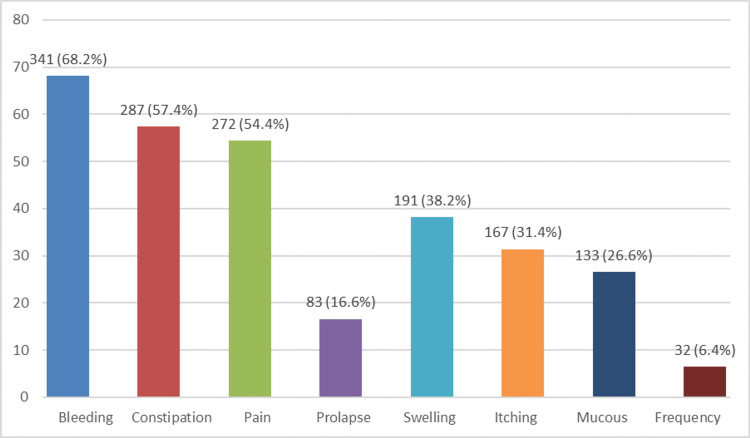 Figure 1
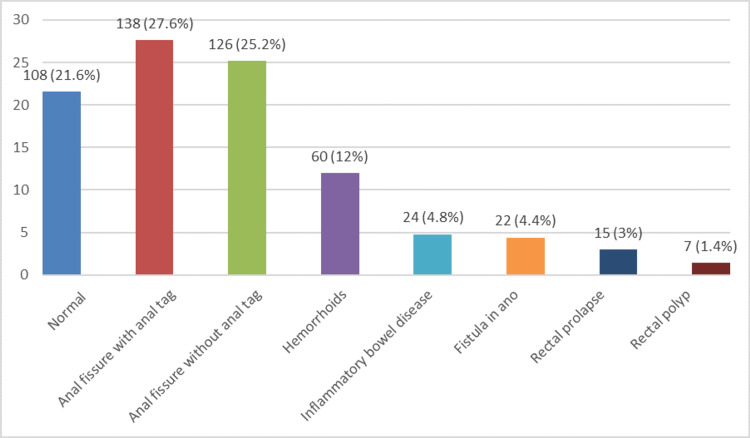 Figure 2
| Proctologic symptoms | Bleeding (N=500) | Constipation (N=500) | Pain (N=500) | Prolapse (N=500) | Swelling (N=500) | Itching (N=500) | Mucous (N=500) | Frequency of stool (N=500) | ||||||||
| Yes (number (%)) | No (number (%)) | Yes (number (%)) | No (number (%)) | Yes (number (%)) | No (number (%)) | Yes (number (%)) | No (number (%)) | Yes (number (%)) | No (number (%)) | Yes (number (%)) | No (number (%)) | Yes (number (%)) | No (number (%)) | Yes (number (%)) | No (number (%)) | |
| Diagnosis | ||||||||||||||||
| Anal fissure with tag | 127 (25.4%) | 11 (2.2%) | 114 (22.8%) | 24 (4.8%) | 135 (27%) | 3 (0.6%) | 2 (0.4%) | 136 (27.2%) | 138 (27.6%) | 0 (0%) | 54 (10.8%) | 84 (16.8%) | 42 (8.4%) | 96 (19.2%) | 1 (0.2%) | 137 (27.4%) |
| Anal fissure without tag | 117 (23.4%) | 9 (1.8%) | 91 (18.2%) | 35 (7%) | 124 (24.8%) | 2 (0.4%) | 3 (0.6%) | 123 (24.6%) | 1 (0.2%) | 125 (25%) | 26 (5.2%) | 100 (20%) | 24 (4.8%) | 102 (20.4%) | 0 (0%) | 126 (25.2%) |
| Hemorrhoid | 60 (12%) | 0 (0%) | 44 (8.8%) | 16 (3.2%) | 5 (1%) | 55 (11%) | 56 (11.2%) | 4 (0.8%) | 17 (3.4%) | 43 (8.6%) | 21 (4.2%) | 39 (7.8%) | 20 (4%) | 40 (8%) | 0 (0%) | 60 (12%) |
| IBD | 22 (4.4%) | 2 (0.4%) | 1 (0.2%) | 23 (4.6%) | 1 (0.2%) | 23 (4.6%) | 0 (0%) | 24 (4.8%) | 0 (0%) | 24 (4.8%) | 4 (0.8%) | 20 (4%) | 3 (0.6%) | 21 (4.2%) | 23 (4.6%) | 1 (0.2%) |
| Fistula in ano | 0 (0%) | 22 (4.4%) | 4 (0.8%) | 18 (3.6%) | 1 (0.2%) | 21 (4.2%) | 0 (0%) | 22 (4.4%) | 0 (0%) | 22 (4.4%) | 19 (3.8%) | 3 (0.6%) | 22 (4.4%) | 0 (0%) | 0 (0%) | 22 (4.4%) |
| Polyp | 7 (1.4%) | 0 (0%) | 0 (0%) | 7 (1.4%) | 1 (0.2%) | 6 (1.2%) | 7 (1.4%) | 0 (0%) | 1 (0.2%) | 6 (1.2%) | 1 (0.2%) | 6 (1.2%) | 1 (0.2%) | 6 (1.2%) | 0 (0%) | 7 (1.4%) |
| Rectal prolapse | 2 (0.4%) | 13 (2.6%) | 0 (0%) | 15 (3%) | 2 (0.4%) | 13 (2.6%) | 15 (3%) | 0 (0%) | 0 (0%) | 15 (3%) | 3 (0.6%) | 12 (2.4%) | 4 (0.8%) | 11 (2.2%) | 1 (0.2%) | 14 (2.8%) |
| Normal | 6 (1.2%) | 102 (20.4%) | 33 (6.6%) | 75 (15%) | 3 (0.6%) | 105 (21%) | 0 (0%) | 108 (21.6%) | 34 (6.8%) | 74 (14.8%) | 19 (3.8%) | 89 (17.8%) | 17 (3.4%) | 91 (18.2%) | 7 (1.4%) | 101 (20.2%) |
Peer Reviews
No public reviews on file for this paper yet. If you reviewed it on a platform where reviews are public (OpenReview, ICLR, NeurIPS, ICML), you can paste yours below so the community can read it here.
Videos
No videos yet. Explain this paper in a talk, walkthrough, or lecture? Add one.
Taxonomy
TopicsAnorectal Disease Treatments and Outcomes · Pelvic floor disorders treatments · Diverticular Disease and Complications
Introduction
Proctologic symptoms arise as a result of a wide range of diseases in the anorectal region. These may range from benign disorders of the anorectal region to malignant diseases that can metastasize to distant organs and tissues [1,2]. The diseases of the anorectal region present as proctologic symptoms such as bleeding in stool, painful defecation, and pain in the anal area [1].
Anorectal diseases are common worldwide. The commonest anorectal diseases presenting with proctologic symptoms are hemorrhoids, anal fissures, fecal incontinence, and anorectal abscess. In the United States, the prevalence of hemorrhoids is about 6%, and only one-third of these cases take clinical consultation [3]. The prevalence of hemorrhoids in the United Kingdom is much higher, i.e., 13%-35% [3]. The worldwide incidence of hemorrhoids is 4% [4].
To make a diagnosis of proctologic symptoms, a detailed clinical history is taken from the patient, and a digital rectal examination is performed [5]. In case of suspicion of malignancy, proctoscopy or sigmoidoscopy is performed to inspect the mucosal surface of the anorectal area. In case of mass, a specimen is taken and sent for histopathological evaluation. It is reported that 20% of cases presenting with proctologic symptoms have disease that needs surgical intervention [5].
Anorectal diseases are associated with significant morbidity. Unluckily, patients avoid reporting the symptoms, and the disease worsens with time [6,7]. With time, the underlying disease becomes chronic, and patients get complications [6]. This worsens the quality of life of patients. In complicated cases, making a diagnosis becomes a challenge [7].
To our knowledge, there is no study that determines the common proctologic diseases in the female population in this part of the world where social stigmatization and scarce healthcare facilities are a problem. The current study is conducted to determine common diagnoses of proctologic symptoms in female patients of the districts of Khyber Pakhtunkhwa.
Materials and methods
This observational cross-sectional study was conducted in the Department of Surgery at Mardan Medical Complex, Mardan, and Khyber Teaching Hospital, Peshawar, after obtaining approval from the institutional ethical review board. The study was conducted from January 2022 to January 2023, i.e., one-year duration. Female patients of all ages presenting with proctologic symptoms such as pain, bleeding, swelling, constipation, prolapse, itching, mucous discharge, and tenesmus were included in the study. Non-consenting patients were excluded from the study. Informed consent was obtained from the patients, and they were explained that their data will be kept confidential. A detailed history was taken from the patients. Examination was done by an experienced surgeon, and findings were noted on a proformas. Digital rectal examination and proctoscopy/sigmoidoscopy were performed where necessary. A biopsy specimen was taken from the gut and sent for confirmation of diagnoses by an experienced histopathologist where necessary. Blood samples were taken and sent for complete blood counts in cases suspicious of anemia and thyroid function tests in cases suspicious of hypothyroidism. Diagnoses were made, and data were analyzed using Statistical Package for the Social Sciences (SPSS) version 20.0 (IBM SPSS Statistics, Armonk, NY) using mean and standard deviation for quantitative variables and frequency and percentage for qualitative variables.
Results
The study was done on 500 female patients who complained of recurrent proctologic symptoms and did not receive any intervention previously. The mean age of the study sample was 38.35±16.305 years with an age range of 7-108 years. The proctologic symptoms and their diagnoses are depicted in Figure 1 and Figure 2, respectively. The diagnoses with respect to proctologic symptoms are shown in Table 1.
Proctologic symptoms in the study participantsData is presented as frequency (number) and percentage (%).
Diagnoses for proctologic symptoms in the study participants (N=500)Data is depicted as frequency (number) and percentages (%).
Figure 1 shows that out of 500 patients, 341 (68.2%) cases presented with bleeding per rectum, while constipation and pain per rectum were seen in 287 (57.4%) and 272 (54.4%) cases, respectively.
Figure 2 shows that out of 500 patients, 138 (27.6%) cases had a diagnosis of anal fissure with anal tags, while 126 (25.2%) patients presented with anal fissure without tags. Thus, the total number of patients presenting with anal fissures turned out to be 264 (52.8%), which constituted more than half of the patients. The next common diagnosis was hemorrhoids, which was seen in 60 (12%) cases.
Table 1 shows that the commonest symptoms in patients with anal fissure with tag were swelling, pain, and bleeding, which were seen in 138 (27.6%), 135 (27%), and 127 (25.4%) cases, respectively. Rectal prolapse was the commonest symptom of hemorrhoids, which was seen in 56 (11.2%) patients with hemorrhoids. Frequency of stool was the commonest symptom in inflammatory bowel disease, which was seen in 23 (4.6%) patients with inflammatory bowel disease.
Discussion
Anorectal diseases are common and affect about one-fourth of the general population [1]. Due to the increasing number of complicated cases related to proctologic diseases, there is currently an emerging field of colorectal surgery to meet the needs of the general population [8]. Unluckily, the incidence of proctologic disorders in females is not appropriately reported due to lack of research and lack of patient referral.
Anorectal diseases worsen the quality of life of patients. Patients are reluctant to consult surgeons, and the disease keeps lingering [6,7]. According to a report, about 80% of cases with proctologic symptoms do not consult their consultant [5]. This is commonly seen in conservative societies where anorectal diseases are considered a stigma and therefore kept a secret. This is true, especially in females. Delays in diagnosis and treatment cause the disease to become chronic and develop complications [6]. Diagnosing such complicated cases can be a diagnostic challenge prompting the adoption of a multidisciplinary approach involving a colorectal specialist, urologist, and gastroenterologist [7].
In the current study, it was observed that the patients were of middle age. Similar data was reported by Oumar et al. [9]. However, Mariko et al. [10] reported a comparatively younger age female population in their study [10].
In the current study, the commonest proctologic symptoms were bleeding, constipation, and pain. Abramowitz et al. [6] reported similar findings from France. In our study, when different diagnoses were considered, it was seen that anal fissures and hemorrhoids were the commonest diagnoses in the female population. A similar pattern of diagnosis was reported by Abramowitz et al. [6] from France and Yadav et al. [1] from Nepal. Mariko et al. [10] from Mali also reported anal fissures and hemorrhoids as the commonest entities in their population [10]. Similar data is reported from Central Africa, Dakar, and India [11-13]. Perveen et al. [5] from Karachi reported hemorrhoids as the commonest anorectal disease.
An anal fissure is characterized by superficial injury or tear in the mucocutaneous junction of the anal canal [9]. Constipation is the risk factor for the development of anal fissures. The disease presents with severe pain during defecation. Due to straining, there appear tears in the fissure that cause the presence of blood in the stool [9]. According to research, the lifetime risk of having anal fissure in any individual is 7% [9]. The condition is common in the female population, especially in pregnant females [9].
Hemorrhoid is another anorectal disease characterized by abnormal dilatation of submucous veins in the anal canal that bleed on straining while defecating. In chronic untreated hemorrhoids, the bleeding can be so profuse that patients develop anemia. Recently, it has been reported that untreated hemorrhoids are associated with a higher risk of colorectal adenomas [14].
The limitation of the current study was that the study was conducted in only two tertiary care centers. Therefore, the result may not represent the general population. We recommend that bigger studies should be done including patients from multiple healthcare centers so that bigger data is generated that can truly represent the whole population.
Conclusions
Bleeding per rectum is the commonest proctologic symptom in patients. Anal fissures and hemorrhoids are the commonest proctologic diseases in females in the province of Khyber Pakhtunkhwa and should be considered in the differential diagnosis of patients presenting with proctologic symptoms. Bleeding per rectum and hemorrhoids in the female population cause loss of blood, which in turn will aggravate the clinical picture of underlying anemia, and the disease will present with complications, thus adding to disease morbidity. Early referral for prompt diagnosis and treatment of these disease entities is recommended to prevent disease complications.
The reference list from the paper itself. Each links out to its DOI / PubMed record.
- 1The prevalence of anorectal disorders among residents of Kirtipur Municipality in Nepal Int J Collab Res Internal Med Public Health R.A.Yadav S.Shrestha J.Shrestha A.M.Joshi 111132021
- 2Sociodemographic and clinical profile of patients with anorectal diseases in a tertiary care hospital of North India: a cross sectional observational study J Coast Life Med Gupta S Garg A Bhagat Tripta S 537543102022
- 3Benign anorectal disease: hemorrhoids, fissures, and fistulas Ann Gastroenterol Gardner IH Siddharthan RV Tsikitis VL 9183320203189279210.20524/aog.2019.0438 PMC 6928486 · doi ↗ · pubmed ↗
- 4Laser hemorrhoidoplasty versus conventional hemorrhoidectomy for grade II/III hemorrhoids: a systematic review and meta-analysis Ann Coloproctol Wee IJ Koo CH Seow-En I Ng YY Lin W Tan EJ 3103920233659357310.3393/ac.2022.00598.0085 PMC 10009065 · doi ↗ · pubmed ↗
- 5Prevalence of benign anorectal diseases: a huge burden on society Isra Med J Perveen S Magsi AM Malik M Waheed A Anwar K Iqbal M 1216142022
- 6The prevalence of proctological symptoms amongst patients who see general practitioners in France Eur J Gen Pract Abramowitz L Benabderrahmane M Pospait D Philip J Laouénan C 3013062020142470204110.3109/13814788.2014.899578 PMC 4438346 · doi ↗ · pubmed ↗
- 7Proctalgia syndromes: update in diagnosis and management Curr Gastroenterol Rep Carrington EV Popa SL Chiarioni G 352220203251908710.1007/s 11894-020-00768-0 · doi ↗ · pubmed ↗
- 8Grand challenges in colorectal and proctological surgery Front Surg Gallo G Goglia M 13318771020233818638510.3389/fsurg.2023.1331877 PMC 10766734 · doi ↗ · pubmed ↗