The association between single-nucleotide polymorphisms within type 1 interferon pathway genes and human immunodeficiency virus type 1 viral load in antiretroviral-naïve participants
Sara Bohnstedt Mørup, Preston Leung, Cavan Reilly, Brad T. Sherman, Weizhong Chang, Maja Milojevic, Ana Milinkovic, Angelike Liappis, Line Borgwardt, Kathy Petoumenos, Roger Paredes, Shweta S. Mistry, Cameron R. MacPherson, Jens Lundgren, Marie Helleberg, Joanne Reekie

TL;DR
This study investigates how genetic variations in the type 1 interferon pathway may influence HIV viral load in people who have not yet started antiretroviral treatment.
Contribution
The study identifies a potential association between a specific SNP in the IFNW1 gene and higher HIV viral load in early-stage patients, though this link is not robust to population structure adjustments.
Findings
A borderline significant association was found between IFNW1 and HIV-1 viral load in early-stage patients.
The association was only observed among African participants and not in the FIRST cohort.
The SNP rs79876898 in IFNW1 was linked to higher viral load, but this was not significant after adjusting for population structure.
Abstract
Human genetic contribution to HIV progression remains inadequately explained. The type 1 interferon (IFN) pathway is important for host control of HIV and variation in type 1 IFN genes may contribute to disease progression. This study assessed the impact of variations at the gene and pathway level of type 1 IFN on HIV-1 viral load (VL). Two cohorts of antiretroviral (ART) naïve participants living with HIV (PLWH) with either early (START) or advanced infection (FIRST) were analysed separately. Type 1 IFN genes (n = 17) and receptor subunits (IFNAR1, IFNAR2) were examined for both cumulated type 1 IFN pathway analysis and individual gene analysis. SKAT-O was applied to detect associations between the genotype and HIV-1 study entry viral load (log10 transformed) as a proxy for set point VL; P-values were corrected using Bonferroni (P < 0.0025). The analyses among those with early…
Genes, proteins, chemicals, diseases, species, mutations and cell lines named across the full text — each resolved to its canonical identifier and authoritative record.
Click any figure to enlarge with its caption.
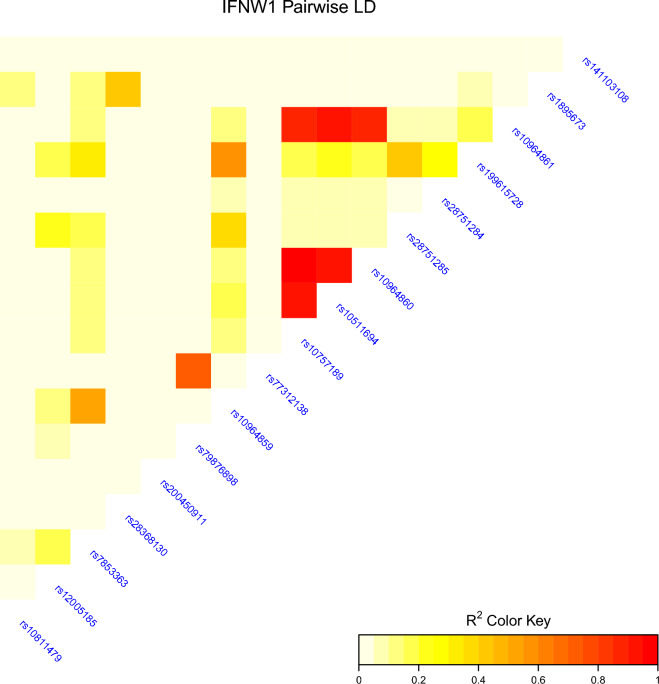 Figure 1
Peer Reviews
No public reviews on file for this paper yet. If you reviewed it on a platform where reviews are public (OpenReview, ICLR, NeurIPS, ICML), you can paste yours below so the community can read it here.
Videos
No videos yet. Explain this paper in a talk, walkthrough, or lecture? Add one.
Taxonomy
TopicsHIV Research and Treatment · HIV/AIDS drug development and treatment · Immune Cell Function and Interaction