Effect of video angle on detection of induced front limb lameness in horses
Alessandro P. Valle, Kara A. Brown, Patrick Reilly, Sarah A. Ciamillo, Elizabeth J. Davidson, Darko Stefanovski, Holly L. Stewart, Kyla F. Ortved

TL;DR
This study finds that the angle of a video recording affects how well horse lameness can be detected, with some angles providing more reliable assessments than others.
Contribution
The study identifies optimal video angles for detecting front limb lameness in horses using subjective and objective lameness assessments.
Findings
A video angle of the horse trotting directly towards the camera provides the best interobserver agreement for lameness assessment.
Objective lameness parameters strongly correlate with subjective scores (AUC of ROC = 0.87).
Some angles, like video angle 5, show perfect agreement for assessing sound horses.
Abstract
Lameness examinations are commonly performed in equine medicine. Advancements in digital technology have increased the use of video recordings for lameness assessment, however, standardization of ideal video angle is not available yielding videos of poor diagnostic quality. The objective of this study was to evaluate the effect of video angle on the subjective assessment of front limb lameness. A randomized, blinded, crossover study was performed. Six horses with and without mechanically induced forelimb solar pain were recorded using 9 video angles including horses trotting directly away and towards the video camera, horses trotting away and towards a video camera placed to the left and right side of midline, and horses trotting in a circle with the video camera placed on the inside and outside of the circle. Videos were randomized and assessed by three expert equine veterinarians…
Genes, proteins, chemicals, diseases, species, mutations and cell lines named across the full text — each resolved to its canonical identifier and authoritative record.
Click any figure to enlarge with its caption.
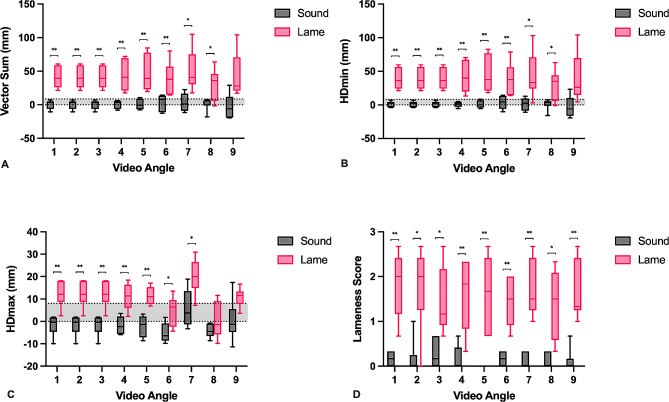 Figure 1
 Figure 2
Peer Reviews
No public reviews on file for this paper yet. If you reviewed it on a platform where reviews are public (OpenReview, ICLR, NeurIPS, ICML), you can paste yours below so the community can read it here.
Videos
No videos yet. Explain this paper in a talk, walkthrough, or lecture? Add one.
Taxonomy
TopicsVeterinary Equine Medical Research · Animal Behavior and Welfare Studies · Veterinary Pharmacology and Anesthesia