Neuroanatomical correlates of distracted straight driving performance: a driving simulator MRI study across the lifespan
Dylan X. Guan, Nathan W. Churchill, Corinne E. Fischer, Simon J. Graham, Tom A. Schweizer

TL;DR
This study explores how brain structure relates to driving performance, especially when distracted, across different ages.
Contribution
The study identifies specific brain regions linked to distracted driving performance across the lifespan.
Findings
Greater volume and cortical thickness in the PPC and cerebellum are linked to better lane maintenance during distracted driving.
Cortical thickness in multiple brain regions correlates with speed and acceleration, often in an age-dependent manner.
Posterior brain regions are associated with lane maintenance, while anterior and posterior regions relate to speed and acceleration during distraction.
Abstract
Driving is the preferred mode of transportation for adults across the healthy age span. However, motor vehicle crashes are among the leading causes of injury and death, especially for older adults, and under distracted driving conditions. Understanding the neuroanatomical basis of driving may inform interventions that minimize crashes. This exploratory study examined the neuroanatomical correlates of undistracted and distracted simulated straight driving. One-hundred-and-thirty-eight participants (40.6% female) aged 17–85 years old (mean and SD = 58.1 ± 19.9 years) performed a simulated driving task involving straight driving and turns at intersections in a city environment using a steering wheel and foot pedals. During some straight driving segments, participants responded to auditory questions to simulate distracted driving. Anatomical T1-weighted MRI was used to quantify grey matter…
Genes, proteins, chemicals, diseases, species, mutations and cell lines named across the full text — each resolved to its canonical identifier and authoritative record.
Click any figure to enlarge with its caption.
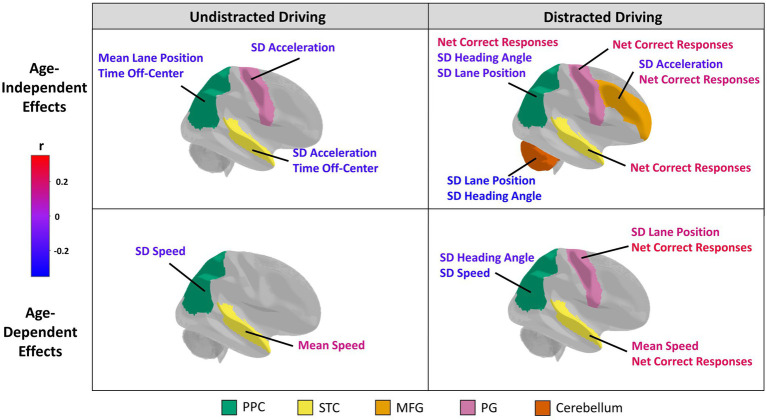 Figure 1
Peer Reviews
No public reviews on file for this paper yet. If you reviewed it on a platform where reviews are public (OpenReview, ICLR, NeurIPS, ICML), you can paste yours below so the community can read it here.
Videos
No videos yet. Explain this paper in a talk, walkthrough, or lecture? Add one.
Taxonomy
TopicsOlder Adults Driving Studies · Human-Automation Interaction and Safety · Insurance, Mortality, Demography, Risk Management