Perceptions and behaviors of healthcare providers towards rehabilitation support to children with severe malaria-related disability in Ethiopia: A qualitative descriptive study using the Theoretical Domains Framework
Eshetu Haileselassie Engeda, Heather M. Aldersey, Colleen M. Davison, Kassahun Alemu Gelaye, Nora Fayed, Taofiki Ajao Sunmonu, Edison Arwanire Mworozi, Edison Arwanire Mworozi

TL;DR
This study explores how healthcare providers in Ethiopia perceive and behave regarding rehabilitation for children with severe malaria-related disabilities.
Contribution
The study introduces a novel application of the Theoretical Domains Framework to analyze healthcare providers' perceptions and behaviors in malaria-related disability rehabilitation.
Findings
Nine theoretical domains influencing healthcare providers' perceptions and behaviors were identified.
Healthcare providers showed less positive beliefs about their roles in disability screening and referral.
Interventions are needed to improve provider behavior in both acute and post-acute phases of care.
Abstract
Severe malaria often results in childhood disability. The prevalence of disability related to severe malaria is significant and is estimated to affect up to 53% of severe malaria survivors. In contrast, information is sparse about how healthcare providers in Africa think about or provide rehabilitation support in acute and post-acute phases respectively. Understanding the perceptions and behaviors of healthcare providers treating malaria could help inform malaria-related disability research, policy, and practice, aimed at the providers themselves. This study explored the perceptions and behaviors of healthcare providers towards rehabilitation for children with severe malaria-related disability. The Theoretical Domains Framework was used to describe the findings relative to wider literature on health provider behavior change. A qualitative descriptive approach was used to interview…
Genes, proteins, chemicals, diseases, species, mutations and cell lines named across the full text — each resolved to its canonical identifier and authoritative record.
Click any figure to enlarge with its caption.
 Figure 1
 Figure 2
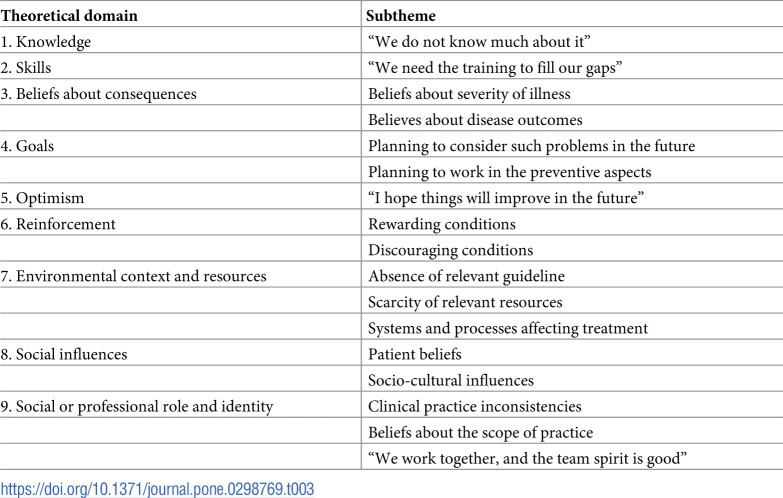 Figure 3
Peer Reviews
No public reviews on file for this paper yet. If you reviewed it on a platform where reviews are public (OpenReview, ICLR, NeurIPS, ICML), you can paste yours below so the community can read it here.
Videos
No videos yet. Explain this paper in a talk, walkthrough, or lecture? Add one.
Taxonomy
TopicsGlobal Maternal and Child Health · Malaria Research and Control · Mosquito-borne diseases and control