The long-term outcomes of patients with negative prolonged ambulatory electroencephalography tests: A cross-sectional follow-up study
Sumika Ouchida, Armin Nikpour, Xin Zhang, Howard Faulkner, Maricar Senturias, Nicole Reid, Eleanor Stephens, Greg Fairbrother, Enrica Bonanni, Sumika Ouchida, Radhakrishnan Delhibabu, Sumika Ouchida

TL;DR
This study found that nearly half of patients with initially negative AEEG tests were later diagnosed with epilepsy, highlighting the importance of clinical evaluation alongside AEEG.
Contribution
The study reveals that a negative AEEG result does not rule out epilepsy, emphasizing the need for continued clinical assessment.
Findings
45% of participants with negative AEEG tests were later diagnosed with epilepsy after 12 years.
Factors like seizure history and medication use were linked to an epilepsy diagnosis.
Quality of life was associated with age, employment, and seizure experience, but not with an epilepsy diagnosis.
Abstract
Ambulatory electroencephalography (AEEG) recording is an essential aid for detecting interictal discharges and providing a clinical diagnosis. This study aimed to describe long-term outcomes among a cohort of patients who yielded negative results on AEEG at the time of assessment and identify factors associated with contemporary quality of life (QOL) and ultimate epilepsy diagnosis. This cross-sectional telephone follow-up study was conducted in June-November 2021 at the Neurology Department in a metropolitan hospital in Sydney, Australia. In total, 47 of 105 eligible (45%) participants were enrolled. Overall, 21 (45%) participants had been diagnosed with epilepsy at a 12-year follow-up. Taking anti-seizure medication, having experienced a seizure event, and having marriage and education-related characteristics were associated with an epilepsy diagnosis. QOL was found to be associated…
Genes, proteins, chemicals, diseases, species, mutations and cell lines named across the full text — each resolved to its canonical identifier and authoritative record.
Click any figure to enlarge with its caption.
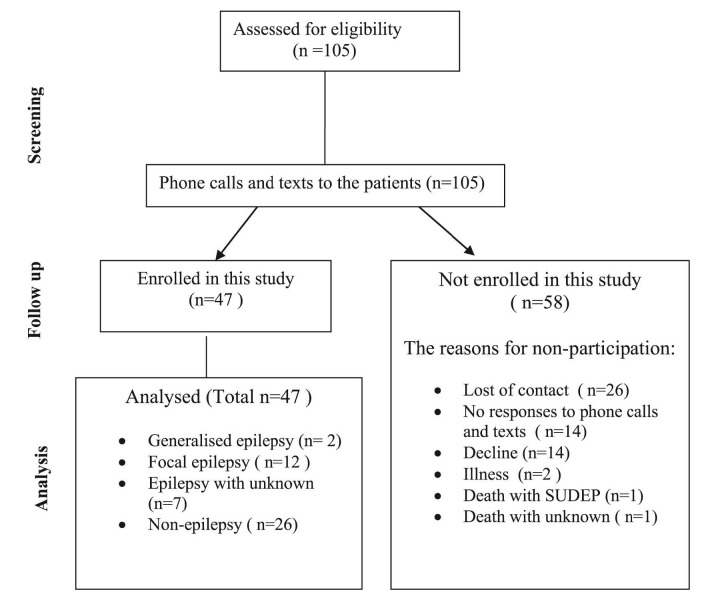 Figure 1
Peer Reviews
No public reviews on file for this paper yet. If you reviewed it on a platform where reviews are public (OpenReview, ICLR, NeurIPS, ICML), you can paste yours below so the community can read it here.
Videos
No videos yet. Explain this paper in a talk, walkthrough, or lecture? Add one.
Taxonomy
TopicsEpilepsy research and treatment · Pharmacological Effects and Toxicity Studies · Neonatal and fetal brain pathology