Continuous Bump Attractor Networks Require Explicit Error Coding for Gain Recalibration
Gorkem Secer, James J. Knierim, Noah J. Cowan

TL;DR
This paper shows that continuous bump attractor networks need explicit error coding to recalibrate their integration gain for accurate continuous variable representation.
Contribution
The paper introduces a modified ring attractor model with error-rate coding and Hebbian plasticity to achieve gain recalibration in continuous bump attractor networks.
Findings
Gain recalibration in CBANs requires an explicit error signal encoded via a rate code.
Combining error-rate coding with Hebbian plasticity enables accurate integration gain recalibration.
Existing CBAN models lack mechanisms for gain recalibration, which this study addresses.
Abstract
Representations of continuous variables are crucial to create internal models of the external world. A prevailing model of how the brain maintains these representations is given by continuous bump attractor networks (CBANs) in a broad range of brain functions across different areas, such as spatial navigation in hippocampal/entorhinal circuits and working memory in prefrontal cortex. Through recurrent connections, a CBAN maintains a persistent activity bump, whose peak location can vary along a neural space, corresponding to different values of a continuous variable. To track the value of a continuous variable changing over time, a CBAN updates the location of its activity bump based on inputs that encode the changes in the continuous variable (e.g., movement velocity in the case of spatial navigation)—a process akin to mathematical integration. This integration process is not perfect…
Genes, proteins, chemicals, diseases, species, mutations and cell lines named across the full text — each resolved to its canonical identifier and authoritative record.
Click any figure to enlarge with its caption.
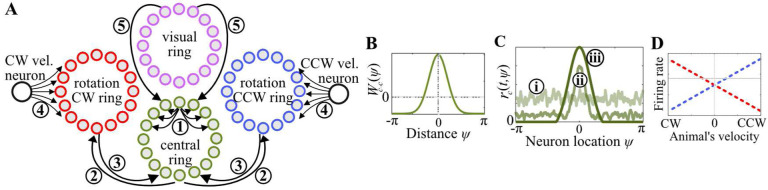 Figure 1
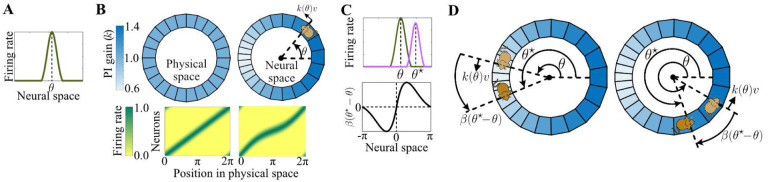 Figure 2
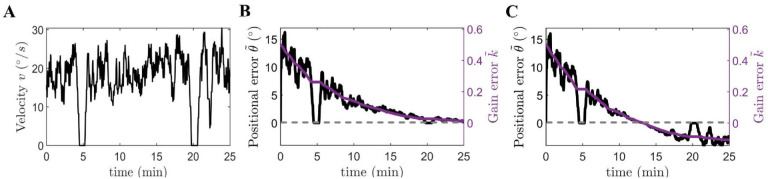 Figure 3
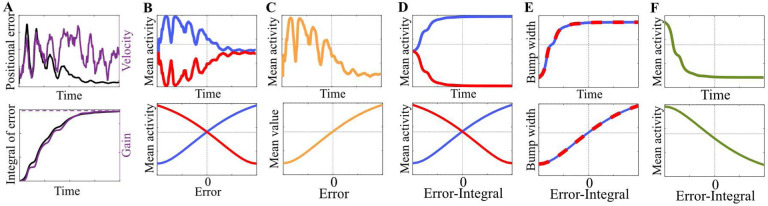 Figure 4
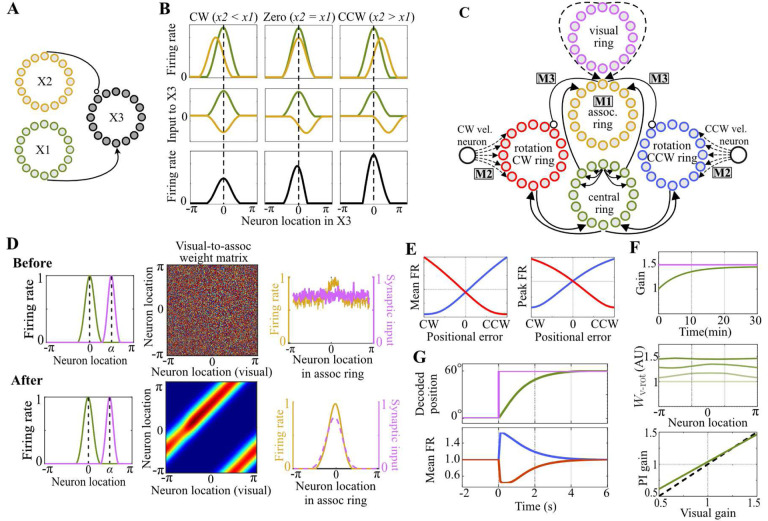 Figure 5
 Figure 6
 Figure 7
 Figure 8
Peer Reviews
No public reviews on file for this paper yet. If you reviewed it on a platform where reviews are public (OpenReview, ICLR, NeurIPS, ICML), you can paste yours below so the community can read it here.
Videos
No videos yet. Explain this paper in a talk, walkthrough, or lecture? Add one.
Taxonomy
TopicsPhotoreceptor and optogenetics research · Neuroscience and Neural Engineering · Neural dynamics and brain function