Homeostasis of cytoplasmic crowding by cell wall fluidization and ribosomal counterions
Markus Basan, Avik Mukherjee, Yanqing Huang, Seungeun Oh, Carlos Sanchez, Yu-Fang Chang, Xili Liu, Gary Bradshaw, Nina Benites, Johan Paulsson, Marc Kirschner, Yongjin Sung, Jens Elgeti

TL;DR
Cells maintain cytoplasmic balance by adjusting turgor pressure through ribosomal RNA counterions, coordinating cell wall expansion and biomass density.
Contribution
A novel mechanism linking ribosomal RNA counterions to turgor pressure control, coordinating cell wall expansion and biomass homeostasis.
Findings
Turgor pressure increases with growth rate in E. coli, yet biomass density remains constant.
Mathematical modeling shows cell wall fluidization explains turgor and biomass density coordination.
Ribosomal RNA counterions directly control turgor pressure, linking cytoplasmic and cell wall processes.
Abstract
In bacteria, algae, fungi, and plant cells, the wall must expand in concert with cytoplasmic biomass production, otherwise cells would experience toxic molecular crowding1,2 or lyse. But how cells achieve expansion of this complex biomaterial in coordination with biosynthesis of macromolecules in the cytoplasm remains unexplained3, although recent works have revealed that these processes are indeed coupled4,5. Here, we report a striking increase of turgor pressure with growth rate in E. coli, suggesting that the speed of cell wall expansion is controlled via turgor. Remarkably, despite this increase in turgor pressure, cellular biomass density remains constant across a wide range of growth rates. By contrast, perturbations of turgor pressure that deviate from this scaling directly alter biomass density. A mathematical model based on cell wall fluidization by cell wall endopeptidases not…
Genes, proteins, chemicals, diseases, species, mutations and cell lines named across the full text — each resolved to its canonical identifier and authoritative record.
Click any figure to enlarge with its caption.
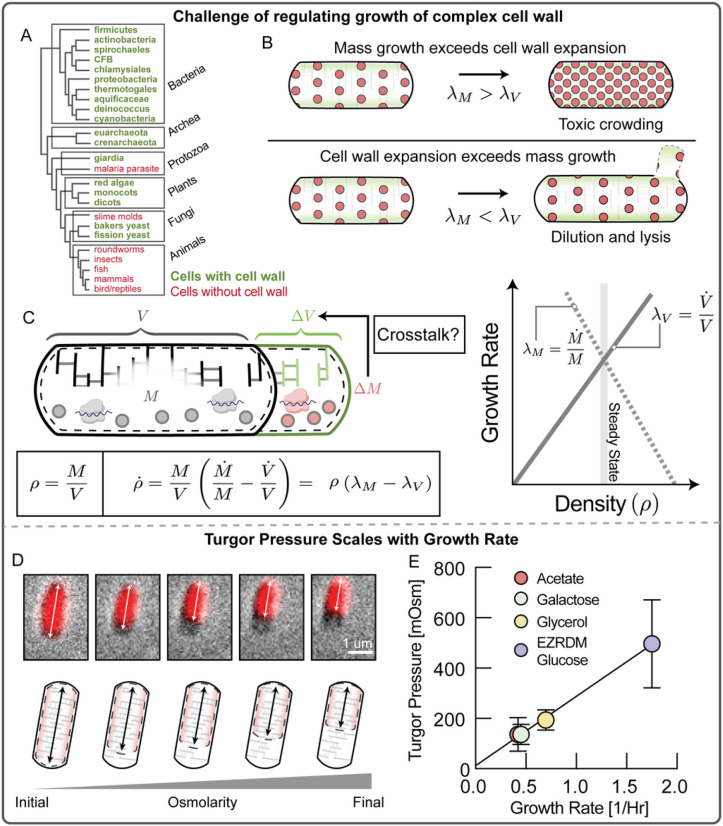 Figure 1
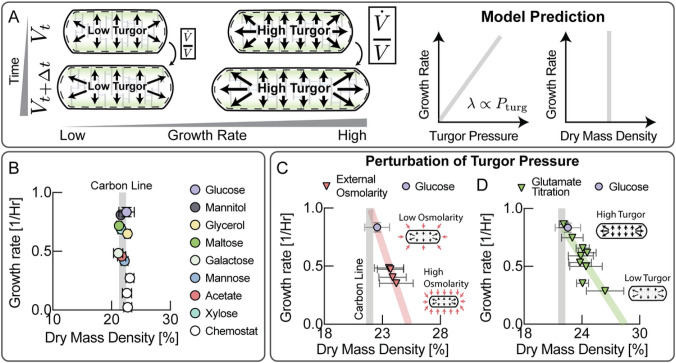 Figure 2
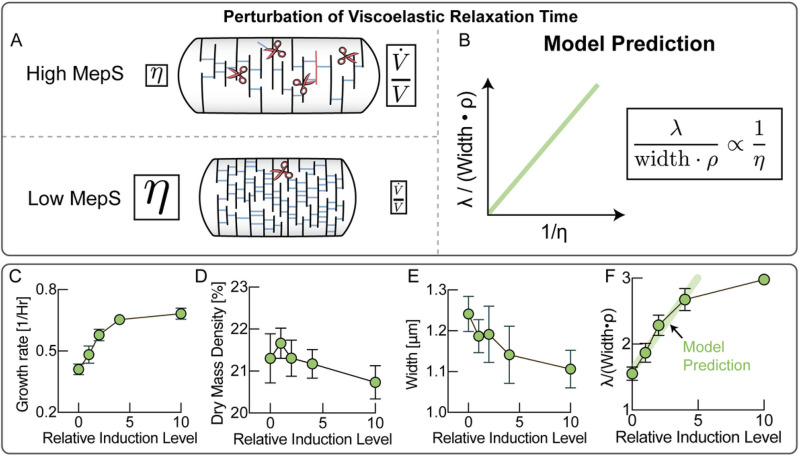 Figure 3
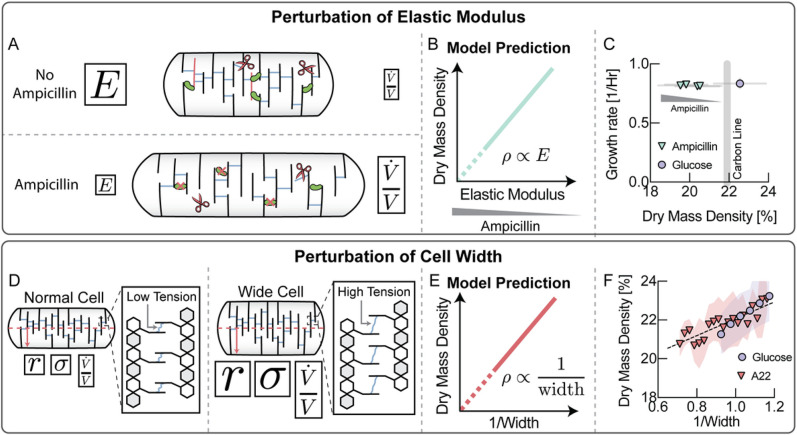 Figure 4
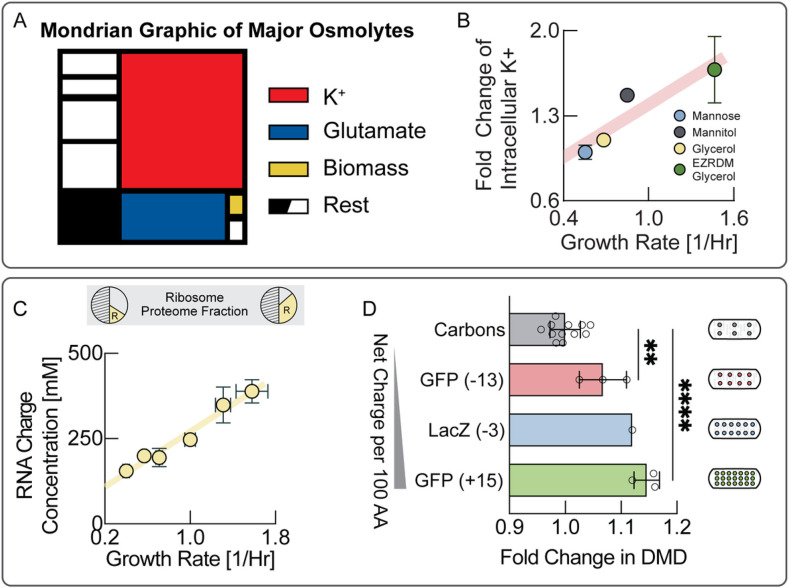 Figure 5
Peer Reviews
No public reviews on file for this paper yet. If you reviewed it on a platform where reviews are public (OpenReview, ICLR, NeurIPS, ICML), you can paste yours below so the community can read it here.
Videos
No videos yet. Explain this paper in a talk, walkthrough, or lecture? Add one.
Taxonomy
TopicsBacterial Genetics and Biotechnology · Fungal and yeast genetics research · Photosynthetic Processes and Mechanisms