Predictive value of the inconsistency between the residual and post-PCI QFR for prognosis in PCI patients
Lihua Chen, Jiaxin Zhong, Ruijin Hong, Yuxiang Chen, Beilei Li, Laicheng Wang, Yuanming Yan, Lianglong Chen, Qin Chen, Yukun Luo

TL;DR
This study shows that when the actual improvement in blood flow after heart stent placement is less than expected, patients face a higher risk of future heart issues.
Contribution
The study introduces ΔQFR as a novel metric to assess PCI outcomes and identifies it as a predictor of long-term prognosis.
Findings
The underanticipated ΔQFR group had significantly higher target vessel failure (TVF) rates than the consistent group.
A ΔQFR ≤ −0.1 was identified as an independent risk factor for TVF.
Nonlinear relationship between ΔQFR and TVF risk was observed using restricted cubic spline regression.
Abstract
To investigate the prognostic value of the consistency between the residual quantitative flow ratio (QFR) and postpercutaneous coronary intervention (PCI) QFR in patients undergoing revascularization. This was a single-center, retrospective, observational study. All enrolled patients were divided into five groups according to the ΔQFR (defined as the value of the post-PCI QFR minus the residual QFR): (1) Overanticipated group; (2) Slightly overanticipated group; (3) Consistent group; (4) Slightly underanticipated group; and (5) Underanticipated group. The primary outcome was the 5-year target vessel failure (TVF). A total of 1373 patients were included in the final analysis. The pre-PCI QFR and post-PCI QFR were significantly different among the five groups. TVF within 5 years occurred in 189 patients in all the groups. The incidence of TVF was significantly greater in the…
Genes, proteins, chemicals, diseases, species, mutations and cell lines named across the full text — each resolved to its canonical identifier and authoritative record.
Click any figure to enlarge with its caption.
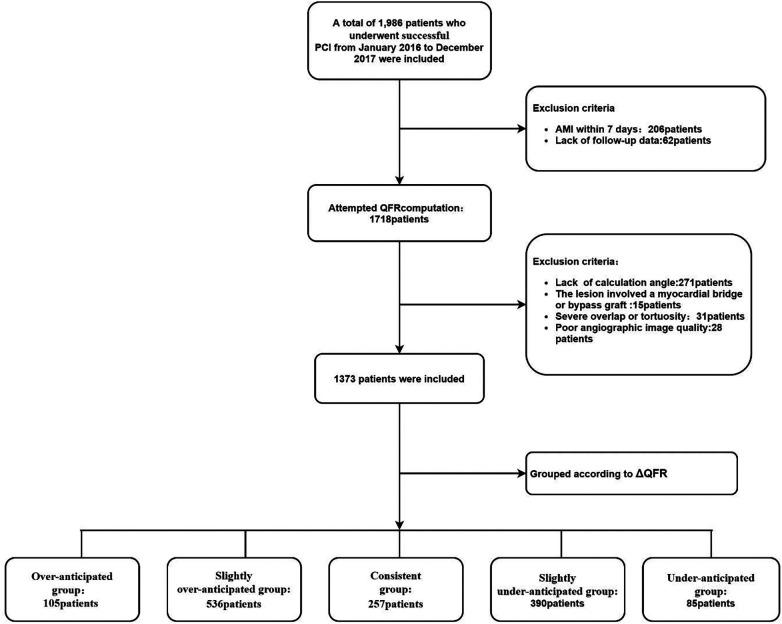 Figure 1
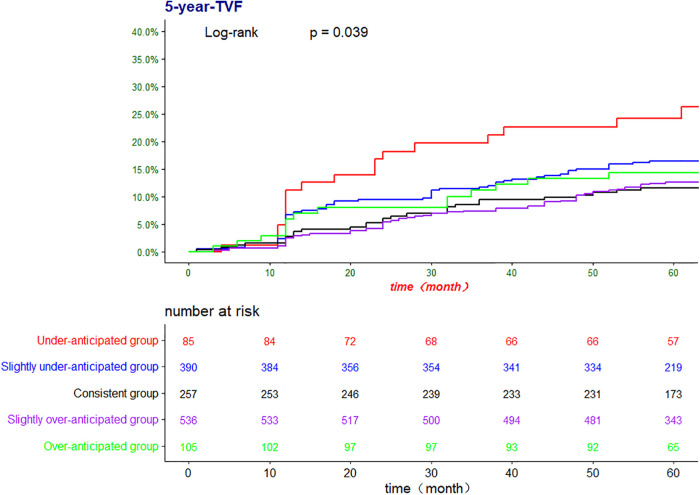 Figure 2
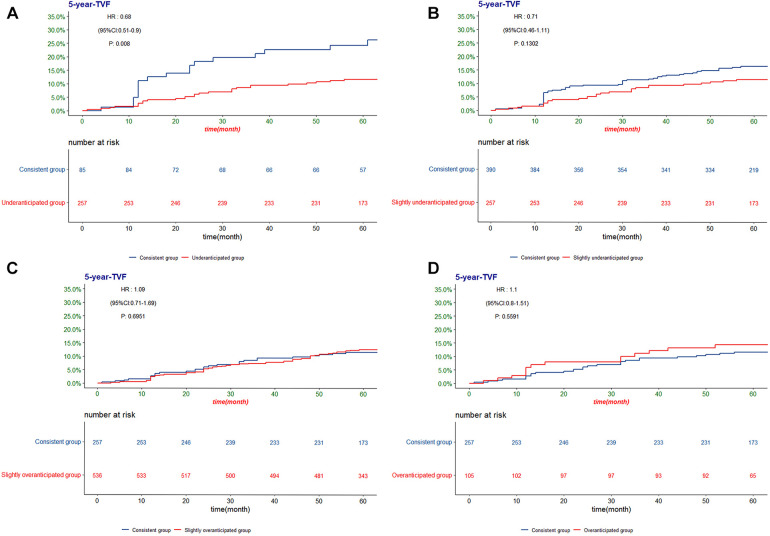 Figure 3
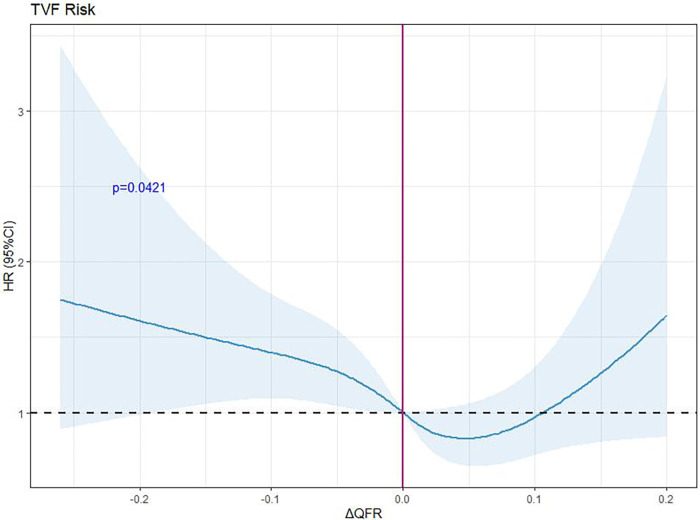 Figure 4
Peer Reviews
No public reviews on file for this paper yet. If you reviewed it on a platform where reviews are public (OpenReview, ICLR, NeurIPS, ICML), you can paste yours below so the community can read it here.
Videos
No videos yet. Explain this paper in a talk, walkthrough, or lecture? Add one.
Taxonomy
TopicsCoronary Interventions and Diagnostics · Cardiac Imaging and Diagnostics · Cardiac, Anesthesia and Surgical Outcomes