Zinc metabolism and its role in immunity status in subjects with trisomy 21: chromosomal dosage effect
Giuseppe Ramacieri, Chiara Locatelli, Michela Semprini, Maria Chiara Pelleri, Maria Caracausi, Allison Piovesan, Michela Cicilloni, Marco Vigna, Lorenza Vitale, Giacomo Sperti, Luigi Tommaso Corvaglia, Gian Luca Pirazzoli, Pierluigi Strippoli, Francesca Catapano, Beatrice Vione

TL;DR
This study explores how zinc levels are lower in people with Down syndrome and how this might affect their immune system.
Contribution
The study confirms a chromosomal dosage effect on zinc levels and suggests zinc's role in immune cell function rather than cell count.
Findings
Blood zinc levels in trisomy 21 subjects are lower than in the general population with a 2:3 T21/control ratio.
Transcriptome analysis shows altered gene expression that may explain reduced zinc levels in trisomy 21.
Zinc levels are not directly linked to immune cell counts but may affect immune cell function.
Abstract
Trisomy 21 (T21), which causes Down syndrome (DS), is the most common chromosomal aneuploidy in humankind and includes different clinical comorbidities, among which the alteration of the immune system has a heavy impact on patient’s lives. A molecule with an important role in immune response is zinc and it is known that its concentration is significantly lower in children with T21. Different hypotheses were made about this metabolic alteration and one of the reasons might be the overexpression of superoxide dismutase 1 (SOD1) gene, as zinc is part of the SOD1 active enzymatic center. The aim of our work is to explore if there is a linear correlation between zinc level and immune cell levels measured in a total of 217 blood samples from subjects with T21. Furthermore, transcriptome map analyses were performed using Transcriptome Mapper (TRAM) software to investigate whether a difference…
Genes, proteins, chemicals, diseases, species, mutations and cell lines named across the full text — each resolved to its canonical identifier and authoritative record.
Click any figure to enlarge with its caption.
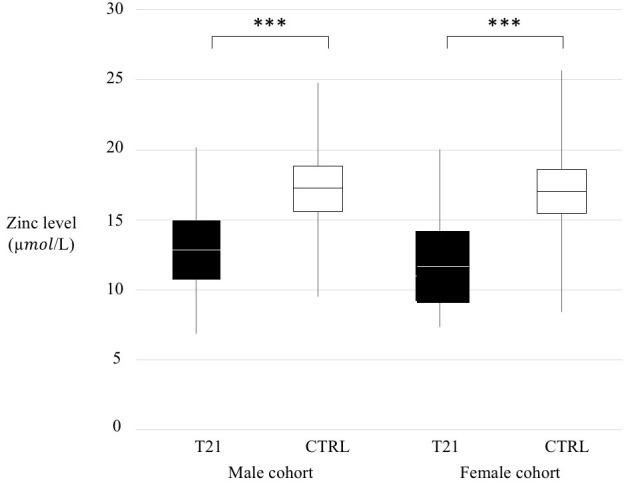 Figure 1
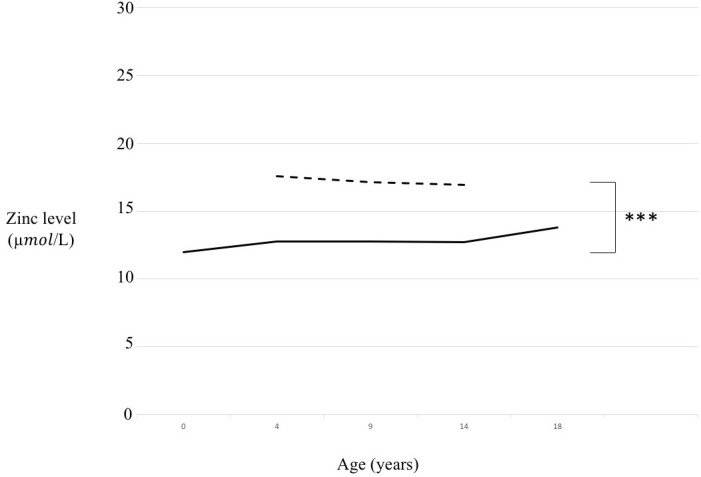 Figure 2
Peer Reviews
No public reviews on file for this paper yet. If you reviewed it on a platform where reviews are public (OpenReview, ICLR, NeurIPS, ICML), you can paste yours below so the community can read it here.
Videos
No videos yet. Explain this paper in a talk, walkthrough, or lecture? Add one.
Taxonomy
TopicsTrace Elements in Health · Child Nutrition and Water Access · Aluminum toxicity and tolerance in plants and animals