A role for nNOS in mediating stress and female sexual behavior in mice
Konstantina Chachlaki

TL;DR
The study explores how early-life stress affects adult female mouse sexual behavior through a brain protein called nNOS.
Contribution
The paper identifies nNOS-mediated NO release in the hypothalamus as a novel link between early stress and adult sexual behavior in mice.
Findings
nNOS activity in the ventromedial hypothalamus is crucial for stress effects on female sexual behavior.
Pre-pubertal stress influences adult sexual receptivity via nNOS-promoted NO release.
This mechanism may explain how early stress impacts reproductive outcomes in mice.
Abstract
Developmental stress can detrimentally affect adult female reproductive behavior, influencing sexual receptivity and fertility. Recent work has demonstrated neuronal nitric oxide (NO) synthase (nNOS)-promoted NO release in the ventromedial hypothalamus as a nexus between pre-pubertal stress and adult sexual behavior in mice.
Genes, proteins, chemicals, diseases, species, mutations and cell lines named across the full text — each resolved to its canonical identifier and authoritative record.
Click any figure to enlarge with its caption.
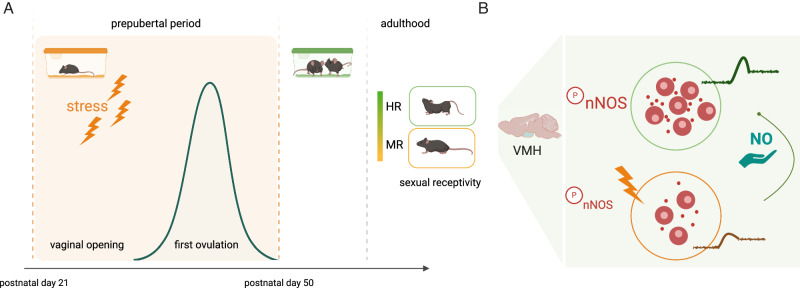 Figure 1
Peer Reviews
No public reviews on file for this paper yet. If you reviewed it on a platform where reviews are public (OpenReview, ICLR, NeurIPS, ICML), you can paste yours below so the community can read it here.
Videos
No videos yet. Explain this paper in a talk, walkthrough, or lecture? Add one.
Taxonomy
TopicsNeuroendocrine regulation and behavior · Stress Responses and Cortisol · Hypothalamic control of reproductive hormones