Healing condition of WATCHMAN surface 2.5 years after implantation observed in cardiac surgery
Masamichi Yano, Yasuyuki Egami, Haruhiko Kondoh, Masami Nishino

Abstract
Genes, proteins, chemicals, diseases, species, mutations and cell lines named across the full text — each resolved to its canonical identifier and authoritative record.
Click any figure to enlarge with its caption.
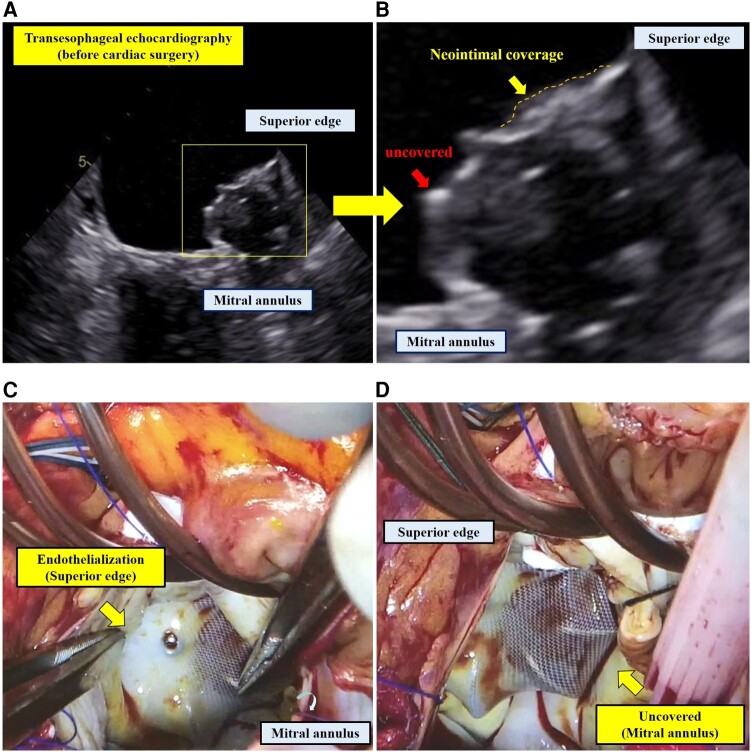 Figure 1
Peer Reviews
No public reviews on file for this paper yet. If you reviewed it on a platform where reviews are public (OpenReview, ICLR, NeurIPS, ICML), you can paste yours below so the community can read it here.
Videos
No videos yet. Explain this paper in a talk, walkthrough, or lecture? Add one.
Taxonomy
TopicsAtrial Fibrillation Management and Outcomes · Cardiac Valve Diseases and Treatments · Cardiac Arrhythmias and Treatments
A 74-year-old female with paroxysmal atrial fibrillation underwent successful left atrial (LA) appendage closure (LAAC) using a 27 mm WATCHMAN device (Boston Scientific, Marlborough, MA, USA), chosen based on a maximal ostial diameter of 22.0 mm measured by transoesophageal echocardiography (TEE) (see Supplementary material online, Supplementary Video S1). She was prescribed a combination of aspirin and rivaroxaban for 45 days post-LAAC, followed by dual antiplatelet therapy with aspirin and clopidogrel for six months. Aspirin monotherapy commenced thereafter. At the 45-day follow-up, TEE revealed no evidence of thrombus formation or peri-device leakage; however, endothelialization of the device surface was indeterminate (see Supplementary material online, Supplementary Videos S2 and S3). Concurrently, mitral regurgitation progressed to a severe condition and surgical intervention was considered. Two months prior to surgery, TEE indicated partial endothelial coverage at the device’s superior edge but not on the mitral annulus side (Figure 1A and B and Supplementary material online, Video S1). Mitral valve repair was electively performed 934 days post-LAAC. Intraoperative findings showed white and reddish-brown tissue enveloping the superior edge of the device, with the mitral annulus side remaining exposed (Figure 1C and D and Supplementary material online, Video S2). Post-operatively, warfarin was administered for three months, with aspirin reintroduced thereafter. A computed tomography at 10 months post-surgery displayed contrast enhancement within the left atrial appendage, suggesting incomplete device endothelialization (see Supplementary material online, Figure S1). The endothelialization timeline for WATCHMAN device is not fully understood, with various reports depicting the state of endothelialization post-deployment.^1–3^ Our case exhibited delayed endothelialization, persisting 2.5 years following device.
Supplementary Material
ytae198_Supplementary_Data
The reference list from the paper itself. Each links out to its DOI / PubMed record.
- 1Sick PB , Schuler G, Hauptmann KE, Grube E, Yakubov S, Turi ZG, et al Initial worldwide experience with the WATCHMAN left atrial appendage system for stroke prevention in atrial fibrillation. J Am Coll Cardiol 2007;49:1490–1495.17397680 10.1016/j.jacc.2007.02.035 · doi ↗ · pubmed ↗
- 2Schwartz RS , Holmes DR, Van Tassel RA, Hauser R, Henry TD, Mooney M, et al Left atrial appendage obliteration: mechanisms of healing and intracardiac integration. JACC Cardiovasc interv 2010;3:870–877.20723861 10.1016/j.jcin.2010.04.017 · doi ↗ · pubmed ↗
- 3Sharma SP , Singh D, Nakamura D, Gopinathannair R, Lakkireddy D. Incomplete endothelialization of Watchman™ device: predictors and implications from two cases. J Atr Fibrillation. 2019; 11:2162.31139304 10.4022/jafib.2162 PMC 6533822 · doi ↗ · pubmed ↗