Analysis of the uterine artery pulsatility index on the day of endometrial transformation and pregnancy outcomes of patients undergoing frozen–thawed embryo transfer
Li Li, Mingze Du, Sheling Wu, Caiyuzhu Wen, Pingping Kong, Junwei Zhang, Yichun Guan

TL;DR
This study found that the uterine artery pulsatility index on the day of endometrial transformation does not predict pregnancy outcomes in frozen–thawed embryo transfer patients.
Contribution
The study provides new evidence that the uterine artery PI is not a reliable predictor of clinical pregnancy in frozen–thawed embryo transfer cycles.
Findings
The mean PI was not an independent factor influencing clinical pregnancy rates.
There was no significant difference in mean PI between clinical and nonclinical pregnancy groups.
Key predictors of pregnancy outcomes included maternal age, AMH levels, embryo type, and number of embryos transferred.
Abstract
The objective was to analyze the impact of the uterine artery pulsatility index (PI) on pregnancy outcomes by measuring uterine artery blood flow on the day of endometrial transformation in patients undergoing frozen–thawed embryo transfer (FET). This was a case-control study. In total, 2,036 patients who underwent FET at the Third Affiliated Hospital of Zhengzhou University from October 2019 to September 2020 were included. The patients were divided into a clinical pregnancy group and a nonclinical pregnancy group according to pregnancy outcome. A multivariate logistic regression model was used to analyze the factors affecting the clinical pregnancy rate. The receiver operating characteristic (ROC) curve was used to determine the optimal mean PI cutoff value of 1.75. After 1:1 propensity score matching (PSM), 562 patients were included. For statistical description and analysis, the…
Genes, proteins, chemicals, diseases, species, mutations and cell lines named across the full text — each resolved to its canonical identifier and authoritative record.
Click any figure to enlarge with its caption.
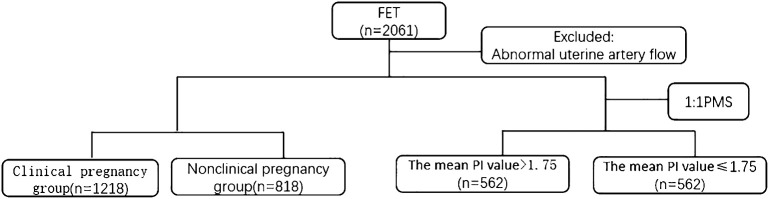 Figure 1
Peer Reviews
No public reviews on file for this paper yet. If you reviewed it on a platform where reviews are public (OpenReview, ICLR, NeurIPS, ICML), you can paste yours below so the community can read it here.
Videos
No videos yet. Explain this paper in a talk, walkthrough, or lecture? Add one.
Taxonomy
TopicsReproductive System and Pregnancy · Diverse Approaches in Healthcare and Education Studies · Gynecological conditions and treatments