Utility and Implementation of the Distress Thermometer for Cancer Patients: A Cross-Sectional Study From Saudi Arabia
Mohammed Alghamdi, Fadi Masharqa, Abdulrahman Alsultan, Sarah Sewaralthahab, Omar Abdelwahab, Sherif Mohamed, Nashwa Abd El-Aziz, Fahad D Alosaimi

TL;DR
This study assesses the usefulness of the Distress Thermometer in identifying distress among cancer patients in Saudi Arabia and suggests a workflow for better care.
Contribution
The study provides new evidence on the effectiveness of the Distress Thermometer in a Saudi Arabian context and proposes a practical workflow for distress screening.
Findings
22% of cancer patients had significant distress based on a Distress Thermometer score of ≥4.
Emotional, spiritual, social, and religious issues were strongly associated with distress in this population.
A suggested workflow for distress screening and management was found to be implementable in oncology centers.
Abstract
Background Cancer patients suffer from variable degrees of distress. The distress thermometer (DT) is a valuable tool for screening those patients for distress. Few studies have addressed the utility of DT in screening cancer patients in Saudi Arabia. We aimed to measure the distress level of adult cancer patients utilizing the DT and identify the appropriate measures and interventions required to improve this population's well-being. Methods This cross-sectional study was carried out at the oncology center of King Saud University Medical City (KSUMC), Riyadh, Saudi Arabia. Enrollment criteria were Saudi adults (≥14 years old), with a diagnosis of cancer, who gave informed consent. They were screened for distress using the DT and its associated problem list (PL). A workflow for a psycho-oncology supportive program was suggested. Results Using DT at a cut-off score of ≥4, 22% of…
Genes, proteins, chemicals, diseases, species, mutations and cell lines named across the full text — each resolved to its canonical identifier and authoritative record.
Click any figure to enlarge with its caption.
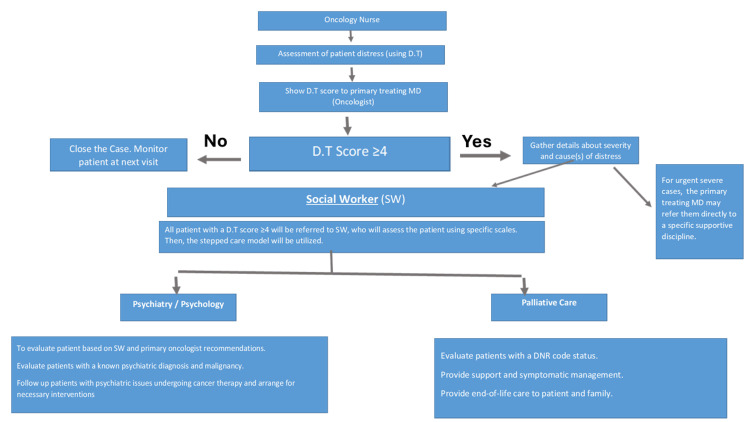 Figure 1
Peer Reviews
No public reviews on file for this paper yet. If you reviewed it on a platform where reviews are public (OpenReview, ICLR, NeurIPS, ICML), you can paste yours below so the community can read it here.
Videos
No videos yet. Explain this paper in a talk, walkthrough, or lecture? Add one.
Taxonomy
TopicsCancer survivorship and care · Cancer-related cognitive impairment studies · Cancer, Stress, Anesthesia, and Immune Response