Horizontal mapping of time-related words in first and second language
Anastasia Malyshevskaya, Martin H. Fischer, Yury Shtyrov, Andriy Myachykov

TL;DR
This study shows that people associate time-related words with left or right directions in both their first and second languages, with the strength of this link depending on language proficiency.
Contribution
It reveals that time-space associations in a second language depend on individual proficiency levels.
Findings
Time-related words show a consistent left-right spatial bias in both first and second languages.
Higher second language proficiency correlates with stronger time-space associations.
The spatial congruency effect was observed across different language pairs.
Abstract
The existence of a consistent horizontal spatial-conceptual mapping for words denoting time is a well-established phenomenon. For example, words related to the past or future (e.g., yesterday/tomorrow) facilitate respective leftward/rightward attentional shifts and responses, suggesting the visual-spatial grounding of temporal semantics, at least in the native language (L1). To examine whether similar horizontal bias also accompanies access to time-related words in a second language (L2), we tested 53 Russian-English (Experiment 1) and 48 German-English (Experiment 2) bilinguals, who classified randomly presented L1 and L2 time-related words as past- or future-related using left or right response keys. The predicted spatial congruency effect was registered in all tested languages and, furthermore, was positively associated with higher L2 proficiency in Experiment 2. Our findings (1)…
Genes, proteins, chemicals, diseases, species, mutations and cell lines named across the full text — each resolved to its canonical identifier and authoritative record.
Click any figure to enlarge with its caption.
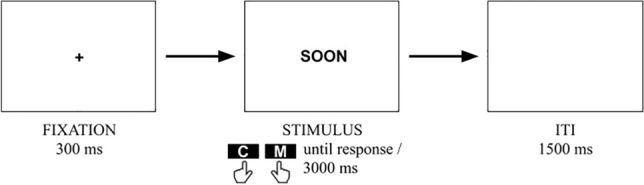 Figure 1
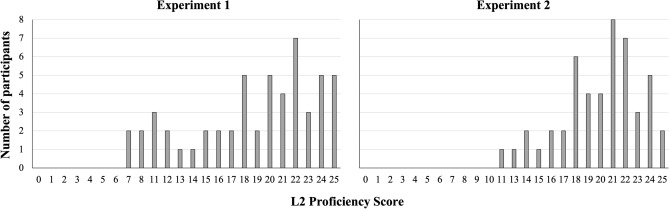 Figure 2
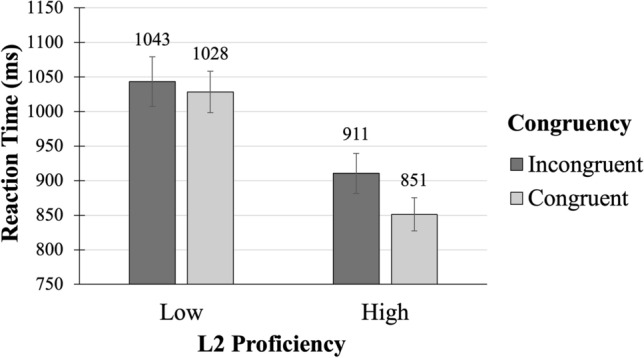 Figure 3
Peer Reviews
No public reviews on file for this paper yet. If you reviewed it on a platform where reviews are public (OpenReview, ICLR, NeurIPS, ICML), you can paste yours below so the community can read it here.
Videos
No videos yet. Explain this paper in a talk, walkthrough, or lecture? Add one.
Taxonomy
TopicsCategorization, perception, and language · Spatial Cognition and Navigation · Neurobiology of Language and Bilingualism