The Inside Scoop: What We Learnt About Getting into Academic Publishing During Our Editorial Internship
Church H. R, Govender L

TL;DR
This paper offers practical advice for newcomers to academic publishing, focusing on how to gain access through reading, authoring, reviewing, and editing.
Contribution
The paper provides a novel perspective on entry-level access to academic publishing through the authors' editorial internship experience.
Findings
Reading across disciplines is foundational to understanding academic publishing.
Newcomers can gain experience through non-research manuscripts and peer review.
Editorial opportunities are accessible with perseverance and proactive engagement.
Abstract
The world of publication can seem intimidating and closed to the newcomer. How then does one even begin to get a foot in the door? In this paper, the authors draw from the literature and their recent lived experience as editorial interns to consider this challenge under the theme of access, and how it overlaps with the various components of academic publication. The main three components of the publication ‘machine’ are discussed in this article, authoring, reviewing, and editing. These are preceded by the first, and arguably foundational, interaction with academic journal publishing—reading. Without reading articles across different journals, and even in different disciplines, understanding the breadth of scholarship and its purpose is impossible. The subsequent components of authoring, reviewing, and editing, which are all enhanced by ongoing familiarity with current literature…
Click any figure to enlarge with its caption.
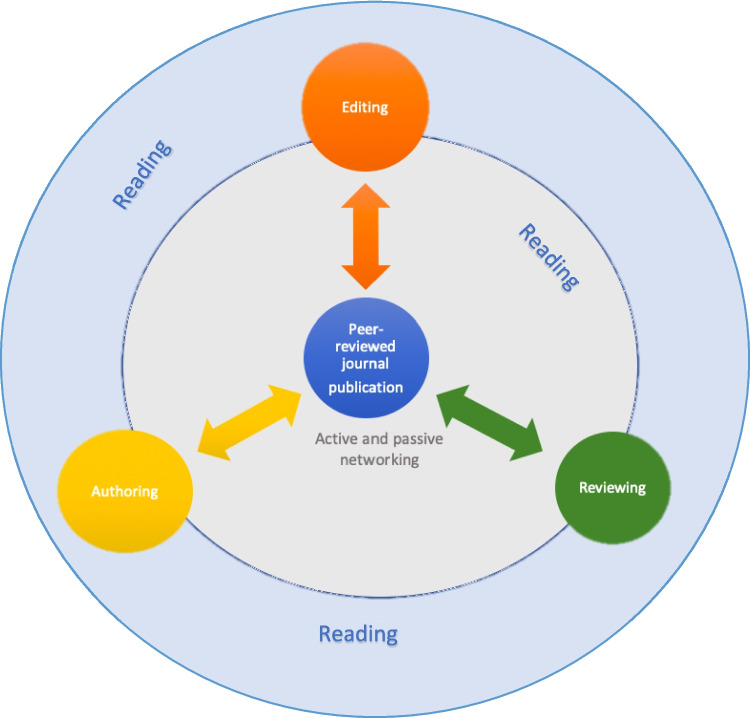 Figure 1
Peer Reviews
No public reviews on file for this paper yet. If you reviewed it on a platform where reviews are public (OpenReview, ICLR, NeurIPS, ICML), you can paste yours below so the community can read it here.
Videos
No videos yet. Explain this paper in a talk, walkthrough, or lecture? Add one.
Taxonomy
TopicsHealth and Medical Research Impacts · Innovations in Medical Education · Health Sciences Research and Education