Synthesis of ω-Chloroalkyl Aryl Ketones via C–C Bond Cleavage of tert-Cycloalkanols with Tetramethylammonium Hypochlorite
Natsumi Hanazawa, Masami Kuriyama, Kosuke Yamamoto, Osamu Onomura

TL;DR
A new method for making ω-chloroalkyl aryl ketones from tert-cycloalkanols using a simple and efficient oxidation process.
Contribution
A metal-free, mild method for C–C bond cleavage using TMAOCl and AcOH without phase-transfer reagents.
Findings
TMAOCl and AcOH effectively promote C–C bond cleavage in a two-phase system.
Unstrained tert-cycloalkanols are converted into ω-chloroalkyl aryl ketones in good yields.
The method operates under mild and metal-free conditions.
Abstract
An oxidative C–C bond cleavage of tert-cycloalkanols with tetramethylammonium hypochlorite (TMAOCl) has been developed. TMAOCl is easy to prepare from tetramethylammonium hydroxide, and the combination of TMAOCl and AcOH effectively promoted the C–C bond cleavage in a two-phase system without additional phase-transfer reagents. Unstrained tert-cycloalkanols were transformed into ω-chloroalkyl aryl ketones in moderate to excellent yields under metal-free and mild reaction conditions.
Genes, proteins, chemicals, diseases, species, mutations and cell lines named across the full text — each resolved to its canonical identifier and authoritative record.
Click any figure to enlarge with its caption.
 Figure 1
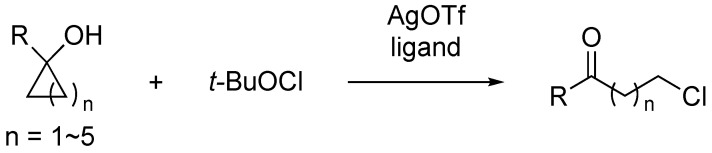 Figure 2
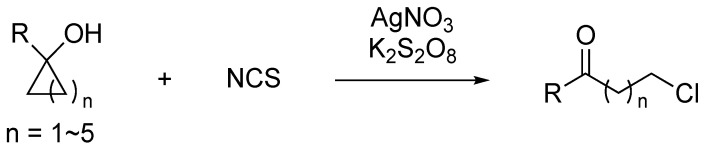 Figure 3
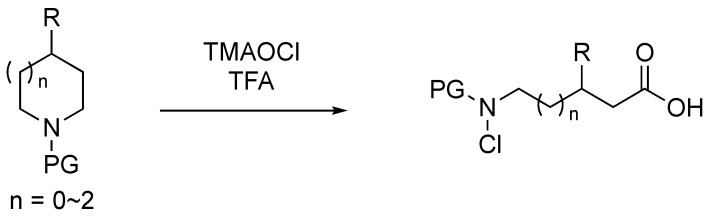 Figure 4
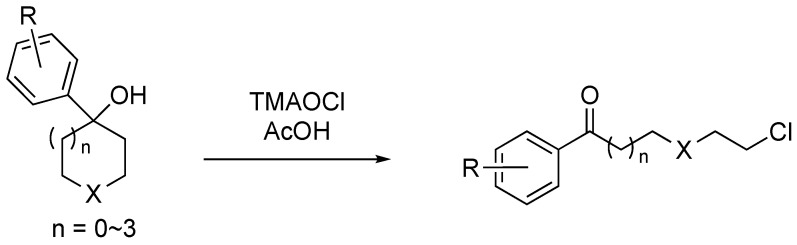 Figure 5
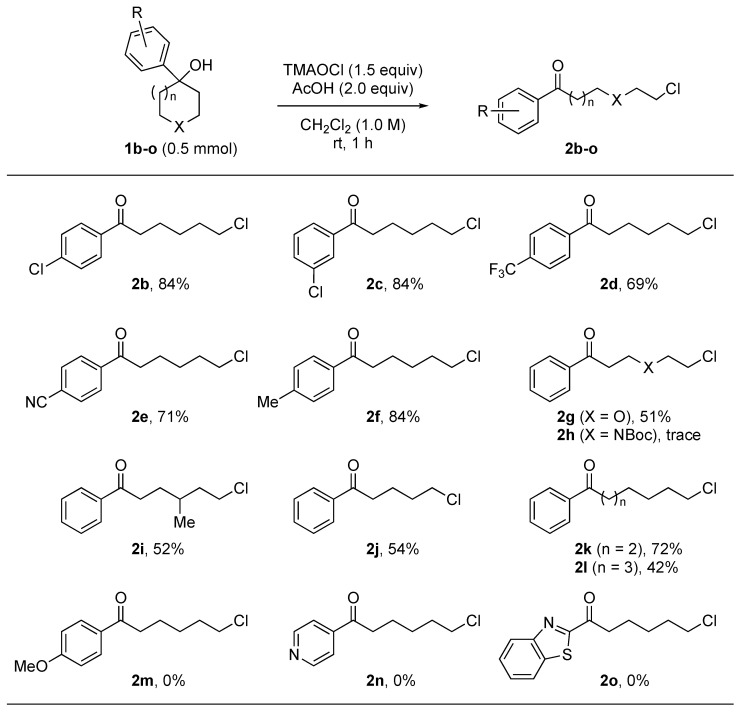 Figure 6
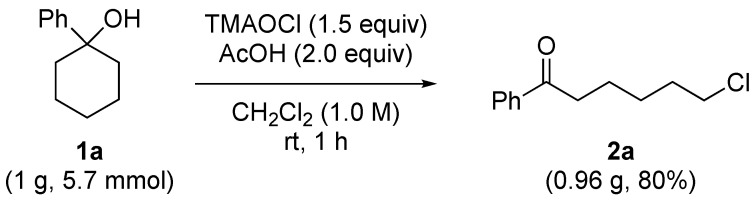 Figure 7
Peer Reviews
No public reviews on file for this paper yet. If you reviewed it on a platform where reviews are public (OpenReview, ICLR, NeurIPS, ICML), you can paste yours below so the community can read it here.
Videos
No videos yet. Explain this paper in a talk, walkthrough, or lecture? Add one.
Taxonomy
TopicsSynthesis and Catalytic Reactions · Chemical Synthesis and Reactions · Vanadium and Halogenation Chemistry