The Effect of the COVID-19 Pandemic on the Factors Influencing Iranian Medical Residents’ Specialty Selection: A Qualitative Study
Yaser Sarikhani, Seyedeh Maryam Najibi, Rahil Mosallanejad, Ali Rayatinejad, Mohammad Reza Sanjabi, Fereshteh Gholami, Shahidul Islam, Peivand Bastani

TL;DR
This study explores how the COVID-19 pandemic influenced Iranian medical residents' decisions on choosing their medical specialties.
Contribution
The study provides new qualitative insights into how the pandemic affected specialty selection factors in Iran.
Findings
The pandemic significantly impacted educational, professional, and personal aspects of specialty choices.
Four main themes emerged: educational aspects, career hazards, lifestyle changes, and pandemic-related beliefs.
Findings can inform national health policy and planning in Iran.
Abstract
Medical students’ specialty selection influences the composition of the physician workforce and the effectiveness of health systems. Therefore, the identification of factors that influence the choice of specialty is critical for an evidence-based health policy. This study aimed to investigate the effect of the Coronavirus Disease 2019 (COVID-19) pandemic on the determinants of specialty choice among Iranian medical residents. In early 2022, this qualitative study was conducted among Iranian medical residents in seven provinces, including Tehran, Isfahan, Fars, Khorasan Razavi, Kerman, Kermanshah, and Khuzestan. The participants were selected using a purposeful sampling method. Data were collected using 74 semi-structured in-depth face-to-face interviews. Finally, a thematic content analysis (conventional content analysis) method was applied for data synthesis. The participant’s mean…
Genes, proteins, chemicals, diseases, species, mutations and cell lines named across the full text — each resolved to its canonical identifier and authoritative record.
Click any figure to enlarge with its caption.
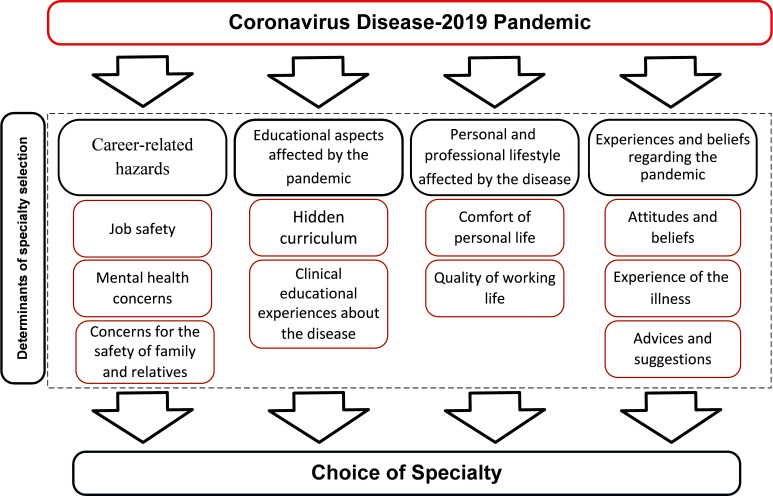 Figure 1
| Main Themes | Sub-themes | Categories |
|---|---|---|
| Educational aspects affected by the pandemic | Hidden curriculum | Atmosphere of academic environments |
| Atmosphere of clinical environments | ||
| Clinical educational experiences about the disease | Educational experience in COVID-19 wards | |
| Unsuccessful experiences in the treatment of COVID-19 patients | ||
| Career-related hazards | Job safety | Fear of encountering infected patients |
| The probability of getting the disease | ||
| Concerns for the safety of family and relatives | Concerns about the family members’ health | |
| Concerns about transmitting the disease to people outside the workplace | ||
| Mental health concerns | Stress from dealing with patients | |
| Psychological resilience | ||
| Stress-induced job burnout | ||
| Personal and professional lifestyles affected by the disease | Comfort of personal life | Mental comfort in the home environment |
| Cost-benefit attitudes | ||
| Quality of working life | Working hours | |
| Emergency cases and on-call schedules | ||
| Experiences and beliefs regarding the pandemic | Attitudes and beliefs | Professional accountability |
| Social accountability | ||
| Sense of sympathy | ||
| Experience of the illness | Personal experience of the disease, | |
| Experience of the illness by family members | ||
| Experience the disease by acquaintances | ||
| Advice and suggestions | Educators’ opinions | |
| Comments of other students | ||
| Suggestions from family members |
Peer Reviews
No public reviews on file for this paper yet. If you reviewed it on a platform where reviews are public (OpenReview, ICLR, NeurIPS, ICML), you can paste yours below so the community can read it here.
Videos
No videos yet. Explain this paper in a talk, walkthrough, or lecture? Add one.
Taxonomy
TopicsHealth and Well-being Studies · Global Health Workforce Issues · Diversity and Career in Medicine
What’s Known
- The COVID-19 pandemic has had a significant impact on various aspects of medical education.
- Factors such as the balance between personal life and professional requirements, as well as external issues that have emerged after the COVID-19 pandemic, can influence medical students’ specialty selection.
What’s New
- The COVID-19 pandemic influenced the determinants of general practitioners’ choice of specialty, which are classified into four themes: educational determinants, work-related hazards, personal and professional lifestyle, and experiences and beliefs.
- Pandemics have had a significant impact on various aspects of medical students’ specialty selection.
Introduction
Choosing a medical specialty is a very important decision for physicians because it determines their professional career and medical performance. ^ 1 ^ For many physicians, the field of specialization is not only a career option but also a chance to enhance their social life and the availability of new job opportunities. ^ 2 ^ Medical students choose their medical specialty based on the influence of role models and instructors, personality traits, personal interests, academic performance, and the skills developed during their education. ^ 3 ^ The importance of evidence on the determinants of preferences in specialty selection is that it can be utilized as a foundation for various planning and policies, such as medical education, physician workforce, and successful health care delivery. ^ 4 ^
The future composition of the health workforce depends on medical students’ choices of specialty. Therefore, the factors influencing this choice have become a topic of interest for many healthcare planners. Understanding the factors that influence the choice of specialty is essential to ensure an equal distribution of physicians by specialty. ^ 4 ^ During the Coronavirus Disease 2019 (COVID-19) pandemic, little information was available on these influential factors. However, developments in the education system during the COVID-19 pandemic necessitate an examination of the consequences of this pandemic on the choice of medical specialty. ^ 5 ^
In countries severely affected by COVID-19, the medical staff is exhausted. ^ 3 ^ COVID-19 has had a significant impact on medical students’ educational programs and has become a major concern for them. ^ 6 ^ Aside from the various occupational, educational, and psychological effects of COVID-19 on medical students, studies conducted in Canada, ^ 7 ^ China, ^ 3 , 8 ^ and the United States ^ 5 ^ showed that the COVID-19 pandemic had an impact on medical students’ choice of specialty. In fact, by eliminating clinical rotations, this disease generated new challenges for students, which might influence their career beliefs and their choice of specialty. ^ 8 ^
With the spread of COVID-19 and the utilization of different educational methods, medical students’ acquaintance with various specialties has changed. ^ 9 , 10 ^ Factors such as the balance between personal life and the occupational environment, as well as external issues caused by the pandemic, can also influence students’ choice of specialty. ^ 10 ^ A study found that during the pandemic, limitations such as reduced contact between students and patients, not attending various surgeries, and limited familiarity with different specialties led to an increased desire for medical specialties with less clinical contact among medical students. ^ 11 ^
Although the COVID-19 pandemic has had a significant impact on public health, its effects on medical specialty selection are less obvious. Therefore, it is crucial to identify the impact of the pandemic on specialty selection as a phenomenon influencing the health service delivery function. While some studies indicated that the COVID-19 pandemic had little impact on specialty selection, ^ 12 , 13 ^ another study suggested that this disease had a major impact on specialty selection as a profession. ^ 14 ^ Due to the existing controversies regarding the impact of the COVID-19 pandemic on specialty selection and the lack of a comprehensive national study, it was necessary to investigate the impact of the pandemic on the components of specialty selection in the specific context of the country. Therefore, this study aimed to investigate the impact of the COVID-19 pandemic on the determinants of specialty choice among Iranian medical residents.
Materials and Methods
Study Setting
From January 2022 to March 2022, this qualitative study was conducted in seven provinces of Iran, including Tehran, Isfahan, Fars, Razavi Khorasan, Kerman, Kermanshah, and Khuzestan. These provinces were selected based on their geographic distribution and socioeconomic status. The utilization of geographical diversity in the selection of participants on the one hand, and the employment of a qualitative approach on the other, provide the opportunity to establish a comprehensive understanding of the issue.
Sampling
To ensure the quality of the data synthesis, a purposeful sampling method was applied to select the participants. The study population was first-year medical residents (MRs). All first-year residents were eligible to participate in the study, regardless of their previous practice experience. This group of physicians was considered because of their previous experience in choosing a specialty during the COVID-19 outbreak. The reluctance of physicians to participate at any stage of the study was considered as the exclusion criterion. The sampling was performed based on a list of MRs obtained from the medical universities in the regional capitals. Although data saturation is the leading determinant of sample size in qualitative studies, we attempted to recruit samples from MRs of all disciplines from various provinces to strengthen the validity of the results. Although theoretical saturation was achieved after 31 interviews, 74 MRs participated in the study after signing an informed consent form. We called the participants and informed them of the aims and the procedures of the study. All the physicians who consented to take part in the study continued their participation without any withdrawal.
Data Collection
To provide a more in-depth understanding of the issue, we conducted in-depth face-to-face interviews to collect the data. The results of two open interviews with key informants were used to create a semi-structured interview guide. The interview guide was divided into four sections: the key determinants of specialty selection, the impact of epidemics on specialty selection, the impact of the COVID-19 pandemic on specialty selection, and the participants’ experience in choosing a specialized field during the COVID-19 outbreak.
All interviews were conducted by two researchers experienced in qualitative research at the most convenient time and place for the participants. Before the interviews, the two researchers held a collaborative meeting to discuss the research methodology and protocols. The interviews lasted 35±5 min on average. All the participants were initially instructed on the objectives of the study and the interview process. They were allowed to stop the interview at any time and could also request that particular information not be published. All interviews were digitally recorded and verbatim transcribed. To confirm the accuracy of the content, all transcripts were matched to the audio files by a third researcher.
Trustworthiness and Rigor of the Study
To improve the validity and quality of the study results, we used Guba and Lincoln’s four criteria, which included credibility, dependability, confirmability, and transferability. ^ 15 , 16 ^ We attempted to ensure the credibility of the results by engaging with the data for an extended period of time, applying the participant check approach in the data analysis phase, and providing the possibility of external checks at all phases of the study by two colleagues outside the project as a peer debriefing method. The results of 10 interviews were reviewed by the participants to validate the themes, get further details, and investigate contradictory content. Moreover, we used a peer-check technique as a triangulation method. Two researchers independently analyzed the interviews and compared the findings to determine similarities and discrepancies. Accordingly, a joint meeting was organized with all researchers to review the sub-themes and themes. We attempted to accurately document all phases of the study to improve its dependability. In this regard, two external reviewers verified the protocol as well as the methodology of the study. We aimed to improve the confirmability of the results by requesting two external qualitative researchers to verify the accuracy of the study protocol procedure and data synthesis. To ensure transferability, we detailed the research procedure. Finally, to ensure reflexivity, a bracketing approach was applied. In this regard, all researchers used reflective journals to minimize the impact of their attitudes, ideas, and expectations on the results. Moreover, none of the authors had prior experience in selecting a specialty throughout the study.
This study was approved by the Ethics Committee of Jahrom University of Medical Sciences (code: IR.JUMS.REC.1400.013).
Statistical Analysis
For data synthesis, a thematic content analysis method (conventional content analysis) was applied. Accordingly, the six-step methodology proposed by Graneheim and Lundman was used. ^ 17 ^ It included getting familiar with data, extracting initial codes, developing themes, reviewing themes, defining themes, and reporting results. ^ 17 ^ In this approach, instead of using a predetermined framework for interpreting the data, the themes and their sub-themes arose from the present data. This method is recommended in cases where little information is available about the issue. ^ 18 ^ We became familiar with the data by reading each interview several times. Following each interview, the researchers synthesized the data immediately. Therefore, each interviewee was informed of the data from the preceding phase.
The analysis and interpretation of the data were carried out by researchers who had no conflict of interest regarding the subject of the study. To organize the qualitative data, Microsoft Office 2013 (Microsoft Corporation, Redmond, Washington, USA) was used.
Results
We interviewed 74 first-year MRs. The participant’s mean age was 28.7±2.5 years, and 31% (N=23) of them were married. More than 52% (N=39) of the participants were men, and 47% (N=35) lived in big cities. The data synthesis resulted in the development of 24 categories, 10 sub-themes, and four main themes, including educational aspects affected by the pandemic, career-related hazards, personal and professional lifestyles affected by the disease, and pandemic experiences and beliefs. The results of the thematic analysis are shown in detail in table 1. Finally, the conceptual map resulting from the data synthesis is presented in figure 1.
The conceptual framework, resulting from the results of the study, shows the effects of the COVID-19 pandemic on the determinants of specialty selection by medical residents.
Educational Aspects Affected by the Pandemic
The first theme includes educational determinants that are affected by the COVID-19 pandemic. These factors are categorized into two sub-themes, including hidden curriculum and clinical educational experiences about the disease.
Hidden Curriculum
The hidden curriculum is considered an influential component in the educational process and decisions related to graduate education. This study found that the COVID-19 pandemic had an impact on the ambiance of academic and clinical environment wards, which was a component of the hidden curriculum. One of the MRs pointed this out and stated:
“There were no positive reflections of the disease in the college. Therefore, there was a prevailing atmosphere against the disease that influenced my decision not to pursue disciplines that were directly related to COVID-19 patients.” [MR24]
Clinical Educational Experiences about the Disease
The clinical educational experiences about the disease were another educational determinant of specialty choice that was found to be influenced by the COVID-19 pandemic. These findings indicated that the educational experience of medical students in COVID-19 wards was an important factor in their choice of specialty.
Career-Related Hazards
The theme “Career-related hazards” explains those determinants of specialty selection that are related to the physical and psychological hazards of a particular career. Although the impact of these determinants in choosing a profession has long been considered, the outbreak of COVID-19 has affected these factors in different ways.
Job Safety
Fear of contracting the disease and confronting COVID-19 patients was a major concern recognized by many participants. For instance, a participant expressed:
“You know, at the beginning of the pandemic, there was a lot of fear of this disease among the people. For me, such emotional reactions really had a significant impact on my career choice.” [MR17]
Concern for the Safety of Family and Relatives
Concern about the safety and health of family members and other acquaintances appeared to be another contributing factor in the specialty selection during the COVID-19 outbreak. One of the female participants gave an example, stating:
“I was fully aware of what happened to my classmate. She transmitted the disease to her family from the hospital.” [MR41]
Mental Health Concerns
The findings revealed that another aspect of occupational hazards was related to psychological well-being issues as a result of professional exposure during the disease outbreak. Among the factors identified in this regard were job stress and the possibility of psychological resilience. A physician said:
“It was obvious that this disease was causing great stress to my older colleagues. I wasn’t sure if I could handle this amount of stress and anxiety. … I preferred to choose a less stressful career.” [MR7]
Personal and Professional Lifestyles Affected by the Disease
This theme discusses aspects that influence an individual’s comfort and overall well-being. These factors are among the leading determinants of personal and professional lifestyle. The present study indicated that the COVID-19 pandemic had overshadowed some aspects of physicians’ lifestyles.
Comfort of Personal Life
A high proportion of the participants underlined the relevance of personal comfort in choosing a career. One of them pointed to the impact of the pandemic on these factors:
“I think the outbreak of COVID-19 has had a negative impact on many professional aspects, such as the personal lifestyle. … For example, since the beginning of the pandemic, I have not had that previous mental comfort at home.” [MR11]
Quality of Working Life
Some physicians also mentioned the quality of their working lives. For example, a female doctor explained the impact of the outbreak on her profession, emphasizing her professional lifestyle and explaining:
“… It was clear to me that treating COVID-19 patients involves many emergencies and unforeseen circumstances, and as a result, will demand a lot of on-call schedules. This is a difficult issue for me.” [MR55]
Experiences and Beliefs Regarding the Pandemic
The last theme that emerged from data synthesis was “experiences and beliefs regarding the pandemic”, which was divided into three sub-themes: remarks from others, attitudes and beliefs, and disease experience.
Attitudes and Beliefs
Some participants noted the effects of the disease on their beliefs and attitudes. They explained how they were influenced by moral and altruistic cultural values due to the disease outbreak. In this regard, a participant stated:
“I really wanted to be able to help my community in this situation. Because I felt responsible for the health of the community. I tried to make my choice based on this belief.” [MR70]
Experience of the Illness
Some interviewees stated that their personal experience of the disease or that of their relatives influenced their choice of specialty. A male MR described his personal experience with the sickness, saying:
“It was only when I became ill that I was able to understand the condition of the patients. This encounter altered my mindset. … Therefore, I decided to choose this specialty to help individuals suffering from the disease.” [MR33]
Advice and Suggestions
A significant number of participants stated that during the disease outbreak, they received suggestions and recommendations from various people not to pursue certain postgraduate fields. For example, an MRs said:
“In addition to some of my older colleagues, my family has encouraged me to choose this specialty. They believed that it would be better to choose a field that has little to do with the disease.” [MR27]
Discussion
The results of the present study, which was established based on 74 in-depth interviews with Iranian MRs, identified four main themes regarding the effects of COVID-19 on the determinants of specialty selection, including educational aspects affected by the pandemic, career-related hazards, personal and professional lifestyle affected by the disease, as well as experiences and beliefs regarding the pandemic.
This study indicated that the COVID-19 pandemic had an impact on two educational components of specialty selection, including clinical educational experiences about the disease and hidden curriculum. The findings of this study, which were in line with the results of other studies, indicated that educational experiences such as clinical rotations during the COVID-19 period were influential in the choice of specialty. ^ 5 ^ In addition, the lack of holding in-person theory findings due to the pandemic was mentioned as another formal educational aspect that has affected the opportunity for students to gather necessary information and become acquainted with different specialty fields. ^ 7 ^ In terms of informal educational factors, it was reported that strict COVID-19 preventive protocols and how students deal with them in clinical wards could affect their choice of specialty and career. ^ 19 ^ In general, it seems that the educational challenges posed by the COVID-19 pandemic have limited the opportunity for adequate exposure to different specialty fields. This has limited the medical students’ opportunity to gain a comprehensive understanding of the pros and cons of each specialty and has influenced the finding of aptitudes, the formation establishment of career beliefs, and the preferences of medical students in choosing a specialty. These facts necessitate a revision and probably a redesign of medical educational programs to better adapt them to conditions such as the COVID-19 pandemic.
Career-related hazards are other determinants of specialty selection. According to the findings of this study, these factors include concern for the safety of family and relatives, job safety, and mental health concerns. The risk of infection was one of the influential factors in the choice of specialty, which was also extensively explained before the outbreak of COVID-19. ^ 20 , 21 ^ Similarly, studies conducted after the COVID-19 pandemic suggested that medical students’ preferences for medical specialties were influenced by their fear of contracting the disease by themselves or family members. ^ 22 ^ Studies showed that major health events, such as the COVID-19 pandemic, affect the mental health status of medical students. ^ 23 , 24 ^ Increased stress, anxiety, depression, insomnia, and job burnout were reported as the most important psychological consequences of the COVID-19 pandemic. ^ 24 , 25 ^ So far, we found that occupational concerns caused by the spread of COVID-19 have not only affected the learning and educational aspects, ^ 23 ^ but also influenced the tendency to continue education, ^ 26 , 27 ^ the desire to work in the clinical environment, ^ 28 ^ career progression, ^ 29 ^ and physicians’ preferences in choosing specialty. ^ 22 , 26 ^
The findings of this study revealed that another group of factors influencing the choice of specialty during the COVID-19 pandemic were experiences and beliefs, which included attitude and beliefs, disease experience, as well as advice and suggestions. The impact of personal interests and personality type on specialty selection during the COVID-19 pandemic was confirmed. ^ 8 ^ On the other hand, various studies reported that some cultural and belief determinants such as empathy, ^ 30 , 31 ^ altruism, ^ 32 , 33 ^ and social accountability, ^ 34 , 35 ^ influenced the physicians’ career and specialization choices. In addition, the effects of having experienced various diseases, as well as the effects of suggestions and advice, ^ 36 ^ on the physicians’ choice of specialty were well documented. The role of determinants such as disease experience and other people’s suggestions in the selection of COVID-19-related specializations varied among different individuals. The impacts of pandemics and major health events on attitudes, beliefs, advice, and experiences related to the choice of specialty by physicians remain an area for further investigation.
Based on data analysis, personal and professional lifestyle was the last group of components of the specialty selection to be affected by this pandemic. The two main categories of this theme were the comfort of personal life and the quality of working life. The impacts of COVID-19 on career-related psychological aspects were investigated in several studies. ^ 22 , 26 , 27 ^ It was also obvious that career-related psychological factors were among the main determinants of physician’s quality of work and personal life. On the other hand, the role of the COVID-19 pandemic on clinical job features such as the number of shifts, on-call schedules, and emergency cases was well explained in this study. Despite the absence of comparable studies on the effects of COVID-19 on these determinants, several studies highlighted the impact of lifestyle ^ 37 , 38 ^ and occupational components ^ 39 , 40 ^ on medical specialty choice.
Although this study used a qualitative approach to provide a comprehensive understanding of the impact of COVID-19 on medical specialty choice, it was conducted only in one country. Nevertheless, since the process of selecting a specialty by physicians was greatly influenced by the socioeconomic conditions of countries, the findings of this study should be evaluated and generalized considering all these conditions.
Conclusion
The results of data synthesis in this study indicated that the COVID-19 pandemic influenced various components of specialty selection by Iranian physicians, which are categorized into four themes: educational aspects affected by the pandemic, career-related hazards, personal and professional lifestyle influenced by the disease, as well as experiences and beliefs regarding the pandemic. Although several studies were conducted worldwide to identify the factors influencing medical students’ choice of specialty, there is still a lack of accurate and comprehensive evidence on the effects of the COVID-19 pandemic on the determinants of specialty selection. Therefore, further investigations in terms of different socioeconomic conditions are required to strengthen evidence-informed physician workforce planning and policy.
The reference list from the paper itself. Each links out to its DOI / PubMed record.
- 1Barbosa-Camacho FJ Miranda-Ackerman RCVázquez-Reyna I Jimenez-Ley VB Barrera-López FJ Contreras-Cordero V Setal Association between HEXACO personality traits and medical specialty preferences in Mexican medical students: a cross-sectional survey BMC Psychol 2020819[ PMC Free Article ]10.1186/s 40359-020-0390-032171327 PMC 7071694 · doi ↗ · pubmed ↗
- 2Newton DA Grayson MS Thompson LF The variable influence of lifestyle and income on medical students’ career specialty choices: data from two U.S. medical schools, 1998-2004 Acad Med 2005808091410.1097/00001888-200509000-0000516123458 · doi ↗ · pubmed ↗
- 3Cai CZ Lin Y Alias H Hu Z Wong LP Effect of the COVID-19 Pandemic on Medical Student Career Perceptions: Perspectives from Medical Students in China Int J Environ Res Public Health 202118[ PMC Free Article ]10.3390/ijerph 1810507134064814 PMC 8151743 · doi ↗ · pubmed ↗
- 4Shakurnia A Mozaffari A Ghadiri A Factors Influencing Choice of Specialty by medical residents in Ahvaz, Iran Bangladesh Journal of Medical Science 20161510.3329/bjms.v 15i 1.20478 · doi ↗
- 5Byrnes YM Civantos AM Go BC Mc Williams TL Rajasekaran K Effect of the COVID-19 pandemic on medical student career perceptions: a national survey study Med Educ Online 2020251798088[ PMC Free Article ]10.1080/10872981.2020.179808832706306 PMC 7482653 · doi ↗ · pubmed ↗
- 6Kaplan AB Riedy KN Grundfast KM Increasing Competitiveness for an Otolaryngology Residency: Where We Are and Concerns about the Future Otolaryngol Head Neck Surg 201515369970110.1177/019459981559373426187905 · doi ↗ · pubmed ↗
- 7Dobson JL Fenwick A Linehan V Hartery A Radiology Interest Groups: A Recipe for Success Can Assoc Radiol J 2021723435110.1177/084653711989955132070110 · doi ↗ · pubmed ↗
- 8Deng J Que J Wu S Zhang Y Liu J Chen Setal Effects of COVID-19 on career and specialty choices among Chinese medical students Med Educ Online 2021261913785[ PMC Free Article ]10.1080/10872981.2021.191378533849405 PMC 8057072 · doi ↗ · pubmed ↗