Effect of Daytime versus Nighttime on Prehospital Care and Outcomes after Severe Traumatic Brain Injury
Carolien S. E. Bulte, Floor J. Mansvelder, Stephan A. Loer, Frank W. Bloemers, Dennis Den Hartog, Esther M. M. Van Lieshout, Nico Hoogerwerf, Joukje van der Naalt, Anthony R. Absalom, Saskia M. Peerdeman, Georgios F. Giannakopoulos, Lothar A. Schwarte, Patrick Schober

TL;DR
This study found that patients with isolated severe traumatic brain injury had lower 30-day mortality when treated at night compared to during the day.
Contribution
The study identifies a potential time-of-day effect on mortality in isolated severe TBI cases treated by helicopter emergency services.
Findings
Univariable analysis showed lower 30-day mortality for nighttime treatment of severe TBI.
Multivariable analysis found no significant difference in overall mortality between day and night treatments.
Isolated TBI patients had significantly lower mortality when treated at night.
Abstract
Background/Objectives: Severe traumatic brain injury (TBI) is a frequent cause of morbidity and mortality worldwide. In the Netherlands, suspected TBI is a criterion for the dispatch of the physician-staffed helicopter emergency medical services (HEMS) which are operational 24 h per day. It is unknown if patient outcome is influenced by the time of day during which the incident occurs. Therefore, we investigated the association between the time of day of the prehospital treatment of severe TBI and 30-day mortality. Methods: A retrospective analysis of prospectively collected data from the BRAIN-PROTECT study was performed. Patients with severe TBI treated by one of the four Dutch helicopter emergency medical services were included and followed up to one year. The association between prehospital treatment during day- versus nighttime, according to the universal daylight period, and…
Genes, proteins, chemicals, diseases, species, mutations and cell lines named across the full text — each resolved to its canonical identifier and authoritative record.
Click any figure to enlarge with its caption.
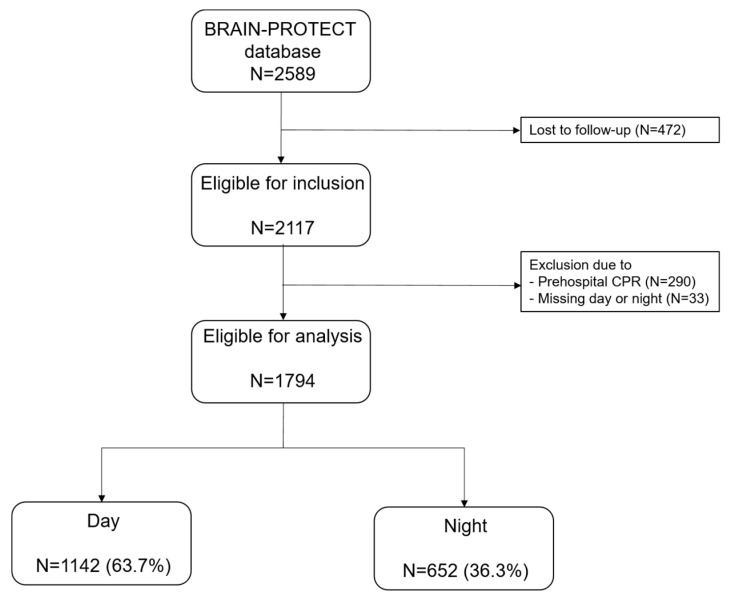 Figure 1
Peer Reviews
No public reviews on file for this paper yet. If you reviewed it on a platform where reviews are public (OpenReview, ICLR, NeurIPS, ICML), you can paste yours below so the community can read it here.
Videos
No videos yet. Explain this paper in a talk, walkthrough, or lecture? Add one.
Taxonomy
TopicsCardiac Arrest and Resuscitation · Trauma and Emergency Care Studies · Emergency and Acute Care Studies