Side Information Design in Zero-Error Coding for Computing
Nicolas Charpenay, Maël Le Treust, Aline Roumy

TL;DR
This paper studies how to design encoder side information to minimize communication rates in zero-error computing tasks.
Contribution
The paper introduces two greedy algorithms for optimizing side information design in zero-error coding.
Findings
A condition for computing the optimal rate R*(g) was derived for full-support PX,Y.
Two greedy algorithms are proposed for the side information design problem.
One of the algorithms runs in polynomial time.
Abstract
We investigate the zero-error coding for computing problems with encoder side information. An encoder provides access to a source X and is furnished with side information g(Y). It communicates with a decoder that possesses side information Y and aims to retrieve f(X,Y) with zero probability of error, where f and g are assumed to be deterministic functions. In previous work, we determined a condition that yields an analytic expression for the optimal rate R*(g); in particular, it covers the case where PX,Y is full support. In this article, we review this result and study the side information design problem, which consists of finding the best trade-offs between the quality of the encoder’s side information g(Y) and R*(g). We construct two greedy algorithms that give an achievable set of points in the side information design problem, based on partition refining and coarsening. One of them…
Genes, proteins, chemicals, diseases, species, mutations and cell lines named across the full text — each resolved to its canonical identifier and authoritative record.
Click any figure to enlarge with its caption.
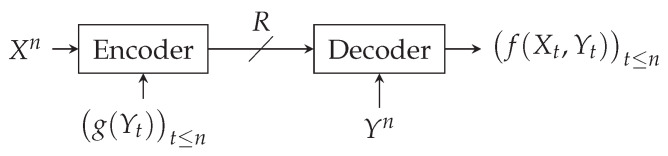 Figure 1
 Figure 2
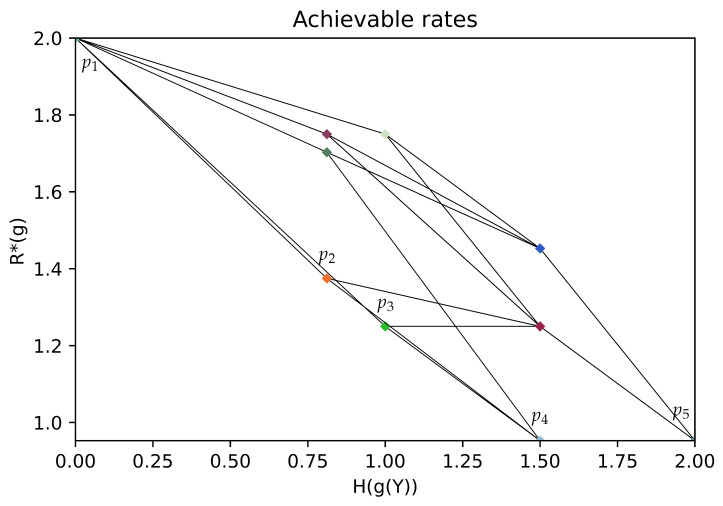 Figure 3
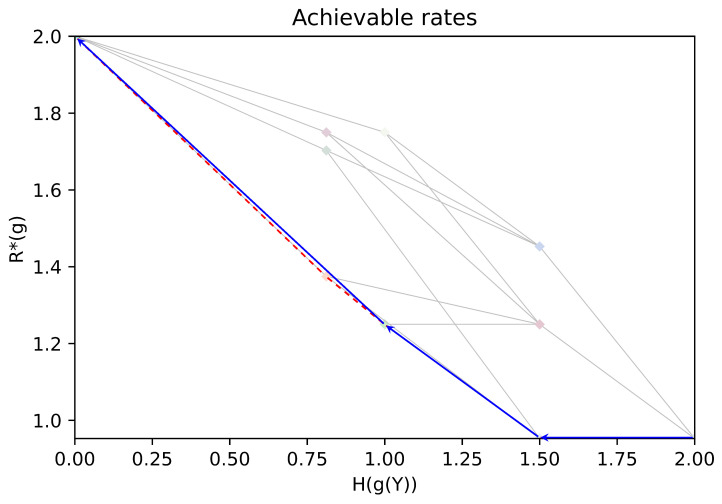 Figure 4
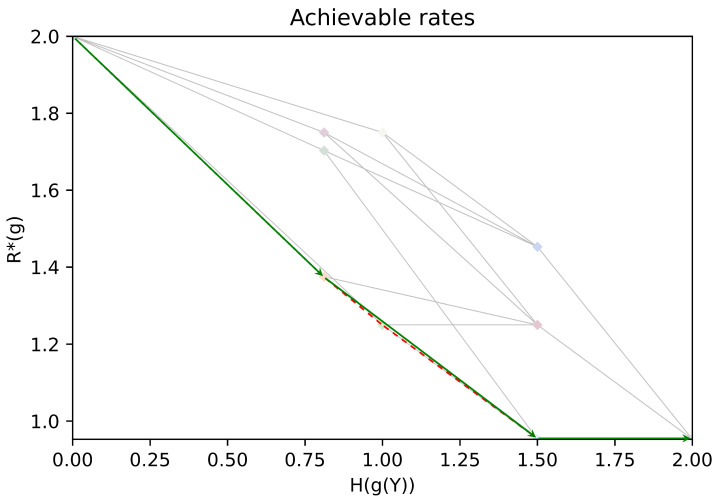 Figure 5
 Figure 6
Peer Reviews
No public reviews on file for this paper yet. If you reviewed it on a platform where reviews are public (OpenReview, ICLR, NeurIPS, ICML), you can paste yours below so the community can read it here.
Videos
No videos yet. Explain this paper in a talk, walkthrough, or lecture? Add one.
Taxonomy
TopicsCooperative Communication and Network Coding · Wireless Communication Security Techniques · Cryptography and Data Security