Exploring the Potential of Humoral Immune Response to Commensal Bifidobacterium as a Biomarker for Human Health, including Both Malignant and Non-Malignant Diseases: A Perspective on Detection Strategies and Future Directions
Kyogo Itoh, Satoko Matsueda

TL;DR
This paper reviews how immune responses to gut bacteria called Bifidobacterium could serve as health indicators for both cancer and non-cancer diseases.
Contribution
The paper introduces Bifidobacterium's humoral immune response as a novel biomarker for predicting and managing diverse diseases.
Findings
Bifidobacterium's antigenic mimicry may trigger immune responses useful for disease prediction.
Higher antibody levels against Bifidobacterium correlate with lower disease risk in healthy individuals.
Manipulating gut Bifidobacterium could improve cancer immunotherapy and manage inflammatory diseases.
Abstract
In this comprehensive review, we explore the pivotal role of commensal Bifidobacterium (c-BIF) as potent non-self-antigens through antigenic mimicry, along with exploring the potential of humoral immune responses for both malignant and non-malignant disease. c-BIF, a predominant component of the human gut microbiome encompassing around 90% of the human genome, has emerged as a pivotal player in human biology. Over recent decades, there has been extensive research elucidating the intricate connections between c-BIF and various facets of human health, with particular emphasis on their groundbreaking impact on anti-cancer effects and the management of non-malignant diseases. The multifaceted role of c-BIF is explored, ranging from enhancing anti-tumor immunity to improving the efficacy of anti-cancer and anti-infectious disease strategies, and serving as predictive biomarkers for various…
Genes, proteins, chemicals, diseases, species, mutations and cell lines named across the full text — each resolved to its canonical identifier and authoritative record.
Click any figure to enlarge with its caption.
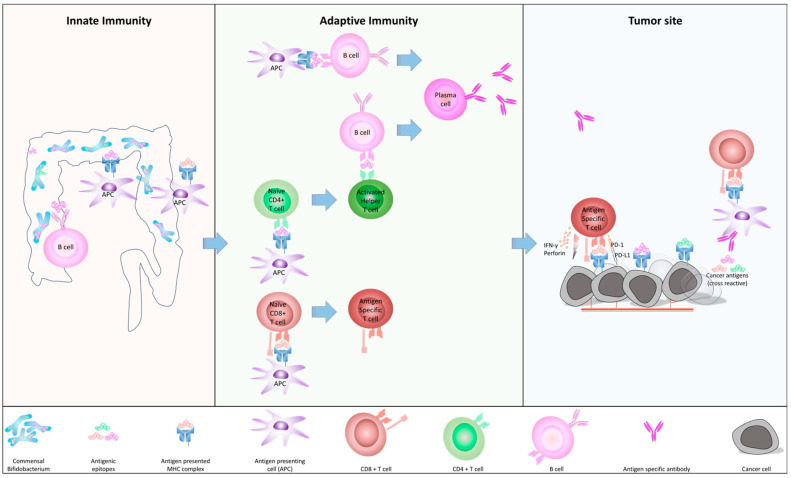 Figure 1
Peer Reviews
No public reviews on file for this paper yet. If you reviewed it on a platform where reviews are public (OpenReview, ICLR, NeurIPS, ICML), you can paste yours below so the community can read it here.
Videos
No videos yet. Explain this paper in a talk, walkthrough, or lecture? Add one.
Taxonomy
TopicsHuman Health and Disease