Independence Threat or Interdependence Threat? The Focusing Effect on Social or Physical Threat Modulates Brain Activity
Guan Wang, Lian Ma, Lili Wang, Weiguo Pang

TL;DR
This study explores how the brain processes social and physical threats when attention is focused on one type, revealing differences in neural responses.
Contribution
The study introduces a novel attention-guided paradigm to compare brain activity during social and physical threat processing.
Findings
Social threats show stronger neural processing advantages, as indicated by higher N170 and EPN amplitudes.
Physical threat focus is influenced by social threat presence, as shown by increased N190 amplitudes.
Attention modulates how social and physical threats are processed in the brain.
Abstract
Objective: The neural basis of threat perception has mostly been examined separately for social or physical threats. However, most of the threats encountered in everyday life are complex. The features of interactions between social and physiological threats under different attentional conditions are unclear. Method: The present study explores this issue using an attention-guided paradigm based on ERP techniques. The screen displays social threats (face threats) and physical threats (action threats), instructing participants to concentrate on only one type of threat, thereby exploring brain activation characteristics. Results: It was found that action threats did not affect the processing of face threats in the face-attention condition, and electrophysiological evidence from the brain suggests a comparable situation to that when processing face threats alone, with higher amplitudes of…
Genes, proteins, chemicals, diseases, species, mutations and cell lines named across the full text — each resolved to its canonical identifier and authoritative record.
Click any figure to enlarge with its caption.
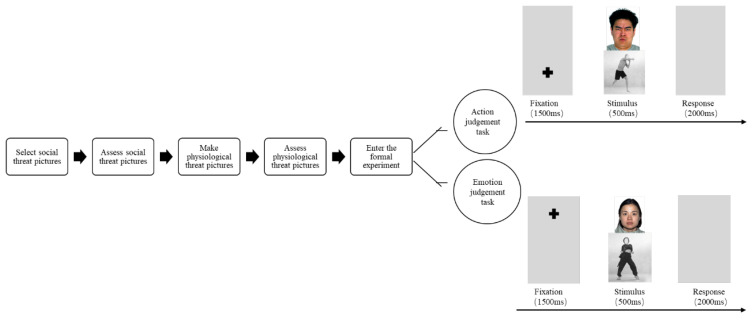 Figure 1
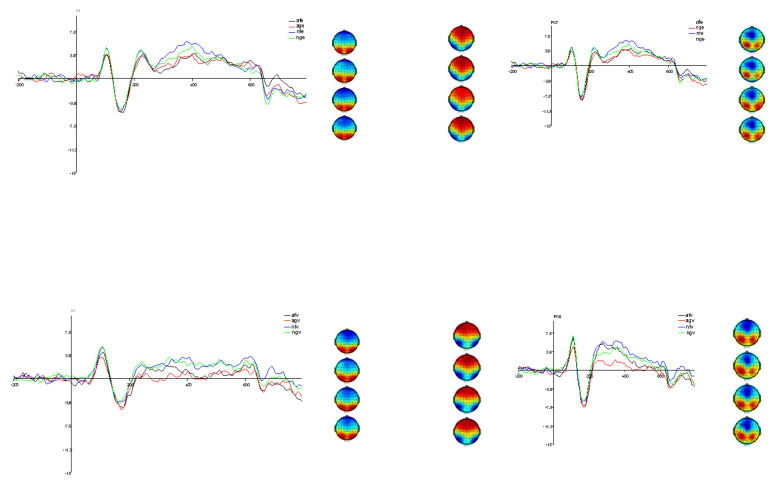 Figure 2
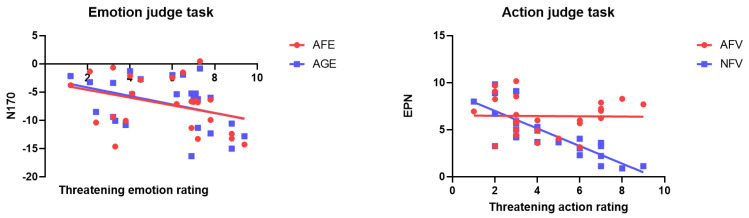 Figure 3
Peer Reviews
No public reviews on file for this paper yet. If you reviewed it on a platform where reviews are public (OpenReview, ICLR, NeurIPS, ICML), you can paste yours below so the community can read it here.
Videos
No videos yet. Explain this paper in a talk, walkthrough, or lecture? Add one.
Taxonomy
TopicsNeural and Behavioral Psychology Studies · Face Recognition and Perception · Neural dynamics and brain function