An Introduction to the Native and Non-Native Plant-Insect Interactions and Potential Pollinators of Puerto Williams and Yendegaia, Cabo de Hornos, Chile
Carmen A Burkett, Ri Corwin, Jonathan Lautenbach, Issabella Serrani Gallego, Sara A Joseph, Francesca Burkett, Benton J Hendrickson, Desiree A Jackson, Morghan McCool, Clarissa M Molina, Felipe Armijo Morales, Erin R Todd, Roy Mackenzie, Laura Sanchez Jardon, Michael Thompson

TL;DR
This paper explores plant-insect interactions in a remote Chilean region, focusing on both native and non-native species and their ecological impacts.
Contribution
The study identifies knowledge gaps and emphasizes the need for biodiversity research in a relatively unstudied sub-Antarctic ecoregion.
Findings
Non-native insects like Bombus terrestris and Vespula vulgaris may harm native populations through competition and predation.
Little is known about interactions between native and non-native plants and insects in the region.
Further research is needed to document biodiversity and ecological relationships in the area.
Abstract
The Magellanic sub-Antarctic ecoregion of southern Chile represents one of the last remaining pristine areas on Earth, but there are knowledge gaps concerning the biodiversity and interactions of the regions’ flora and fauna. Non-native insect species like Bombus terrestris and Vespula vulgaris are known to have detrimental influence on native populations through competition for resources/nesting habitat, larvae predation, and foreign pathogen introduction. However, their interactions with the native and non-native plants in the region and between introduced species are unknown. This study highlights the importance of further investigations documenting the region’s biodiversity, native and non-native species interactions, and local pollinators.
Genes, proteins, chemicals, diseases, species, mutations and cell lines named across the full text — each resolved to its canonical identifier and authoritative record.
Click any figure to enlarge with its caption.
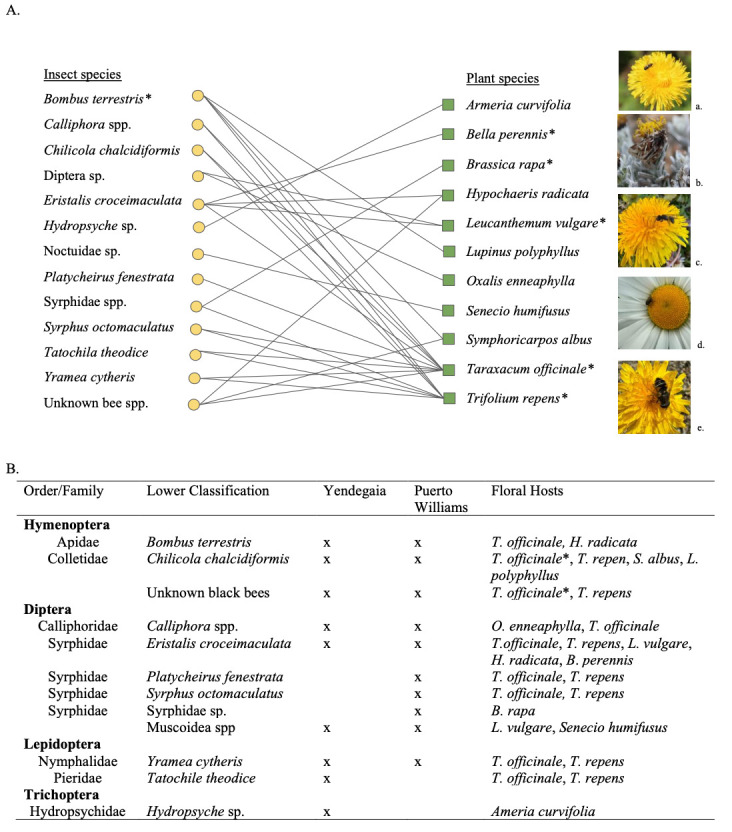 Figure 1
Peer Reviews
No public reviews on file for this paper yet. If you reviewed it on a platform where reviews are public (OpenReview, ICLR, NeurIPS, ICML), you can paste yours below so the community can read it here.
Videos
No videos yet. Explain this paper in a talk, walkthrough, or lecture? Add one.
Taxonomy
TopicsBotany and Geology in Latin America and Caribbean
Description
The Magallanes region represents a unique ecosystem and one of the last pristine habitats in the world. It contains a wealth of native biodiversity, but also includes areas where many non-native plants and animals have been introduced (Armesto et al. 2009, Rendoll-Cárcamo et al. 2017, Rendoll-Cárcamo et al. 2020, Rosenfeld et al. 2023). In at least some cases, these introduced invaders are harmful and rapidly spreading to the point that native species are disappearing (Rendoll-Cárcamo et al. 2017, Rendoll-Cárcamo et al. 2020). However, there does not currently exist a full survey of the current diversity of the region, particularly in regard to insects, or any analysis of the full effects of these non-native introductions. Also, due to the remoteness of the area and the relative recent presence of some invasive species such as the Buff-Tailed Bumblebee ( Bombus terrestris ), there is a lack of information regarding the interactions between native species and non-native species.
In addition, given the rapid expansion of human settlements in the area, many natural areas are being converted to novel ecosystems, which could result in a rise of dark diversity (Larson et al. 2014, Nichter & Gregory 2018) . Dark diversity represents biodiversity that is supported by what are often marginal or heavily impacted areas outside of monitored reserves. This could be, for example, in the form of gardens, prairie strips around agricultural fields, roadside habitat, or urban green spaces. A more insidious form of dark diversity may also be occurring when these marginal areas promote the persistence of non-native or potentially invasive species. For example, clover ( *Trifolium * sp.) and dandelions ( Taraxacum sp.) growing along roadsides and in yards and the Lupine ( Lupinus sp.) growing in private gardens provide floral resources for the invasive Bombus terrestris both in Puerto Williams and Punta Arenas ( personal observation ). This observational study represents, to our knowledge, the first systematic survey into the interactions among plants and native and non-native insects and potential pollinators of the region.
Bombus terrestris was first introduced to the Magallanes region in 2011 for agricultural use as a pollinator of red currant ( Ribes rubrum ). It has spread quickly since its original introduction and was first recorded on Navarino island in 2016. The Common Wasp ( Vespula vulgaris ) has also been recently introduced into the region and, like Bombus terrestris , is rapidly spreading. Both species may have detrimental influence on the native insect populations through competition for resources and nesting habitat, predation of larvae, and the introduction of foreign pathogens (Rendoll Cárcamo et al. 2017, Rendoll Cárcamo et al. 2022). Exotic pollinators such as *Bombus terrestris * may also contribute to the integration of non-native plant species into existing local plant communities (Parra-Tabla & Arceo-Gómez 2021).
During a 2017 survey of regional insects, Rendoll-Cáracamo et al. (2017) found no records of Bombus terrestris in Ushuaia on Tierra del Fuego. At the time of our surveys, Bombus terrestris was not only present, but also quite abundant at Yendegaia on Tierra del Fuego. Meanwhile, the region’s native Patagonian Bumble Bee, which is now endangered (Henríquez-Piskulich 2020), Bombus dahlbohmii , was not observed at either Puerto Williams on Isla Navarino or Yendegaia during our surveys.
Non-native plants may also affect native bee assemblages and existing plant-insect interaction networks (Henríquez-Piskulich et al. 2018, Richard et al. 2018, Parra-Tabla & Arceo-Gómez 2021). White Clover ( Trifolium repens ) and Dandelion ( Taraxacum officinale ) are both species native to Europe, however, they can be found quite abundantly in both Puerto Williams on Isla Navarino and in Yendegaia on Tierra del Fuego. Nearly all the floral visiting insects we recorded were observed visiting either one or both of these plant species, and in many cases, these were the only floral hosts on which we observed the insects, whether they were native or non-native. For example, most of our observations of Chilicola chalcidiformis which is a bee species endemic to Chile, occurred during visits of the species to Taraxacum officinale . Other non-native flowering plant species that were observed in the area include: Cerastium arvense , Papaver sp., and Achillea millefolium . The full extent of these and other non-native plant species’ interactions with native bees and other floral visitors and their effects on the native plant community is currently unknown.
Our preliminary visitation network ( Fig. 1 ) represents insect species that were seen physically on a flower and the flower species that they visited. This network simply illustrates visitation and does not represent any pollination interactions as many insect species visit flowers to nectar or rest without actually performing any pollination services to the plant (Burkett et al. 2023, Barrios et al. 2016) . Insects observed not physically visiting a flower (including Dotocryptus bellicosus , Anthomyiidae sp., Larentiinae sp., Noctuidae spp., Hypodynerus vespiformis , Ceroglossus suturalis , Palpibracus chilensis , Aegohinus vitulus , Anthomyiidae sp., Vespula vulgaris , Aegorhinus vitulus , and *Syncirsodes * sp.) or other flowering species in the area that were not observed having floral visitors (including Anemone multifida , Erigeron sp., Ranunculus peduncularis , Perezia recurvata , Geranium sp., Adenocaulon chilense , Caltha sagittata , Senecio sp., Primula magellanica , Armeria curvifolia , Rubus geoides , Acaena ovalifolia , Cerastium arvense , Leptinella scariosa, Senecio smithii , Olsynium biflorum , Papaver sp., Chiliotrichum diffusum , Gavilea sp., Viola reichei , Codonorchis lessonii , Achillea millefolium , and Sisyrinchium patagonicum .) are also not reflected. In only two weeks of observations, we recorded possible observations of species that are either reportedly rare in the region or previously unrecorded ( Corynura sp., and *Platycheirus * ( Carposcalis )
- walkeri* ); however, further collection and taxonomic work will be needed to confirm their presence in the region. Also, in some cases, the photographic evidence collected lacked the resolution to make a species-level identification of the floral visitor. Further sampling is needed to thoroughly assess the native insect assemblages, abundance of non-native plant and insect species, the interactions between both the native and non-native plants and insects in the region, and to determine if any of these visitors are successfully acting as pollinators.
Methods
Floral visitors and insects belonging to taxa commonly observed as floral visitors/pollinators were observed and recorded by photos and/or videos during two weeks of the austral summer in 2024 (Jan 1st-15th). All observations were made opportunistically in each area during the approximately 14 available daylight hours of that two-week period. Observations took place in the Omora Ethnobotanical Park, throughout the town of Puerto Williams both on Isla Navarino, Cabo de Hornos, Chile, and at Yendegaia National Park in Tierra del Fuego, Chile. These floral visitors and their floral hosts were then identified to the lowest taxonomic rank possible, and records were made of the number of floral species visited by each type of floral visitor ( Fig. 1 ). We did not quantify plant and insect abundance due to the brief and highly focused sample period.
The reference list from the paper itself. Each links out to its DOI / PubMed record.
- 1Barrios B Pena SR Salas A Koptur S 201616 Butterflies visit more frequently, but bees are better pollinators: the importance of mouthpart dimensions in effective pollen removal and deposition.Ao B Plants 82041-285110.1093/aobpla/plw 00126742956 PMC 4779295 · doi ↗ · pubmed ↗
- 2Henríquez-Piskulich P Vera A Sandoval G Villagra C 2018117 Along urbanization sprawl, exotic plants distort native bee (Hymenoptera: Apoidea) assemblages in high elevation Andes ecosystem.Peer J 62167-8359 e 5916 e 591610.7717/peerj.591630425897 PMC 6228549 · doi ↗ · pubmed ↗
- 3Henríquez-Piskulich P, Vera A, Villagra C. 2020. Native bees of high Andes of Central Chile (Hymenoptera:Apoidea): biodiversity, phenology and the description of a new species of Xeromelissa Cockerell (Hymenoptera:Colletidae:Xeromelissinae.Peer J 8:e 8675 http://doi.org/10.7717/peerj.8675 10.7717/peerj.8675 PMC 705055032161691 · doi ↗ · pubmed ↗
- 4Nichter AN, Gregory AJ. 2018. Distribution modeling of Asclepias spp . predicts potential conservation benefits of marginal ecosystem as nature reserves in Northwest Ohio. Natural Areas Journal 38(4):250-258: doi.org/10.3375/043.038.0405.
- 5Parra-Tabla V Arceo-Gómez G 2021414 Impacts of plant invasions in native plant-pollinator networks.New Phytol 23060028-646X 2117212810.1111/nph.1733933710642 · doi ↗ · pubmed ↗
- 6Perez V. 2013. Introducción de Bombus ( Bombus ) terrestris (Linnaeus, 1758) (Hymenoptera: Apidae) en la región de Magallenes: potencial riesgo para las abejas nativas. Anales Instituto Patagonia (Chile). 41(1):147-152
- 7Rosenfeld S Maturana CS Gañan M Rendoll Cárcamo J Díaz A Contador T Aldea C Gonzalez-Wevar C Orlando J Poulin E 2023817 Revealing the hidden biodiversity of Antarctic and the Magellanic Sub-Antarctic Ecoregion: A comprehensive study of aquatic invertebrates from the BASE Project.Biodivers Data J 111314-2828 e 108566 e 10856610.3897/BDJ.11.e 10856638318521 PMC 10840509 · doi ↗ · pubmed ↗