Genomic analysis of Elizabethkingia meningoseptica causing bacteremia in the Brazilian Amazon
Sergio Mascarenhas Morgado, Rosângela Cipriano, Fernanda dos Santos Freitas, Erica Lourenço da Fonseca, Ana Carolina Paulo Vicente

Abstract
Genes, proteins, chemicals, diseases, species, mutations and cell lines named across the full text — each resolved to its canonical identifier and authoritative record.
Click any figure to enlarge with its caption.
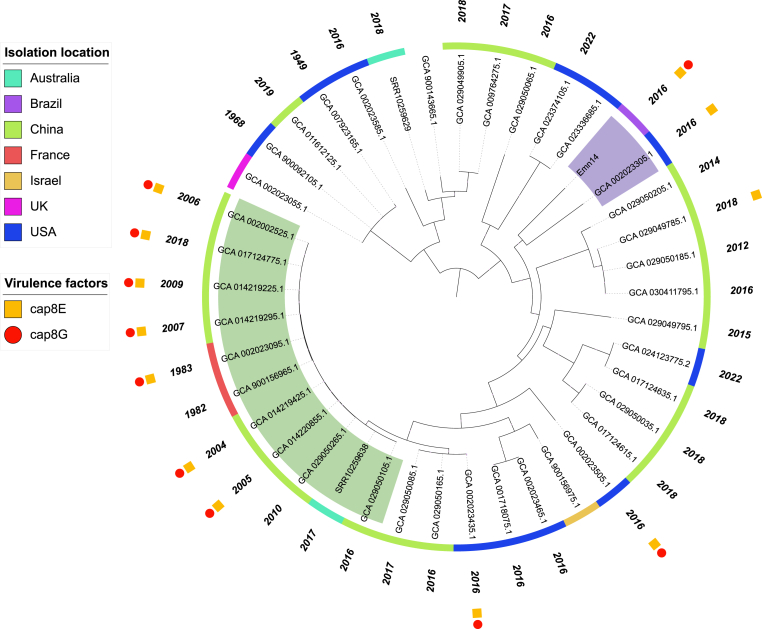 Figure 1
Peer Reviews
No public reviews on file for this paper yet. If you reviewed it on a platform where reviews are public (OpenReview, ICLR, NeurIPS, ICML), you can paste yours below so the community can read it here.
Videos
No videos yet. Explain this paper in a talk, walkthrough, or lecture? Add one.
Taxonomy
TopicsInfections and bacterial resistance · Plant Pathogenic Bacteria Studies · Mycobacterium research and diagnosis
Dear Editor,
Elizabethkingia meningoseptica (formerly Chryseobacterium meningosepticum and Flavobacterium meningosepticum) is a Gram-negative, aerobic, non-fermentative bacterium that colonizes natural and clinical environments [1]. Human E. meningoseptica infections are relatively uncommon, however, misidentification of Elizabethkingia spp. could be underestimating the real epidemiology of this species [2]. Indeed, outbreaks involving E. meningoseptica lineages have begun to emerge in China [1]. E. meningoseptica infections lead to prolonged and complicated hospitalizations due to its ability to form biofilms and intrinsic resistance to multiple antimicrobial drugs, including most β-lactams, colistin, and aminoglycosides [[1], [2], [3]]. Indeed, the Elizabethkingia genus encodes two chromosomal metallo-β-lactamase genes, blaBlaB and blaGOB (carbapenem resistance) and an extended-spectrum β-lactamase, blaCME (cephalosporin resistance) [2,3], which negatively impact the treatment of such infections.
In a routine analysis, an E. meningoseptica (strain Emn14) was isolated from the blood of a young female adult (21y) in a clinical setting in the Brazilian Amazon region, showing a broad spectrum of resistance. Due to the scarcity of phenotypic and genomic data on this species, particularly in South America, we subjected this strain to whole-genome sequencing and determined its genetic relationship with other E. meningoseptica, also exploring its resistome and virulome.
Antimicrobial susceptibility testing of Emn14 was performed by disk-diffusion and minimum inhibitory concentration (MIC) methods and was interpreted according to the Clinical and Laboratory Standards Institute (32nd ed.). Emn14 genome was carried out using an Illumina Hiseq 2500 platform, generating reads of 150 bp. The reads were filtered (Phred score ≥20) using NGSQCtoolkit v.2.3.3 (https://github.com/mjain-lab/NGSQCToolkit), assembled with SPAdes v3.15.2 (https://github.com/ablab/spades), and analyzed with fabricate (https://github.com/tseemann/abricate) using the CARD and VFDB databases. Emn14 genome is deposited in the NCBI under the accession number JAYGGR020000000. To determine the Emn14 lineage we obtained all E. meningoseptica genomes from Genbank (n = 87) in December 2023 and performed a phylogenomic analysis based on their core genome using the Roary v3.13.0 (https://github.com/sanger-pathogens/Roary), snp-sites v2.5.1 (https://github.com/sanger-pathogens/snp-sites), and IQtree v1.6.12 (https://github.com/iqtree/iqtree2).
Antibiotic susceptibility testing of Emn14 showed a broad spectrum of antibiotic resistance, including amikacin, gentamicin, kanamycin, neomycin, streptomycin, tobramycin (aminoglycosides); imipenem, meropenem (carbapenems); cefalotin, cefuroxime, ceftazidime, ceftriaxone, cefotaxime (cephalosporins); spectinomycin (macrolides); ampicillin/sulbactam, amoxicillin, metilicin, penicillin, oxacillin (penicillins); norfloxacin (quinolones); sulfonamides, sulfamethoxazole (sulphonic acids); aztreonam (monobactams); tetracycline, tigecycline (tetracyclines). Susceptibility was observed only for piperacillin/tazobactam, nalidixic acid, and ciprofloxacin. For some antibiotics, the MIC was evaluated: levofloxacin (fluoroquinolone), 2ug/ml (susceptible); imipenem and meropenem (β-lactams), >32ug/ml (resistant); colistin (polymyxin), >256ug/ml (resistant); tetracycline and tigecycline (tetracyclines), 128ug/ml and 4ug/ml, respectively (resistant); chloramphenicol (phenicol), 24ug/ml (intermediate). Like other studies on E. meningoseptica, Emn14 was resistant to most antibiotics tested, except for some quinolones [[3], [4], [5]].
In the phylogeny, Emn14 is positioned apart from most lineages but is related to a US genome (strain CSID_3000515919; GCA_002023305) (Fig. 1; purple background). Curiously, both Emn14 and CSID_3000515919 strains infected humans in the same year (2016). The genomic comparison of these two genomes indicated that in addition to being related (Fig. 1; purple background), they have a common resistome, composed of blaBlaB, blaCME, blaGOB, ranA/B, aadS, and catB genes. While CSID_3000515919 presented the blaBlaB-35 and blaGOB-44 alleles, Emn14 had alleles most similar to blaBlaB-19 (99.47 % identity) and blaGOB-27 (99.43 % identity). Considering their virulome, both shared three genes, cap8E (immune modulation), groEL (adherence), and tufA (adherence), however, Emn14 also had two more genes, cap8G and neuB genes (both related to immune modulation). Except for the neuB gene, Emn14 presented a common virulome with Chinese/French genomes (groEL, tufA, cap8E, cap8G) that belong to a lineage that persisted from 1982 to 2018 (Fig. 1; green background).Fig. 1. Maximum-likelihood tree of 41 E. meningoseptica genomes. This tree was generated with fewer genomes than the initial 87 to simplify it. Genomes representing all observed lineages were maintained. The best evolutionary model was TVM + F + ASC + R2, selected by the Bayesian information criterion. The coloured blocks indicate the location of isolation of the genomes. The purple and green background clusters highlight the Emn14 and CSID_3000515919 clade and the persistent E. meningoseptica lineage, respectively. Red circles on branches represent >70 % bootstrap.Fig. 1
Here we provided an epidemiological scenario in which a Brazilian E. meningoseptica strain is related to a genome from the USA. Indeed, based on evolutionary analysis, the USA may be the most likely source of pathogenic E. meningoseptica [1]. In this way, our study provides evidence about the dispersion of E. meningoseptica strains also between the Americas. Furthermore, surprisingly, the Emn14 strain was isolated from the blood of a young adult, which is even rarer considering that most infections caused by this species are associated with neonates and immunocompromised patients [2]. All these data highlight the need for genomic analyses to survey and understand the current new epidemiological scenario involving E. meningoseptica.
Funding statement
This study was financed by FAPERJ - Fundação Carlos Chagas Filho de Amparo à Pesquisa do Estado do Rio de Janeiro, Processo SEI-260003/019688/2022.
CRediT authorship contribution statement
Sergio Mascarenhas Morgado: Formal analysis, Methodology, Writing – original draft, Writing – review & editing. Rosângela Cipriano: Investigation, Resources. Fernanda dos Santos Freitas: Investigation. Erica Lourenço da Fonseca: Writing – review & editing. Ana Carolina Paulo Vicente: Conceptualization, Funding acquisition, Methodology, Writing – original draft, Writing – review & editing.
Declaration of competing interest
The authors declare that they have no known competing financial interests or personal relationships that could have appeared to influence the work reported in this paper.
The reference list from the paper itself. Each links out to its DOI / PubMed record.
- 1Hu S.Chen Y.Xu H.Chen J.Hu S.Meng X.Probability of outbreaks and cross-border dissemination of the emerging pathogen: a genomic survey of Elizabethkingia meningoseptica Microbiol Spectr 1162023 e 016022310.1128/spectrum.01602-2312 PMC 1071478737815354 · doi ↗ · pubmed ↗
- 2Zajmi A.Teo J.Yeo C.C.Epidemiology and characteristics of Elizabethkingia spp. infections in southeast asia Microorganisms 105202288210.3390/microorganisms 1005088235630327 PMC 9144721 · doi ↗ · pubmed ↗
- 3Comba I.Y.Schuetz A.N.Misra A.Friedman D.Z.P.Stevens R.Patel R.Antimicrobial susceptibility of Elizabethkingia species: report from a reference laboratory J Clin Microbiol 6062022 e 025412110.1128/jcm.02541-21PMC 919940435510517 · doi ↗ · pubmed ↗
- 4Pereira G.H.Garcia Dde O.Abboud C.S.Barbosa V.L.Silva P.S.Nosocomial infections caused by Elizabethkingia meningoseptica: an emergent pathogen Braz J Infect Dis 175201360660910.1016/j.bjid.2013.02.01124055393 PMC 9425126 · doi ↗ · pubmed ↗
- 5Burnard D.Gore L.Henderson A.Ranasinghe A.Bergh H.Cottrell K.Comparative genomics and antimicrobial resistance profiling of Elizabethkingia isolates reveal nosocomial transmission and in vitro susceptibility to fluoroquinolones, tetracyclines, and trimethoprim-sulfamethoxazole J Clin Microbiol 5892020 e 0073010.1128/JCM.00730-2020 PMC 744862732580952 · doi ↗ · pubmed ↗