Predictive value of D-dimer in assessing the risk of pulmonary embolism (PE) in Covid-19
Muhammad Yousaf, Ahmad A. Abujaber, Salah Almughalles, Merlin Marry Thomas, Mansoor Ali Hameed

Abstract
Genes, proteins, chemicals, diseases, species, mutations and cell lines named across the full text — each resolved to its canonical identifier and authoritative record.
Click any figure to enlarge with its caption.
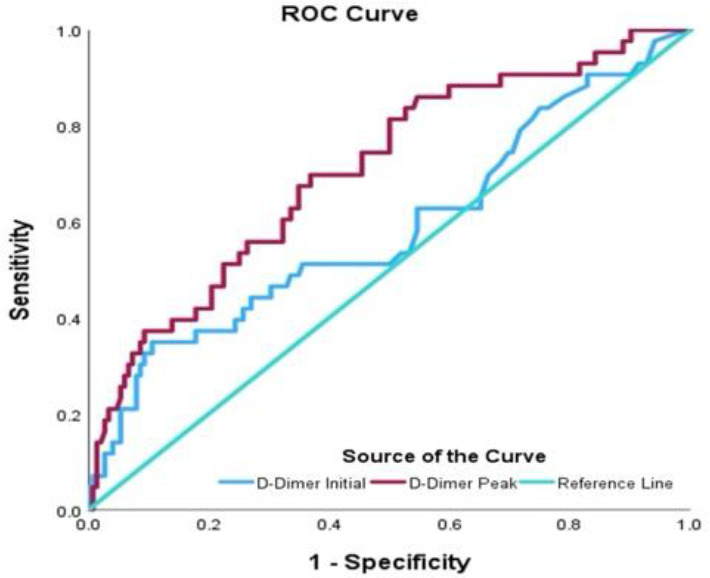 Figure 1
Peer Reviews
No public reviews on file for this paper yet. If you reviewed it on a platform where reviews are public (OpenReview, ICLR, NeurIPS, ICML), you can paste yours below so the community can read it here.
Videos
No videos yet. Explain this paper in a talk, walkthrough, or lecture? Add one.
Taxonomy
TopicsVenous Thromboembolism Diagnosis and Management · COVID-19 Clinical Research Studies · Acute Ischemic Stroke Management
Background
Venous thromboembolism (VTE) is a well-known complication associated with Covid-19. Multiple studies have explored the correlation between various biomarkers and VTE in individuals with Covid-19. We published a study on pulmonary embolism (PE) in Covid-19 (n = 193),^1^ which reported an incidence of PE in 21.8% (n = 42) cases. Only an elevated D-dimer was found to be associated with PE. We conducted a post hoc analysis to assess the predictive ability of D-dimer for PE.
Methods and Results
The mean age of our sample was 51.48 ± 12.8 years and 67% had critical Covid-19 pneumonia. Binary logistic regression was used to assess the predictive ability of D-dimer at two distinct time points: at baseline (upon admission) and at peak during hospitalization. The logistic regression analysis revealed a notable association between peak D-dimer levels and the likelihood of PE occurrence, but no association between baseline D-dimer levels and PE occurrence. The area under the curve for peak D-dimer levels demonstrated an acceptable discriminatory power of 0.71 (Figure 1). Sensitivity, specificity, and positive and negative predictive values for peak D-dimer levels for predicting PE were 38%, 86%, 64%, and 64% respectively. The chi-square test identified a D-dimer cut-off point of 13.22mg/LFEU (normal D-dimer range 0–0.46 mg/LFEU). The chi-square test indicated a significant association (Table 1): 63% of patients with PE had a peak D-dimer level > 13.22, compared to 36.4% with a D-dimer level ≤ 13.22 (p-value < 0.05). D-dimer levels > 13.22 showed a likelihood ratio for developing PE of 1.782 (CI 1.652–1.922), providing robust support for a significant association between elevated D-dimer levels and the occurrence of PE in Covid-19.
Conclusion
Peak D-dimer values may play a role in predicting PE in Covid-19. There are other similar studies with variable results.^2^ The potential of D-dimer prediction models to determine the urgency of diagnostic imaging and aggressive thromboprophylaxis regimens needs to be evaluated in prospective studies.
Conflict of Interest
The authors have no conflicts of interest to declare.
The reference list from the paper itself. Each links out to its DOI / PubMed record.
- 1Yousaf M Thomas MM Almughalles S Hameed MA Alharafsheh A Varikkodan I Pulmonary embolism in COVID-19, risk factors and association with inflammatory biomarkers Medicine 2023;102(7):e 328873680062310.1097/MD.0000000000032887 PMC 9936004 · doi ↗ · pubmed ↗
- 2Louhaichi S Ferchichi M Khalfallah I Boubaker N Belkhir S Ammar J Does D-dimer levels on admission predicts venous thromboembolism in patients with COVID-19?European Respiratory Journal 202158(suppl 65):PA 808